
About A Bag of Stories
A Bag of Stories is the international magazine and cultural platform of Ayzoh!, an Italian nonprofit organization with more than twenty years of experience in documentary photography, research, publishing, and collaborative work with communities across different parts of the world.
Media-kit ➜The magazine brings together what we have witnessed, learned, created, shared, and received through years of encounters and relationships. It is a place for the stories that have accompanied our work, for the questions that continue to emerge from it, and for new voices that can help us understand the world from perspectives other than our own.
Through documentary photography and longform storytelling, we explore the relationships between people and places, work and craftsmanship, culture and memory, and the many ways human experiences are represented, remembered, and passed on.
Rooted in Ayzoh!'s history, A Bag of Stories is open to independent photographers, writers, researchers, artists, and cultural organizations from around the world. It also welcomes partnerships and supporters who share its commitment to knowledge, cultural exchange, and responsible storytelling.
More than twenty years of stories
Long before A Bag of Stories existed, there were journeys, photographs, notebooks, conversations, books, and exhibitions. There were people we met once and others whose lives became intertwined with our own through years of collaboration. There were projects that took unexpected directions, questions that remained unanswered, and experiences that changed the way we understood our work.
For more than two decades, Ayzoh!'s photographers, writers, researchers, and designers have worked alongside communities in Africa, Latin America, Europe, and elsewhere, developing documentary and cultural projects through relationships built over time.
Some of those experiences became publications or exhibitions. Others contributed to community initiatives, research, educational activities, or forms of cultural exchange. Many left us with something less tangible but equally important: knowledge, friendships, questions, and a greater awareness of how much there is to learn from people whose circumstances and experiences differ from our own.
A Bag of Stories gives this accumulated experience a new form. It is not simply an archive of Ayzoh!'s past work, nor a showcase of its achievements. It is a living publication in which earlier experiences can be revisited, new research can take shape, and stories can continue to develop through the contributions of people who were not part of the original journey.
The magazine belongs to a longer cultural undertaking, but it also looks forward. Its purpose is not to establish what we know about the world, but to continue discovering how much more there is to understand.
Stories begin before we arrive
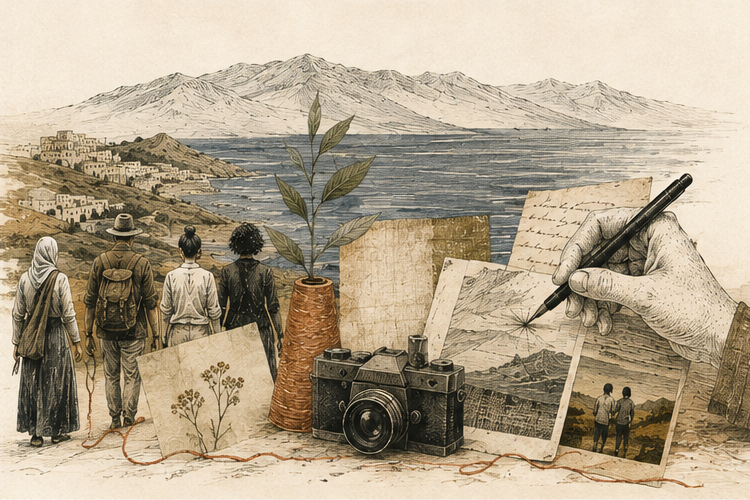
A bag is never only a bag. A photograph is never only an image. A journey does not begin when we board a plane, and a place does not become meaningful because someone from elsewhere has discovered it.
Everything carries something with it: labor, memory, materials, knowledge, relationships, choices.
Our stories often begin with ordinary things. Raffia gathered and worked in Madagascar. Clay becoming a coffee pot in Addis Ababa. A small enterprise finding its own way to organize work. A community preserving its language, or young people creating new possibilities without abandoning the knowledge of previous generations.
Sometimes the beginning is less tangible: an unexpected conversation, a gesture that changes the meaning of a photograph, a familiar landscape seen differently, or a question that becomes impossible to ignore.
We are interested in these connections because they reveal something that conventional narratives often leave aside. Behind an object there are people and systems of production; behind a landscape, histories and ways of living; behind a cultural practice, generations of accumulated knowledge, disagreement, adaptation, and change.
We follow these stories wherever they lead, from places we have known for decades to those we are only beginning to understand.
What matters is not the distance traveled, but the depth of the encounter.
A documentary way of looking
Documentary photography and longform storytelling are at the heart of A Bag of Stories. They are not simply two ways of presenting content, but complementary ways of investigating reality, questioning familiar interpretations, and preserving something of the complexity of human experience.
Photography can reveal what words struggle to describe. Writing can restore context to what a photograph leaves outside its frame. Neither is sufficient on its own, and neither should pretend to offer a complete understanding of another person's life.
Our approach has developed through Ayzoh!'s experience of working in the field, often returning to the same communities and places over many years. It rests on the belief that meaningful documentary work requires time, research, curiosity, and relationships built on mutual respect.
We are interested not only in what people do, but in the circumstances that shape their choices, the knowledge they carry, the histories they inherit, and the futures they are working to create.
We also recognize that knowledge does not move in only one direction. The people who appear in our stories are not simply sources of information or subjects to be observed. They have their own ways of interpreting the world, and their experience may challenge our assumptions, change our questions, or lead the work somewhere we had not anticipated.
This understanding shapes both what we publish and how we work with contributors.
A Bag of Stories welcomes different voices, disciplines, and forms of documentary expression. We do not seek a single style or a uniform way of seeing. An international magazine becomes more valuable when it creates room for perspectives that do not always agree, while remaining committed to factual integrity, intellectual curiosity, and respect for the people whose stories are being told.
Beyond the magazine
A Bag of Stories is a digital magazine, but publishing online is only one part of its purpose.
Drawing on Ayzoh!'s experience in photography, research, publishing, and cultural production, we are developing a wider platform for photographic books, editorial publications, exhibitions, conversations, and public encounters.
A photographic essay may find another life in a book. A documentary project developed over several years may become an exhibition. A question raised in an article may lead to a conversation among photographers, researchers, artists, communities, and audiences who would otherwise have little opportunity to meet.
These different forms of expression are connected by the same intention: to make knowledge accessible, encourage dialogue, and create opportunities for stories to move between people, places, and generations.
We believe that publishing is more than the circulation of content. At its best, it can become a form of cultural participation, a means of preserving and sharing knowledge, and a way of building relationships that continue beyond the publication itself.
An independent editorial project, open to partnerships
A Bag of Stories is conceived, produced, and editorially directed by Ayzoh!, which is responsible for its editorial identity, development, and publishing decisions.
Its independence is essential to its purpose. We want to explore subjects because they matter, not because they serve the interests of a commercial partner, an institution, or a particular organization. We believe that the credibility of documentary work depends on the freedom to ask questions, examine contradictions, and publish stories whose conclusions may be complex or uncomfortable.
At the same time, independent cultural publishing needs relationships, resources, and cooperation to remain sustainable.
For this reason, A Bag of Stories welcomes partnerships with organizations, institutions, enterprises, and individuals who recognize the value of serious documentary work and wish to contribute to its development while respecting its editorial autonomy.
AFAR, a design brand rooted in Ethiopian craftsmanship, played an important role in bringing the magazine to life. Its interest in materials, skilled labor, cultural exchange, and the relationships connecting people and objects helped create the conditions in which this publishing project could take shape.
AFAR remains part of the magazine's history and network of support, and its work continues to be documented through a dedicated editorial space.
But A Bag of Stories is not a brand publication. It is Ayzoh!'s cultural magazine, open to stories and collaborations that extend far beyond the interests or activities of any individual partner.
We see these relationships as opportunities to make independent cultural work possible, not as reasons to compromise it.
The ethics of looking
Photography is never a neutral act. Neither is storytelling. Who photographs whom? Who gives permission? Who chooses the words accompanying an image? What happens when a photograph leaves the place where it was made? And what remains invisible when a complicated life is reduced to a single frame?
These questions are central to our work and to The Ethics of Looking, an ongoing editorial and cultural program within A Bag of Stories.
We believe that the people we encounter should never become scenery for someone else's journey. Places have histories before we arrive, communities possess their own ways of understanding and transforming the world, and individuals have knowledge, aspirations, contradictions, and agency that cannot be reduced to a photograph or a convenient narrative.
We are interested in craftsmanship, but not in romanticizing labor; in tradition, but not in pretending cultures stand still; in resilience, but not when celebrating it conceals the systems that make resilience necessary.
We believe in solidarity rather than charity, collaboration rather than extraction, and the possibility that a story can become an exchange rather than an act of appropriation.
These are not principles we claim to have mastered once and for all. They are questions and responsibilities that accompany every project, requiring us to reconsider our choices, listen to criticism, and recognize the limits of our understanding.
Our aim is not to establish a definitive rulebook for looking at others, but to keep these questions alive and to make them part of the conversations surrounding photography, journalism, design, travel, and contemporary culture.
Because how we tell a story is inseparable from why we tell it.
An open conversation
Although A Bag of Stories grows from Ayzoh!'s experience, its future cannot depend on a single organization, group of authors, or way of interpreting the world.
We welcome independent photographers, journalists, writers, researchers, artists, designers, and cultural institutions interested in contributing work that brings new knowledge, questions, and perspectives to the magazine.
We are open to long-term documentary collaborations, editorial exchanges, publishing projects, exhibitions, and partnerships capable of connecting different experiences and communities.
We also welcome readers who wish to question what we publish, share their perspectives, suggest subjects we have overlooked, or help us recognize something we have failed to understand.
We do not believe that a magazine should speak only to those who already agree with it. Nor do we think its purpose is to provide definitive answers to every question it raises.
A good publication should create the conditions for encounters, disagreements, discoveries, and conversations that continue long after the last page has been read.
The stories gathered here come from different places, experiences, and people. What connects them is not a single geography or subject, but the conviction that looking carefully at the world is also a way of taking responsibility for our place within it.
Every story carries something. What matters is what we choose to do with it.