


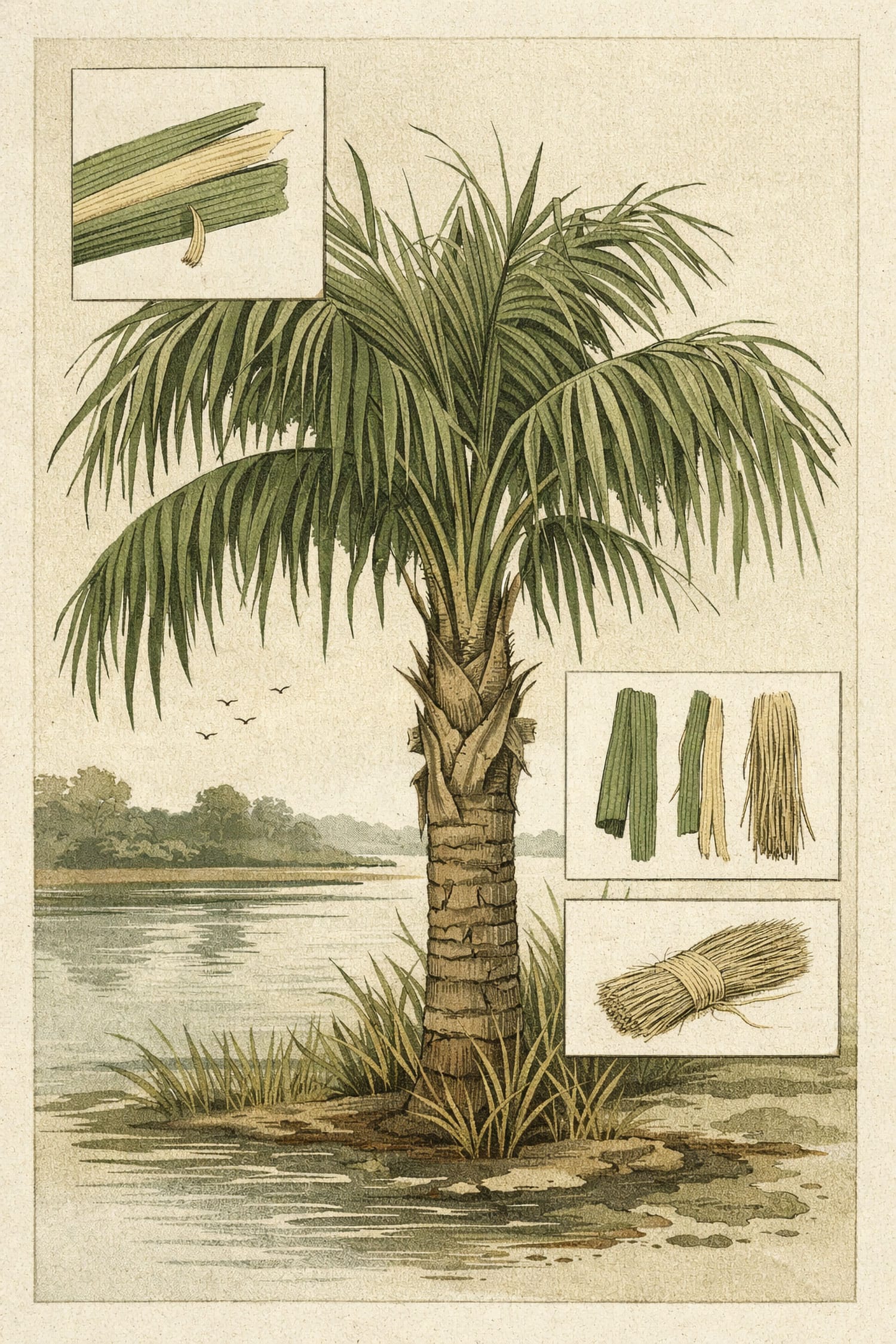
In Madagascar, raffia does not begin in a showroom or a trend report. It begins where the soil holds water: along riverbanks, in wetlands, and near communities that have learned how to work with what the landscape provides.
There, the raffia palm rises with leaves so long they seem to belong to another scale.
The fiber used in bags, baskets, hats, mats, and woven objects comes from those leaves—more precisely, from the surface of their young leaflets. Once separated, cleaned, dried, sorted, and worked by hand, this thin natural layer becomes a remarkably light, flexible, and resistant material. Its origin matters.
What the Fiber Carries
Raffia is not made to resemble something natural. It remains visibly connected to the plant from which it came.
The fiber holds a dry, muted sheen. It bends without immediately losing its strength. Even after it has been dyed, braided, crocheted, or woven into a finished object, its vegetal character remains present. The leaf has not disappeared. It has changed form.
Harvesting requires restraint. A raffia palm cannot be stripped without consequence. Enough growth must remain untouched for the plant to continue producing and for the surrounding ecosystem to sustain itself. This is one of the first truths of raffia: it is renewable, but it is not limitless.
Its future depends on water, time, local knowledge, and the judgment to understand how much can be taken. Before the fiber offers anything, it asks for discipline.
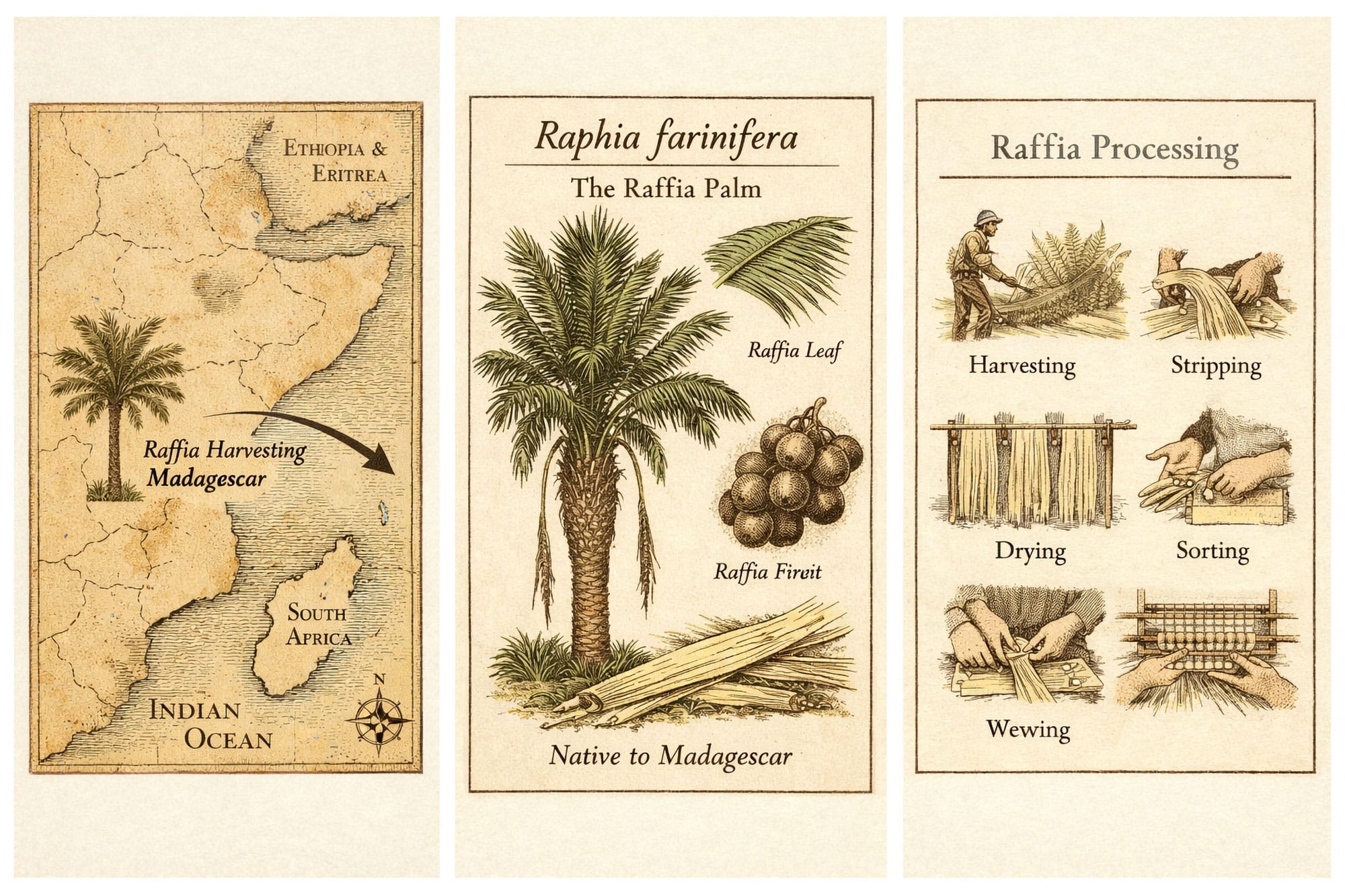
Once harvested, the leaflets are separated from the central stem. The useful surface layer is then removed in long, narrow strips.
Fresh raffia still carries moisture and weight. Dry raffia does not. Between the two lies a sequence of precise work: peeling, cleaning, drying, and sorting. The quality of the finished fiber depends on every stage. Poor drying can leave it brittle, discolored, or uneven. Handled carefully, it retains its strength, flexibility, and clean surface, ready to be dyed or worked in its natural tone.
From Strip to Surface
After drying, raffia begins to reveal what it might become. The strips are sorted by width, color, texture, and quality. Some remain close to their original shade: pale gold, straw, sand, and dust. Others are dyed.
Raffia receives color without entirely surrendering its own character. The dye settles into the fiber rather than covering it completely. Rust, brick, smoke, brown, faded green, deep red, and black still carry subtle variations beneath their surface.
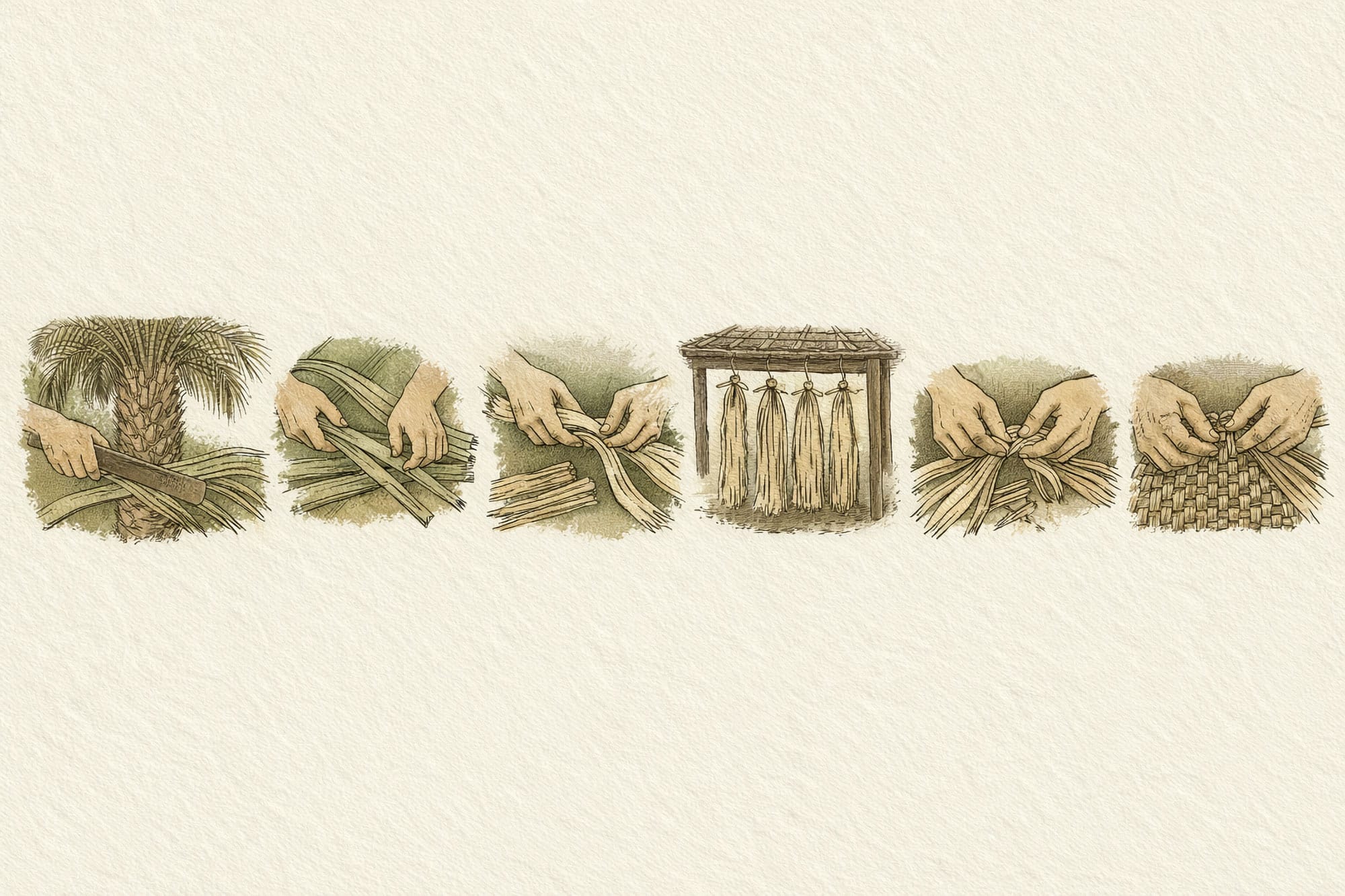
Then the material enters the world of technique. In Madagascar, raffia is transformed through practices that depend on rhythm, judgment, and repetition: crochet, plaiting, braiding, knotting, coiling, and weaving.
A flat strip becomes cord. Cord becomes surface. Surface becomes volume. A bag, a basket, a hat, or a woven panel may appear to belong to different categories, but each offers another answer to the same question: what can a leaf become when guided by skilled hands?
The answer is never completely uniform. One strip may be smoother. Another may be drier or more luminous. One row may pull slightly tighter; another may open more widely. These differences are not flaws. They are the visible record of a material shaped by weather, drying, human judgment, and the movement of the hand.
Industrial production often seeks exact repetition. Raffia also depends on repeated gestures, but repetition does not produce sameness. Each section requires adjustment. Each irregularity asks for a decision. The finished surface remembers those decisions.
A Material with Its Own Logic
Raffia behaves differently from both leather and cloth. It is light but capable of structure, flexible yet able to hold volume.
It can feel open and airy without becoming fragile. It can be formed into a generous silhouette without the weight such a shape might suggest. Worked carefully, it retains softness while remaining resistant enough for everyday use.
Its natural variation gives it movement. Light settles differently across each row and knot. Color shifts as the object turns. The surface changes between distance and touch.
This is why raffia should not be understood simply as decoration. In a well-made object, it becomes a form of architecture built from fiber: tension distributed across rows, volume shaped through the weave, handles and reinforcement points positioned to support what the bag will carry.
The apparent simplicity of the finished piece contains a long sequence of technical choices.
More Than a Summer Material
Raffia is often described through the language of distant markets: summer, resort, escape, ease. The words are light. The work is not.
Behind the finished object lies an accumulation of knowledge: harvesting, peeling, drying, sorting, dyeing, twisting, crocheting, weaving, assembling, and finishing. Value is built slowly, step by step, beginning close to the place where the palm grows.
Keeping that knowledge visible matters. When a natural material becomes desirable, there is always a risk that abundance will be confused with permission. Demand can accelerate extraction. Fragile wetlands can shrink. A renewable resource can still be damaged when the pace of harvesting ignores the pace of growth.
Raffia does not ask to be romanticized. It asks to be understood. Its beauty depends on the conditions that allow the plant to live: wet ground, careful harvesting, skilled preparation, and a rhythm that does not destroy the source of the fiber. The final object carries these conditions, even when they are no longer visible.
The Journey Continues in Addis Ababa
For AFAR, working with raffia means respecting the history, character, and limits of the material.
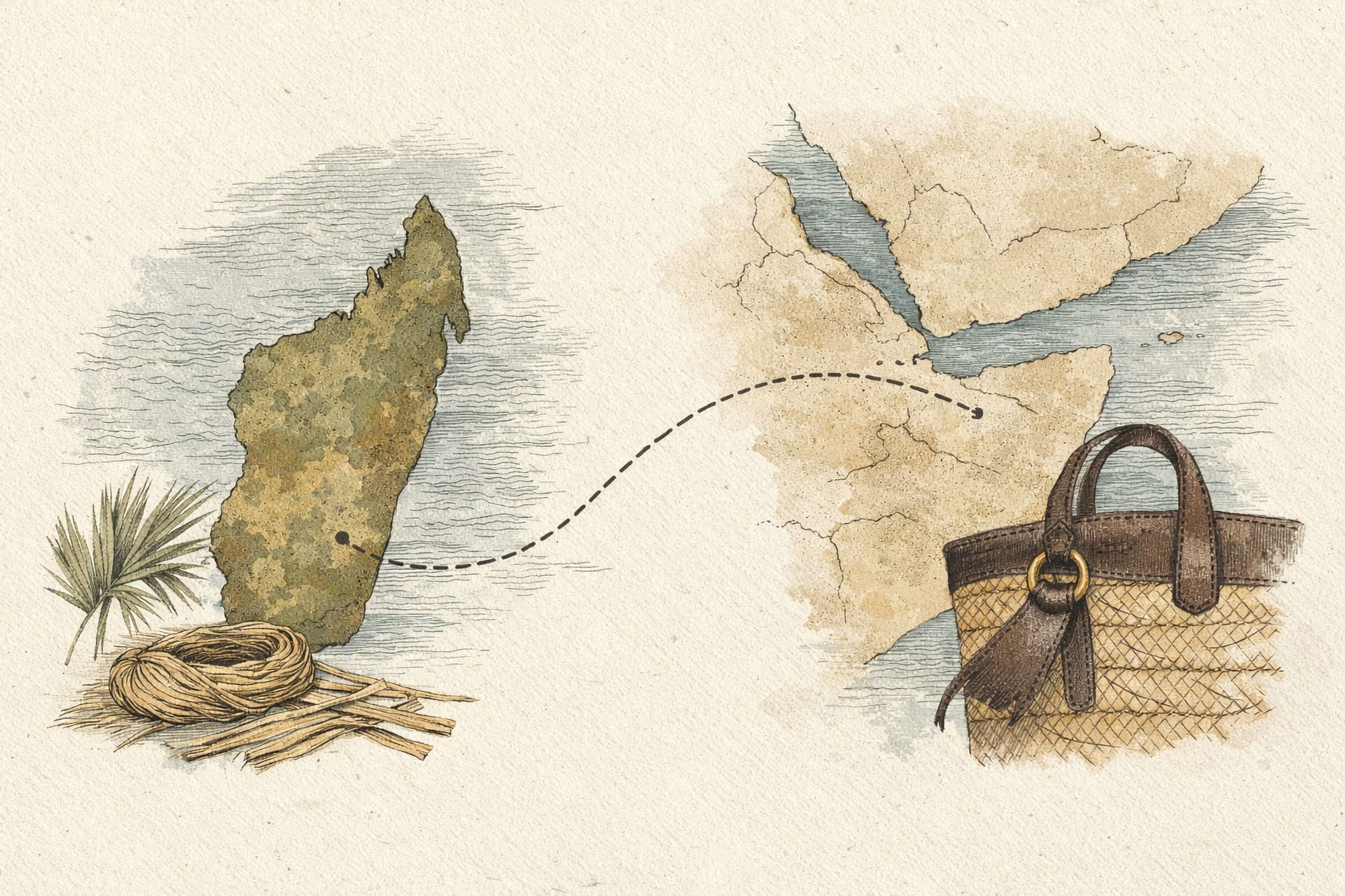
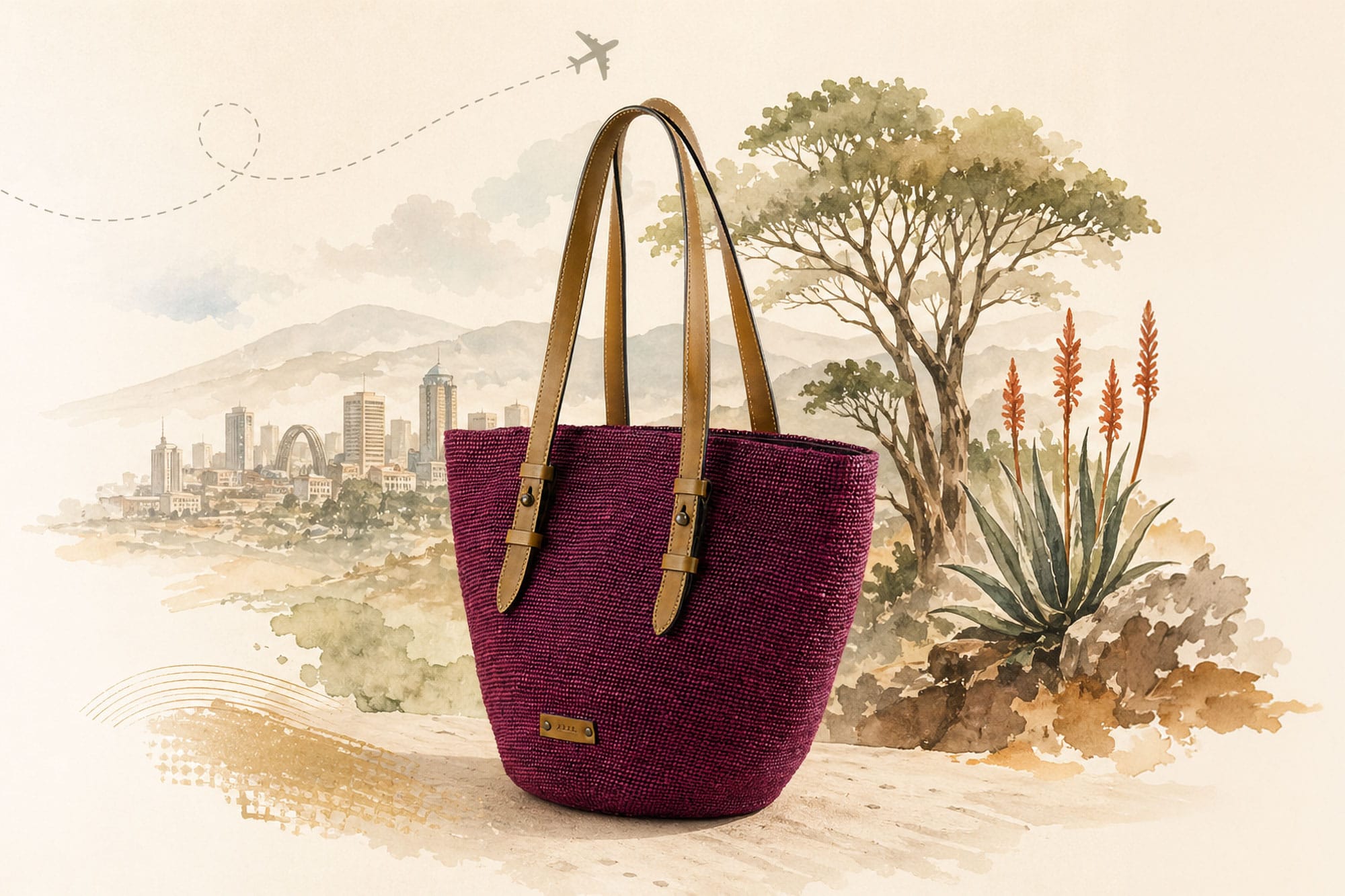
The fiber begins in Madagascar, shaped by landscape, climate, harvesting knowledge, and skilled preparation. Its journey then continues to Addis Ababa, where AFAR’s artisans bring each bag to completion.
Here, raffia meets another body of knowledge. Leather handles must be positioned precisely. Linings and reinforcement points must support the bag without making it rigid. Edges, closures, and seams require careful finishing. Vegetable-tanned zebu leather adds strength and definition; selected designs also incorporate horn details.
The aim is not to make raffia behave like another material. It is to understand what it can do and build around its natural qualities.
Madagascar remains present in the movement, texture, and variation of the fiber. Addis Ababa enters through construction, leatherwork, finishing, and the decisions that allow a soft material to hold its form.
The finished bag carries several places within it. It is not simply a summer object. It is the result of a long conversation between landscapes, materials, and makers—a conversation that began with a leaf growing beside water and continues each time the object is carried.


Member discussion