


Four in the morning
We left at four in the morning, heading toward a forest somewhere in the Marche region of central Italy, where we had arranged to spend a day with Stefano, a logger who still uses mules to carry timber through the woods.
The exact location will remain unnamed, at the request of the people who work there. It is enough to know that the forest grows on steep, difficult ground, crossed by paths that sometimes leave very little room for error.
Our first lesson was physical. Walking along those slopes, with the ground falling sharply away beside us, required considerably more attention than we had expected. We were there to take photographs, certainly, but before we could begin to understand anything about Stefano's work, we had to learn where to put our feet.
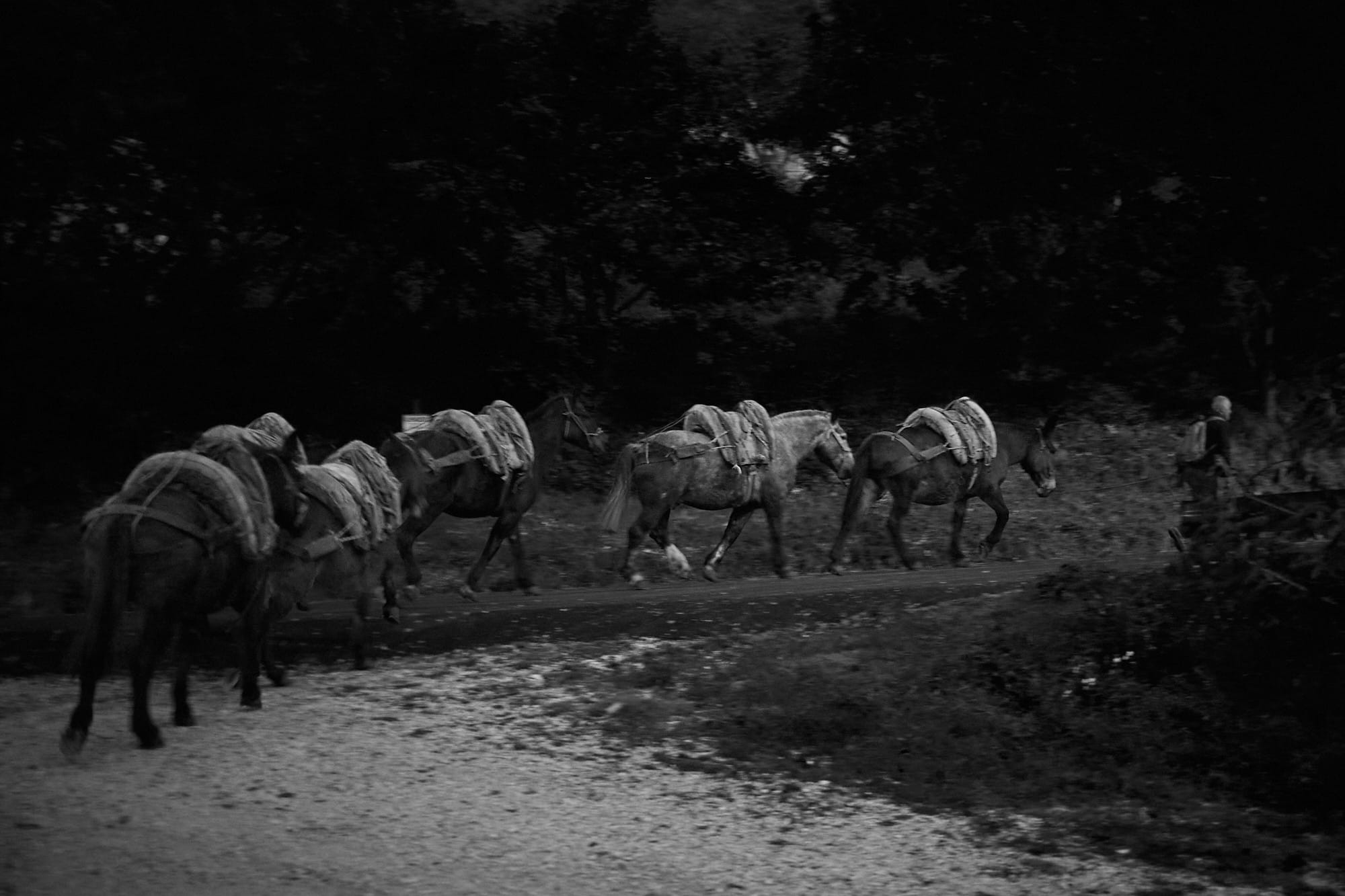
At certain points, the distance between professional curiosity and a very ordinary fear of heights became embarrassingly small.
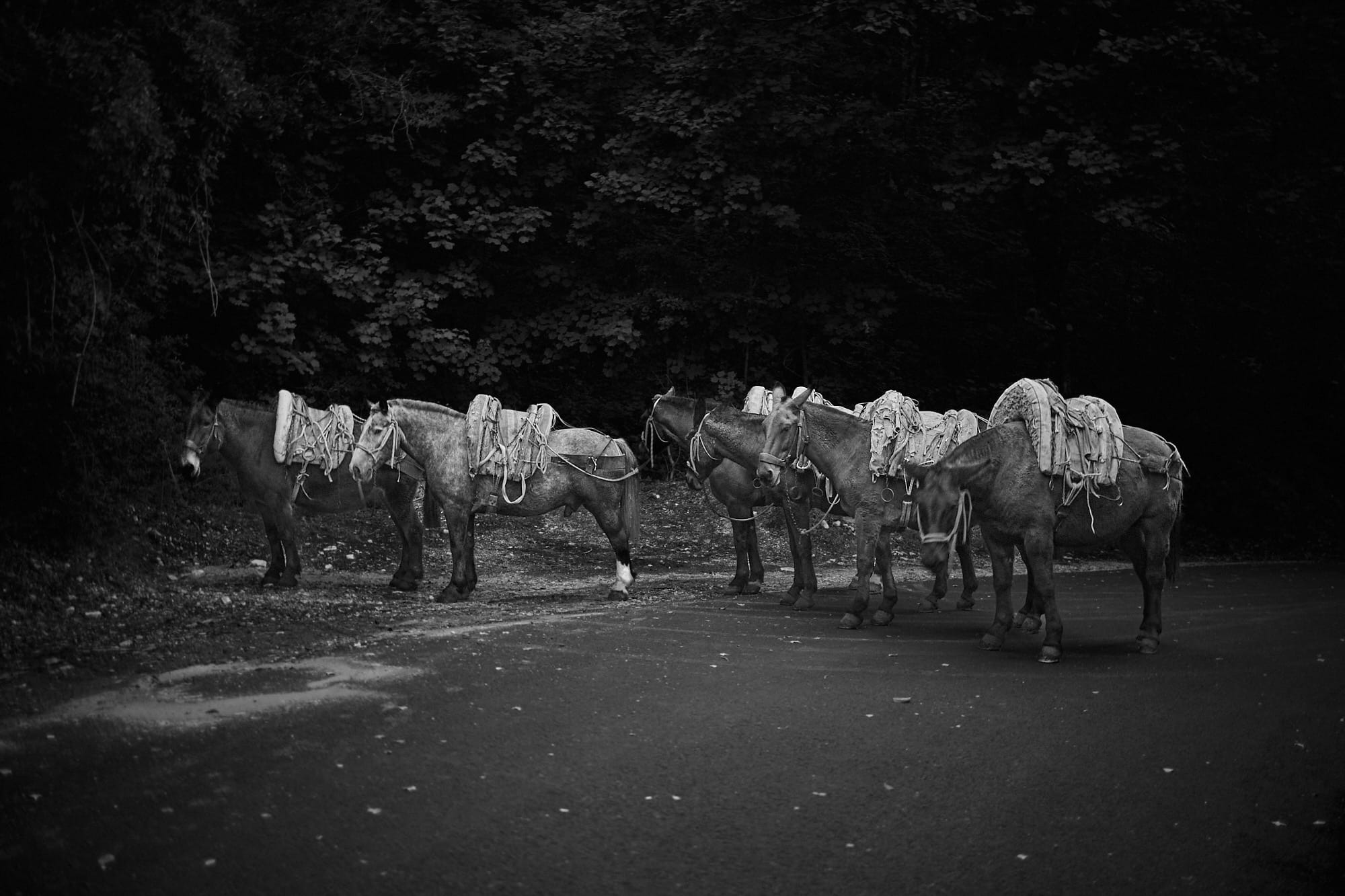
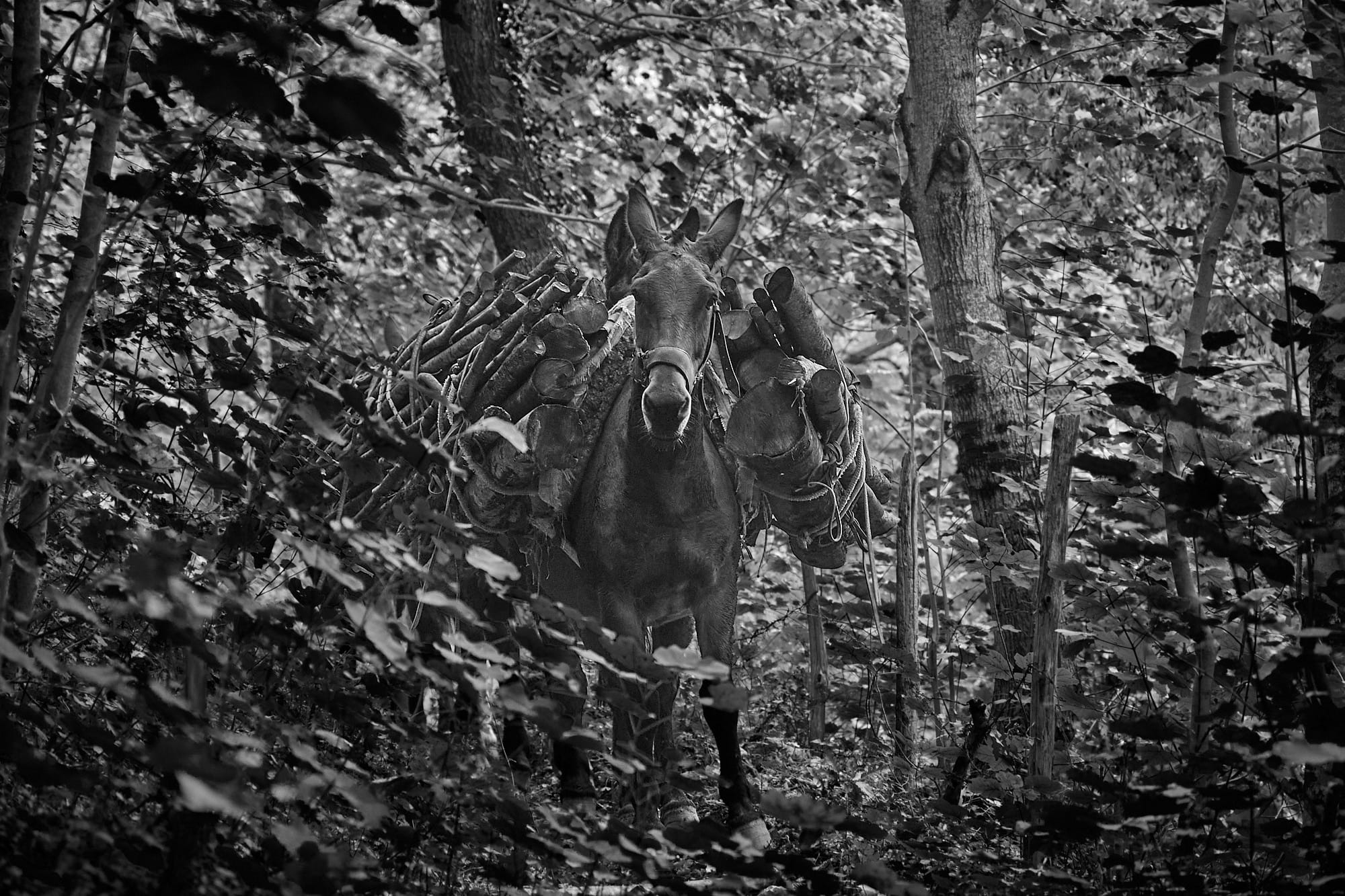
The mules seemed to have no such difficulty. They moved along the paths carrying their equipment, negotiating uneven ground with a confidence that, to an inexperienced observer, bordered on the extraordinary.
Where we stopped to examine the next few steps, they appeared to recognize the possibilities of the terrain almost immediately.
Of course, that impression tells us something about our own unfamiliarity as well as their abilities. These animals had experience that we did not possess. And that, perhaps, was the first important distinction of the day. We had entered the forest as visitors. Stefano and the mules had come to work.
The intelligence of the path
There is a tendency to describe working animals through the language of obedience. A good animal follows orders. A well-trained animal does what it is told. A reliable animal accepts the task assigned to it.
Spend some time watching mules on difficult terrain, however, and that description begins to feel inadequate.
Stefano directs the work, organizes the loads, handles the ropes, and makes decisions that belong to his profession. But each animal must also respond to the ground beneath its feet, to the distribution of weight across its body, to obstacles it encounters, and to the movement of the other animals.
These are not insignificant decisions. A misplaced step on a steep path has consequences that no command, however precise, can completely eliminate. The animal must make adjustments continuously, using its own balance, perception, experience, and judgment.
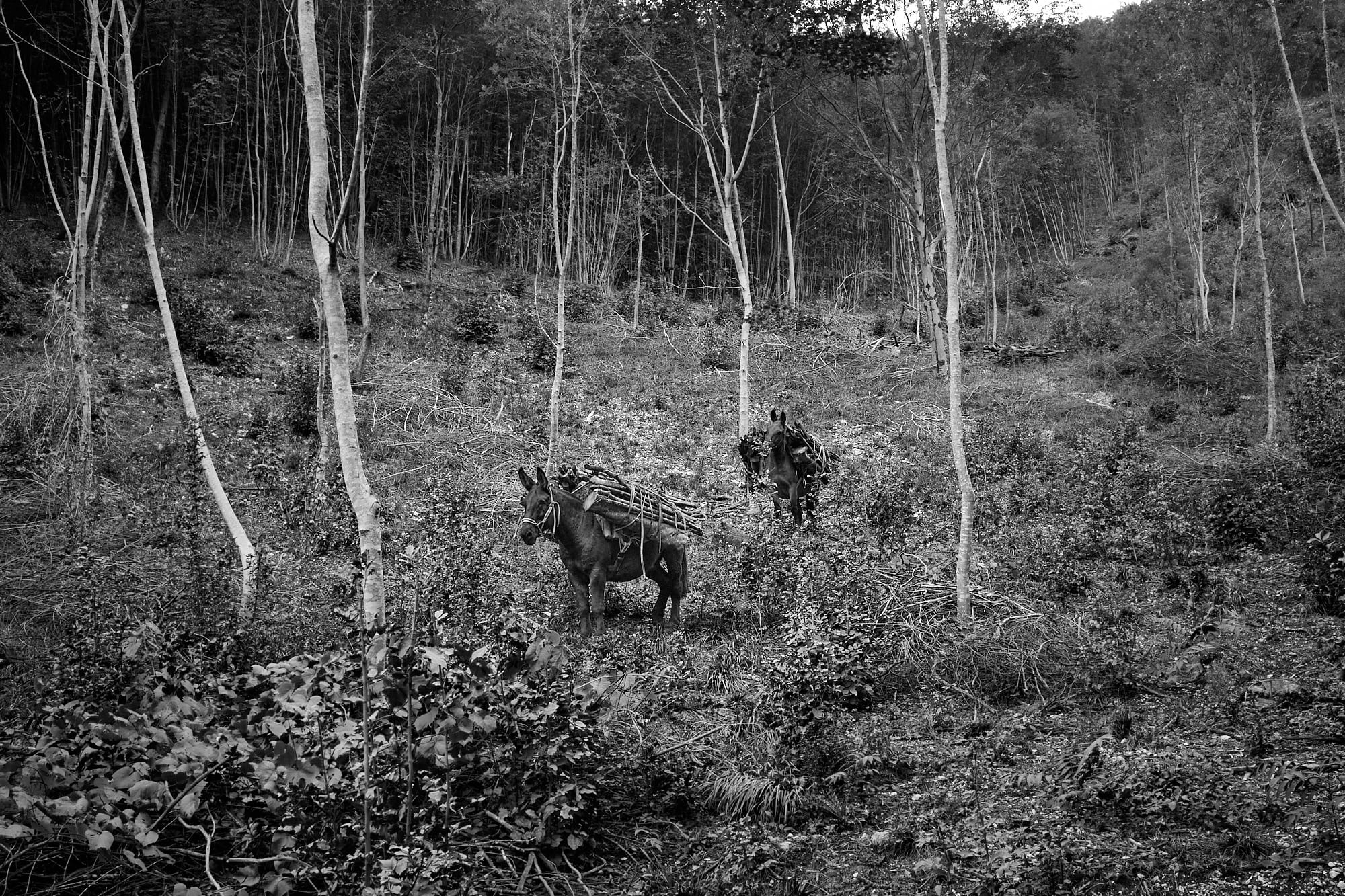
We found ourselves watching this process with increasing admiration. The mules did not appear to require an instruction for every movement. Their behavior suggested familiarity with the routine, with the terrain, and with the demands of the work.
It would be tempting to call this a partnership between equals. It would also be inaccurate. Stefano decides when the working day begins, where the animals go, and what they carry. The relationship contains an unavoidable difference in power.
Yet recognizing that difference does not require us to deny the animals' competence. Quite the opposit: the more closely we watched them, the more difficult it became to regard them simply as instruments of human labor.
They were participants in a working system, responding to their surroundings in ways that no photograph could fully explain. And Stefano, whatever decisions remained his alone, depended on that capacity.
Where tractors cannot go
Stefano makes his living selling firewood. There is nothing symbolic about the timber he brings out of the forest. It is a product that must be collected, transported, prepared, and sold. His working day belongs to an economy, with its costs, physical demands, and practical difficulties.
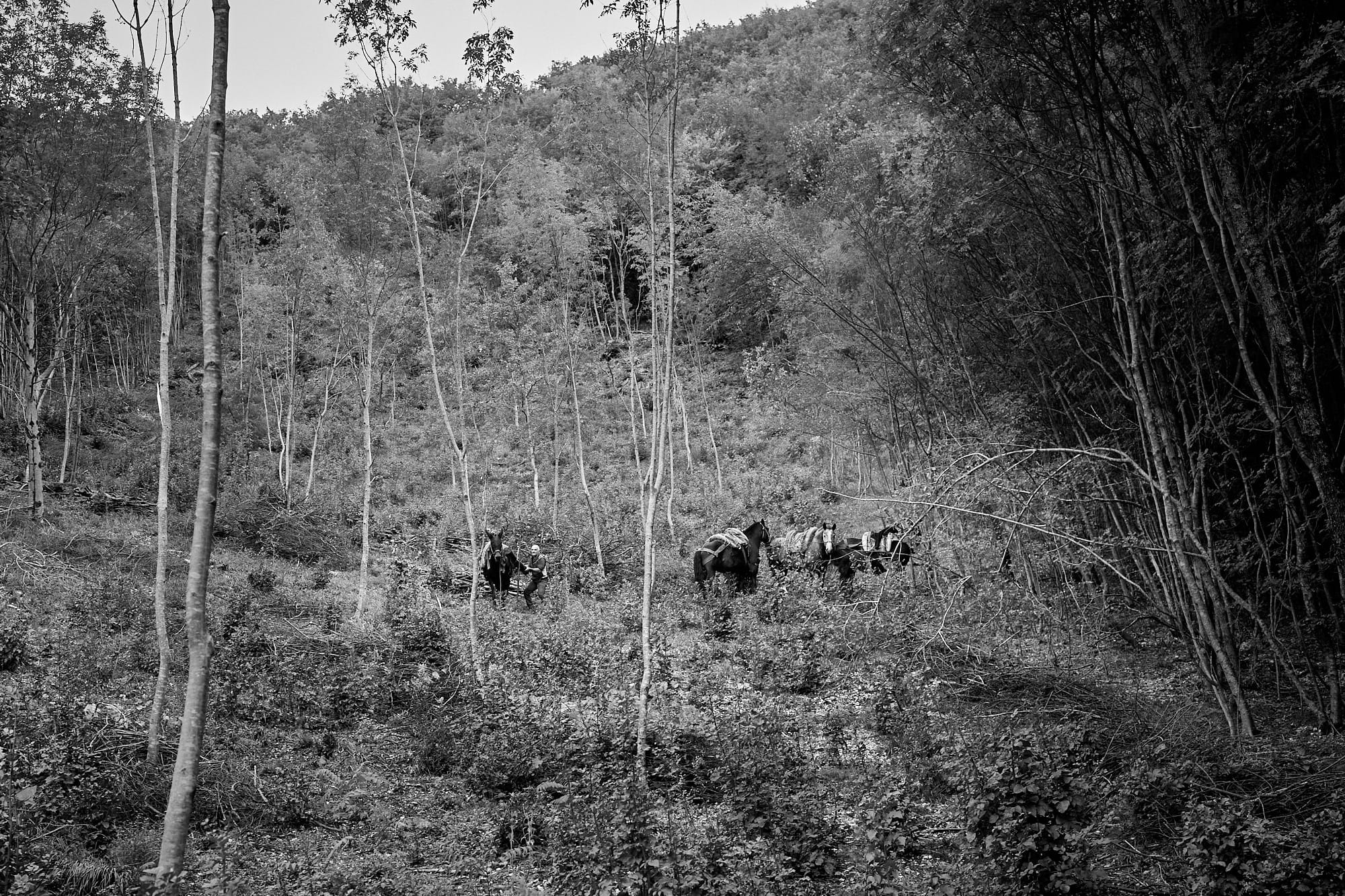
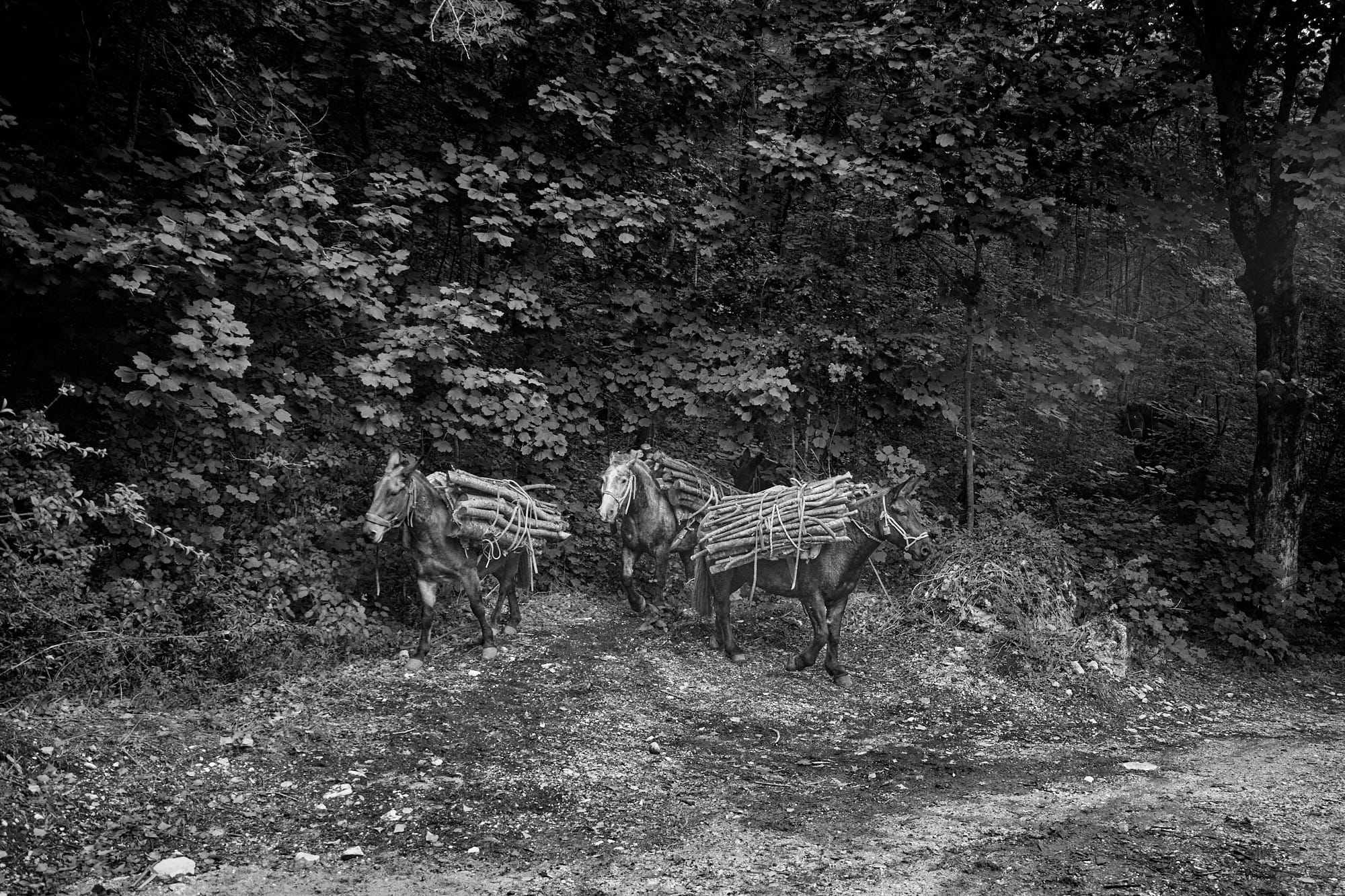
And this is where the mules become essential. In the forest where we accompanied him, the paths are too narrow and the slopes too difficult for a tractor to reach certain working areas without substantial alterations to the terrain.
Widening the tracks would mean cutting into the woodland, disturbing the ground, and changing passages that currently occupy far less space.
The mules can travel along those existing paths. Their ability to negotiate steep, narrow ground makes it possible to extract timber without first constructing access routes for larger machines.
This does not mean that using animals has no environmental impact. Hooves disturb and compact soil, particularly where the same routes are used repeatedly.
Animals carrying heavy loads also need appropriate working conditions, equipment, and rest. But the choice of method must be understood in relation to the place.
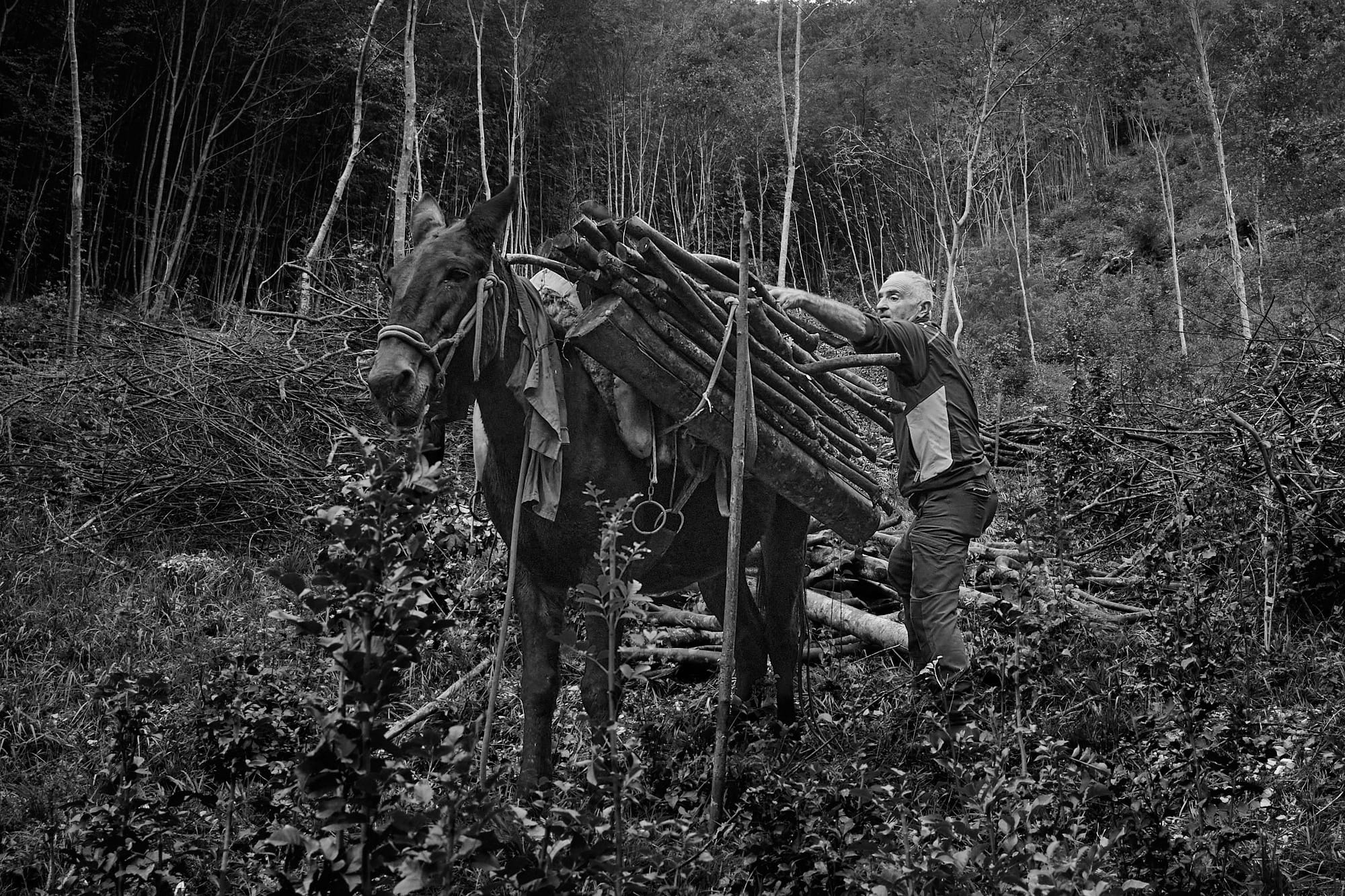
On these slopes, the question is not whether an ancient technique is more picturesque than a modern one. It is what kind of intervention the terrain requires, and how much alteration is necessary to make the work possible.
What might look from the outside like a stubborn attachment to tradition is also a practical response to geography.
The mules are not there because Stefano refuses to acknowledge the existence of tractors. They are there because their particular abilities allow them to work in places that tractors cannot easily reach.
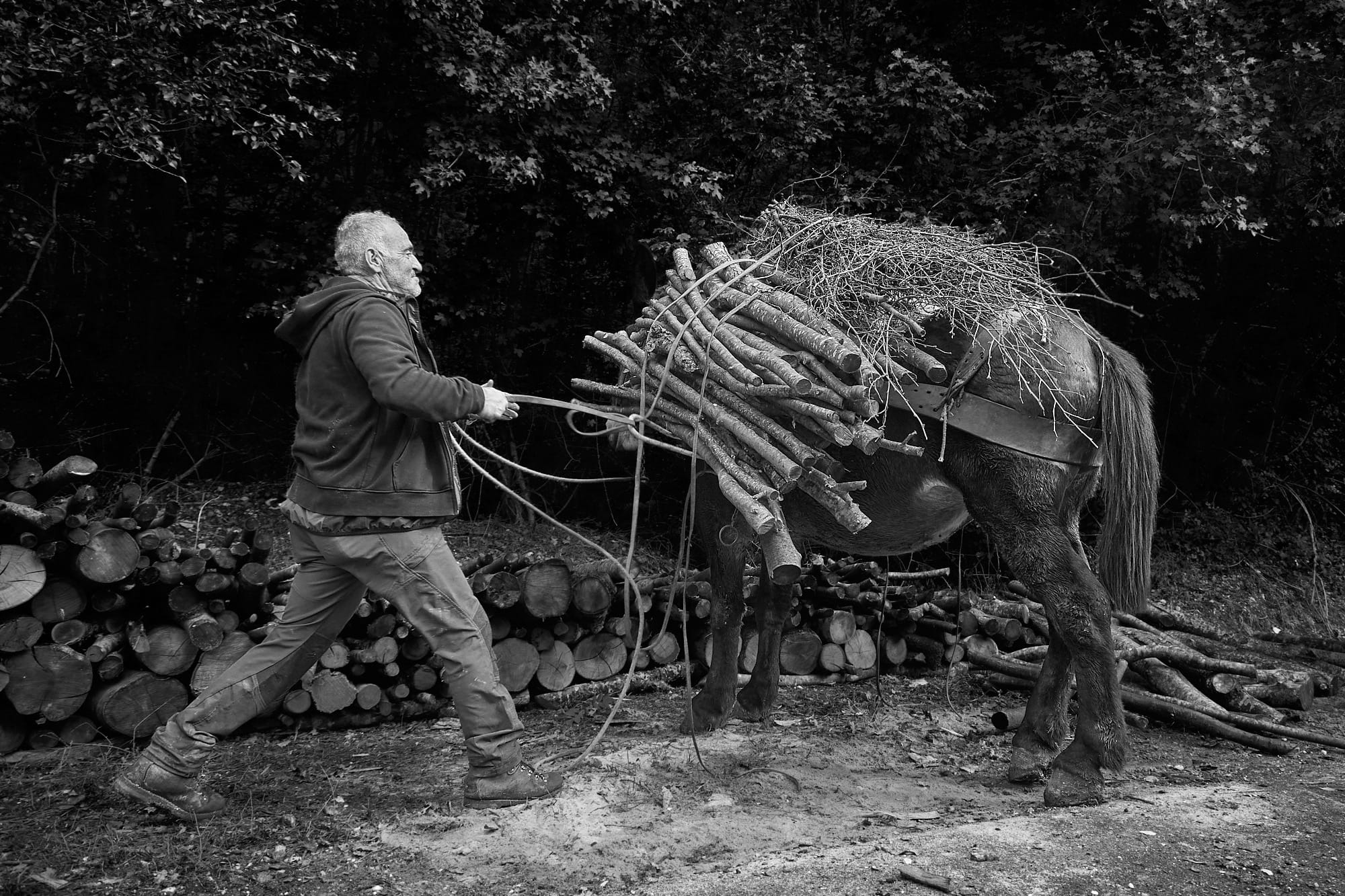
There is a considerable difference. The work itself remains demanding. Wood must be collected, lifted, arranged, balanced, and secured. The equipment must remain stable as the animals travel over difficult ground. Stefano's movements reveal the physical nature of this knowledge.
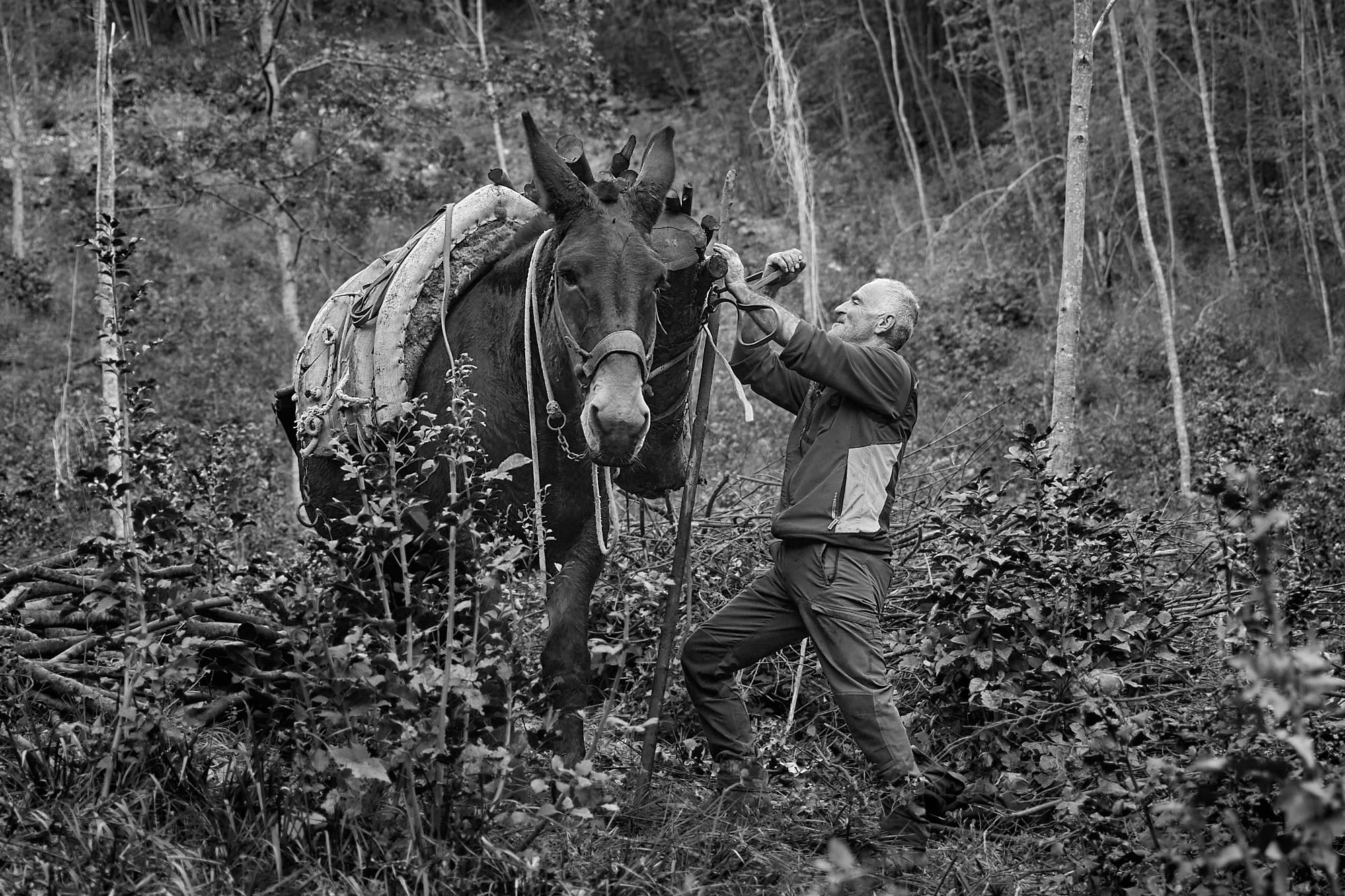
In the photographs, he raises sections of timber, places them onto the pack saddles, adjusts straps, and works with the ropes that hold the loads in position. His hands are constantly involved. So are his shoulders, his back, and his legs. Nothing about this work is abstract.
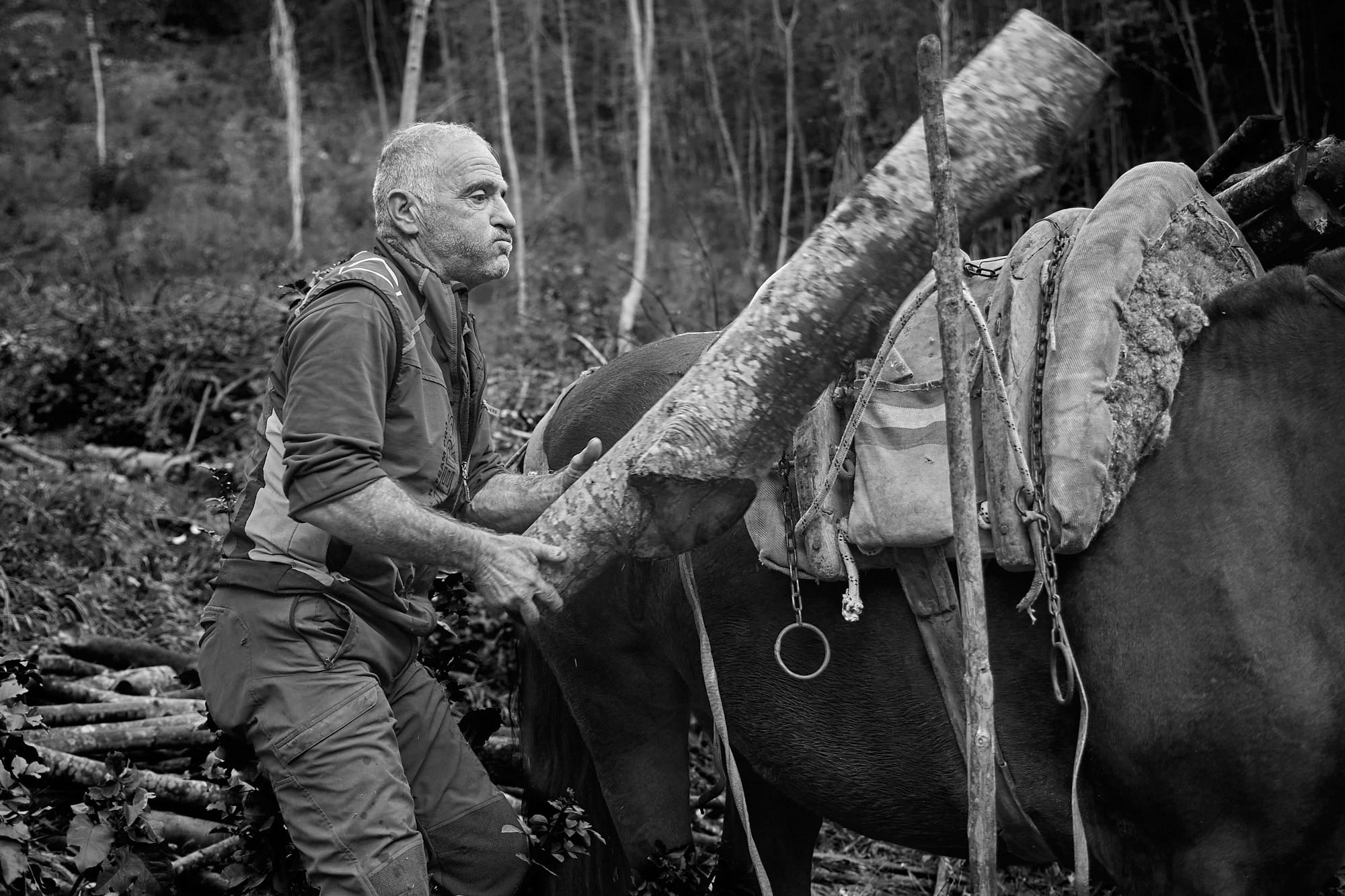
A load that appears straightforward when resting on the ground becomes a different problem when it must be lifted and distributed across a moving animal. Weight has to be managed, not merely carried.
The saddles themselves deserve attention. Their padding, worn surfaces, straps, rings, and ropes are part of a working technology that requires practical knowledge and continuous judgment.
It is easy to admire the simplicity of equipment like this, particularly in an age when machinery dominates so many forms of production. But simplicity should not be confused with ease.
The work is demanding for Stefano, and it is demanding for the mules. Their bodies carry the consequences of every decision about the load.
This is why the relationship between the logger and his animals cannot be understood through affection alone. Competence matters. Good intentions are insufficient when a load is badly distributed, a harness causes discomfort, or an animal is asked to exceed its physical capabilities. In this kind of work, care must take a practical form.
The forest has its own calendar
A forest is not a warehouse of trees. It is a living system whose development takes place over periods much longer than the working life of any individual logger.
The wood removed today belongs to a process that began years or decades earlier, while the consequences of today's decisions will remain visible long after the timber has been sold.
The woodland where Stefano works is subject to regulated harvesting and regeneration cycles. We learned that different sections are managed in rotation, with intervals that may extend from approximately fifteen to twenty-five years before another harvest is permitted.
Areas are renewed as part of this process, allowing successive sections of woodland time to develop while work takes place elsewhere. The precise intervals depend on the species, the type of forest, and the applicable management rules.
In central Italy, much of this kind of forestry is associated with coppicing, a system in which certain broadleaf trees can regenerate from the living stumps and root systems left after cutting.
Harvesting a managed coppice does not necessarily mean removing a forest and planting a completely new one. In many cases, its capacity to regenerate is already present in the trees themselves.
Regional regulations establish minimum harvesting intervals, requirements for retaining selected trees, and other conditions intended to protect the continuity of woodland cover and its ecological functions.
Regulation, however, is not the same thing as a guarantee that every intervention is environmentally beneficial. The condition of a forest depends on far more than the time between successive harvests.
Soil health, biodiversity, water, habitat continuity, the age and composition of trees, and the intensity of extraction all matter. Some forests benefit from particular forms of management; others require different approaches, including periods without harvesting.
The value of regulated forestry is that it recognizes a basic ecological fact: trees cannot be treated as an unlimited resource available whenever an immediate economic need arises.
There must be limits, intervals, and responsibilities extending beyond the present season. Stefano's work takes place within this longer calendar.
The timber he carries out of the forest has an immediate value. It becomes firewood, a source of income, something people will buy and use. But the same forest must continue to exist after that transaction.
This creates a relationship between economic activity and ecological time that is often absent from the way we discuss consumption.
The person who buys firewood encounters the final product. The woodland, the years of growth, the regulations, the labor required to collect it, and the animals that helped move it remain largely invisible.
A photograph can restore some of that context. It can show the hillside, the narrowness of the paths, the distance between the trees, the loads carried by the animals, and the people whose knowledge makes the work possible.
It cannot, by itself, demonstrate that the forest is being managed sustainably. That requires a broader understanding of its history, management, and ecological condition. But it can remind us that a piece of firewood has a history long before it reaches a fireplace.
Respect is not a slogan
There is a question that accompanies almost every encounter between human beings and working animals. What does it mean to respect an animal whose labor we use?
For some people, the answer is immediate: animals should not work for humans at all. For others, the relationship can be acceptable when their needs, physical limits, and welfare are properly respected.
These positions are not easily reconciled, and we do not pretend that a single day in the forest could settle the argument. What we can say is that admiration is not evidence of welfare.
The fact that an animal moves confidently, responds to familiar routines, or appears calm in a photograph does not establish whether it is comfortable, adequately rested, properly fed, free from pain, or able to express its normal behavior outside working hours.
Those questions require knowledge that extends beyond what a camera can capture. A mule may be extraordinarily capable of carrying timber along a difficult path and still be vulnerable to excessive weight, badly fitted equipment, fatigue, injury, or poor treatment.
Its intelligence does not make it invulnerable. In fact, perhaps the opposite is true: the more we recognize an animal's individual abilities, the less acceptable it becomes to overlook its individual needs.
This is something we have discussed at Ayzoh! in a different context. When we decided to work with AFAR, the Ethiopian brand behind A Bag of Stories, the question of animal welfare was an important part of our evaluation.
We have never considered it necessary to identify ourselves as animal-rights activists to believe that respect for animals, and for living beings more generally, is inseparable from the other ethical commitments that guide our work: for us, the treatment of those who have less power to defend their own interests is not a secondary consideration.
AFAR uses leather, a material about which legitimate ethical disagreements exist. Its sourcing policy, however, makes a specific distinction: the company uses hides recovered from existing agricultural and food systems rather than commissioning the breeding or slaughter of animals for the production of bags.
We explored that position in an earlier article, The Life Before the Leather. The principle is straightforward, although its implications are not simple.
 Claudio Maria Lerario
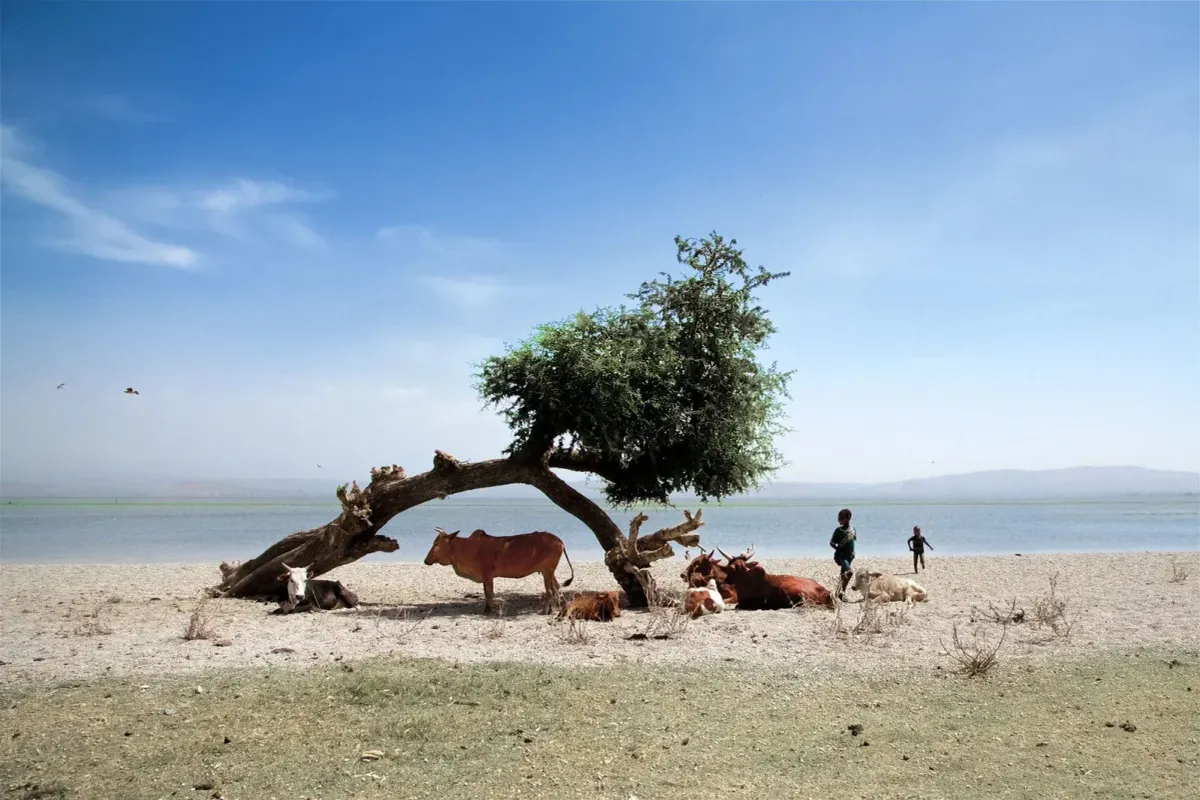
Describing leather as a by-product does not erase the life of the animal, eliminate the economic value of its hide, or guarantee that the animal was treated well. It establishes a limit on the role the company intends to play in creating demand for animal materials.
The animal existed before the product. Its life must remain part of the discussion. There is a relationship between that principle and what we encountered in the Marche forest, although the circumstances are very different.
Here, the animals are alive, working, and directly exposed to the decisions made by the people responsible for them.
Their welfare cannot be assessed through a sourcing policy. It depends on daily practice: how much they carry, how they are equipped, how they are handled, how often they rest, what happens when they are injured or become too old to work, and whether their needs are respected when they are no longer economically useful.
We cannot answer all those questions from the photographs, and we should not pretend otherwise. But we can insist that they belong in the story. A photograph of a working animal can inspire admiration. It should also encourage us to ask what that animal's life is like beyond the frame.
Two lives in one frame
As the day went on, we increasingly found ourselves photographing the mules as individuals rather than as a group.
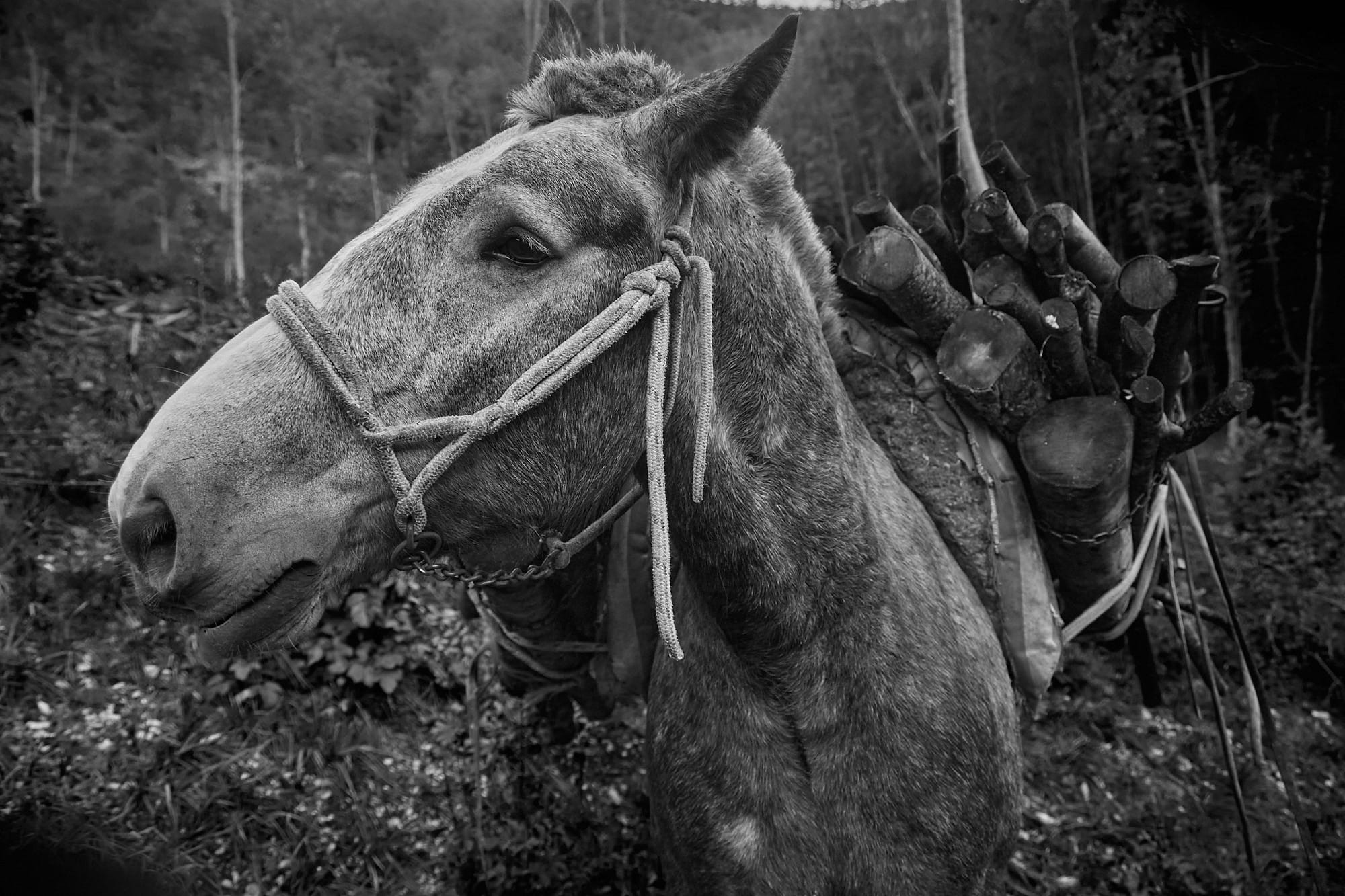
A head turned toward the camera; an ear lifted, a moment of stillness among the trees. The particular shape of a face, the texture of a coat, the way an animal occupied the narrow space between two trunks.
There is a temptation, when photographing animals, to interpret every gesture through human emotions. A mule seems patient, another curious, another stubborn, another content.
Yet a photograph cannot reliably tell us what an animal feels. The camera records appearances and actions. The emotional meaning we attach to them often comes from ourselves.
Still, this limitation does not make the encounter less significant. On the contrary, it gives us a reason to look more carefully. The animals were not interchangeable. They differed in appearance, position, movement, and behavior. Each occupied its own place within the group.
To recognize that individuality is not necessarily to humanize them. It is simply to acknowledge that a living being is more than the function it performs. The same is true of Stefano.
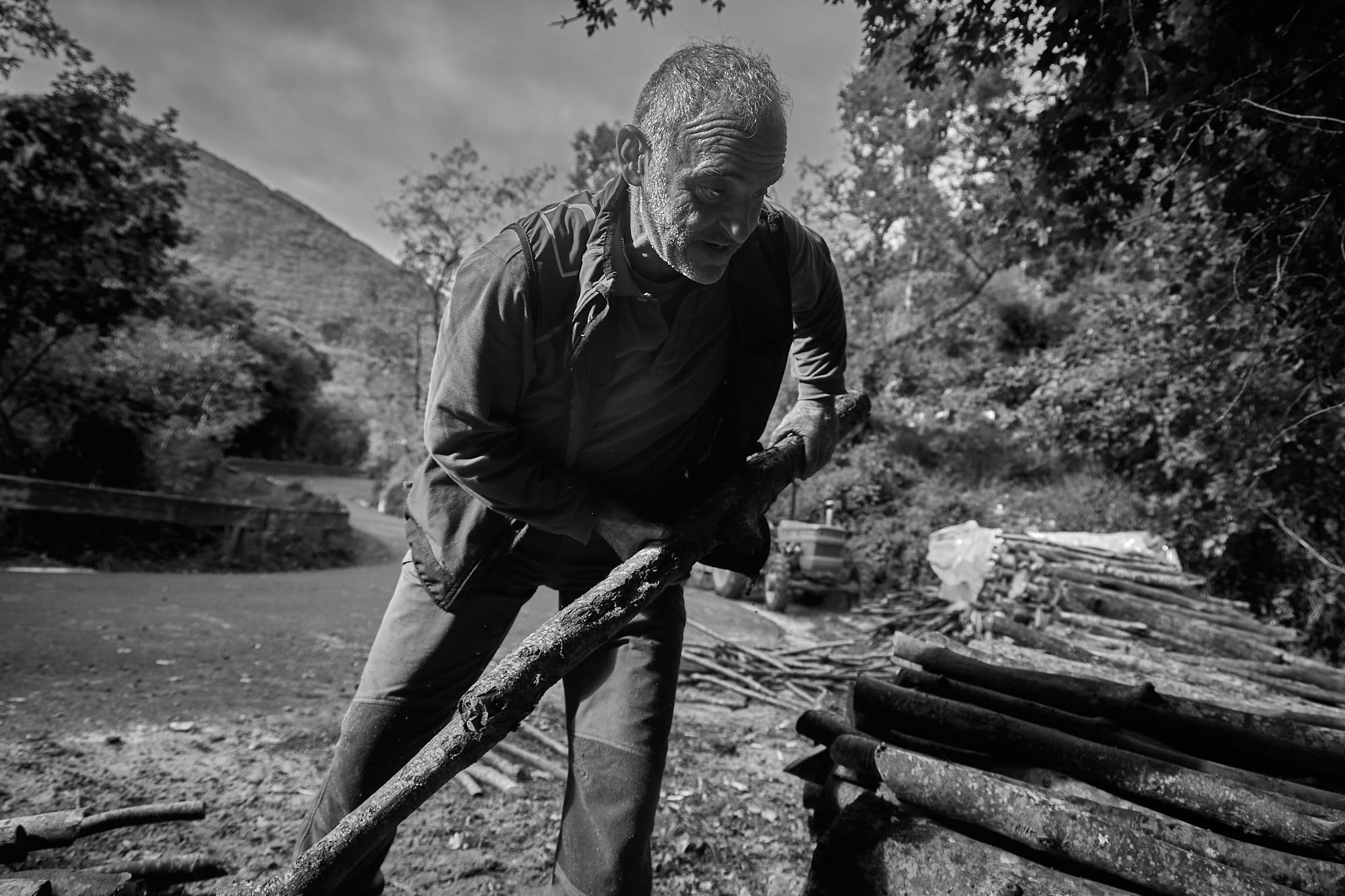
We photographed him at work, often absorbed in the immediate demands of the task. His movements, the effort involved in lifting timber, and the attention required to prepare the loads revealed much about his professional experience.
But he, too, is more than his occupation. He is not particularly interested in making speeches about his work, and there is no reason he should be expected to.
Not everyone who has a story worth telling wants to become its narrator. Sometimes the most respectful approach is to observe carefully, describe what can be established, and resist the temptation to fill every silence with a quotation.
Calling Stefano one of the few loggers who still work with mules may help describe the rarity of what he does. It should not turn him into a relic of another century.
Stefano is a man working in the present, earning a living and facing the physical, economic, and environmental realities of that work now. His knowledge belongs to the present as well, whether or not future generations choose to continue using it.
There is something particularly revealing about a profession in which the abilities of an animal still determine what a human being can accomplish.
We tend to imagine human progress as a succession of technologies that free us from dependence on other living creatures. Yet in this forest, the most useful capabilities are not necessarily those associated with greater mechanical power.
The mule's balance, its ability to negotiate difficult ground, and its familiarity with the work remain essential. This does not make the animal a substitute for technology, or suggest that we should return to some imagined rural past.
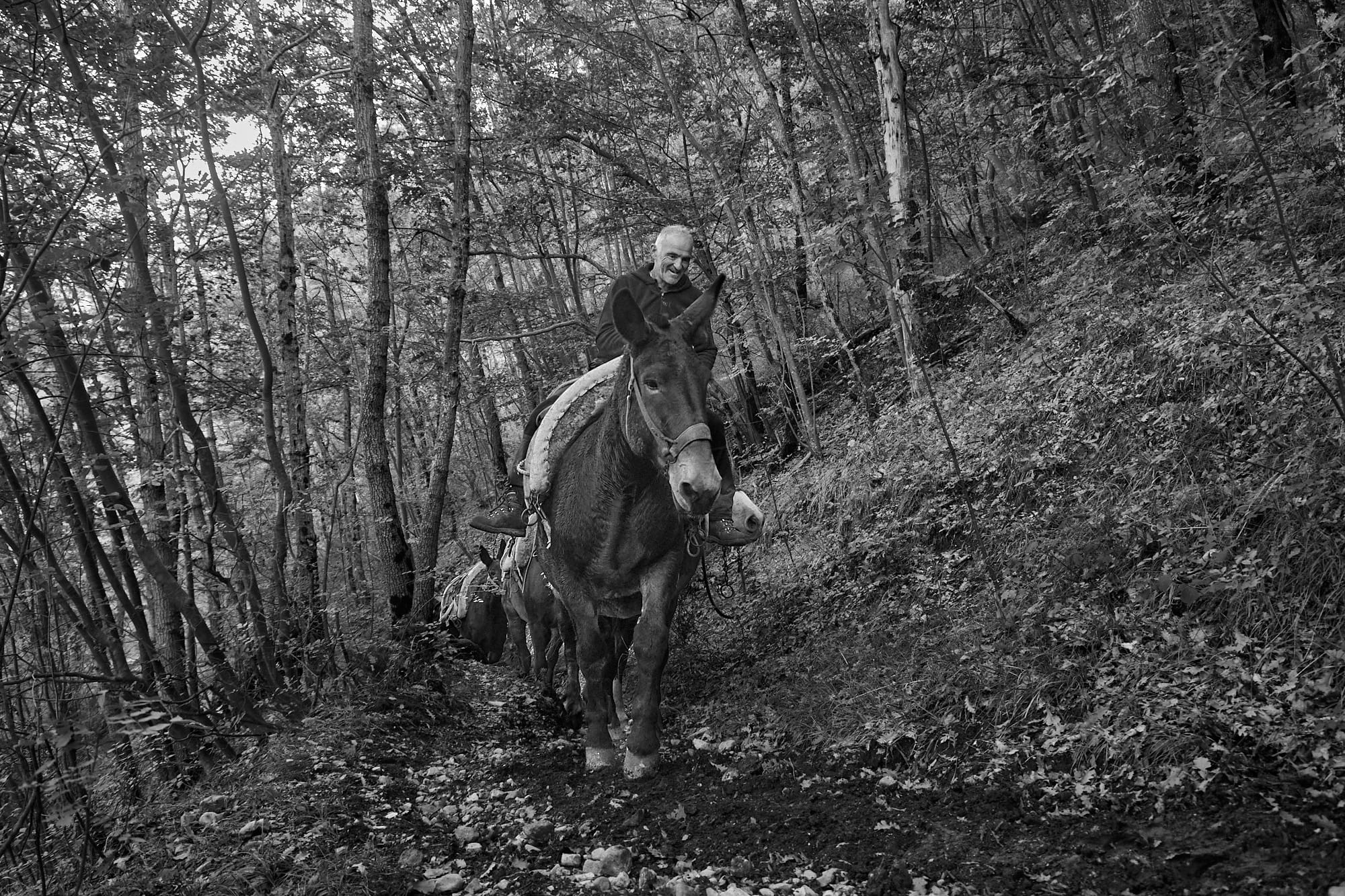
It simply reminds us that intelligence takes different forms, and that human ingenuity has always depended, in ways we sometimes prefer to forget, on the abilities of other species. Near the end of our photographic sequence, there is a portrait of Stefano standing beside one of his mules.
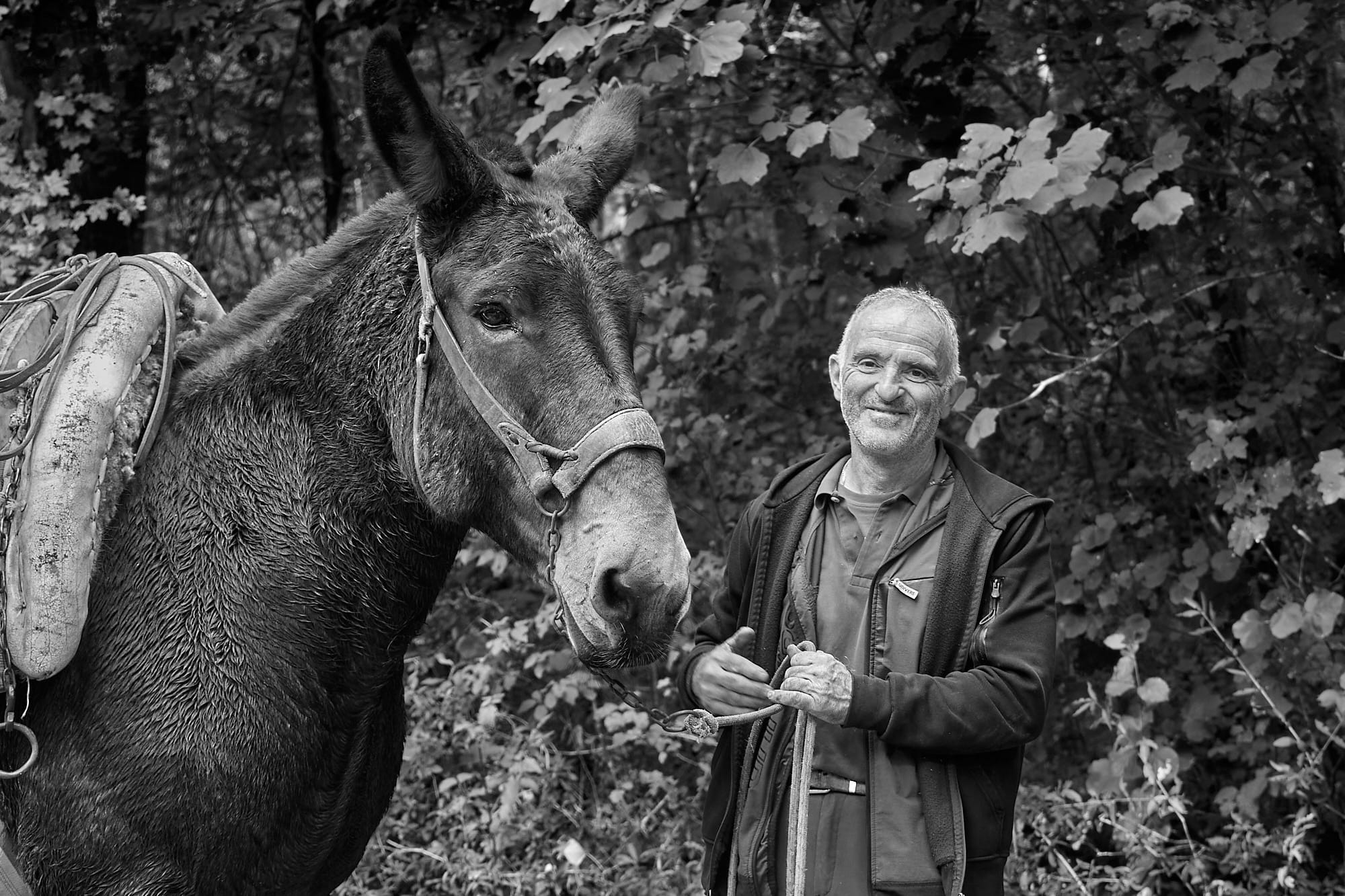
He looks toward the camera and smiles. The animal stands close to him, its head occupying almost as much space in the frame as the man's body. It is an uncomplicated photograph.
There is no dramatic landscape, no steep precipice, no demonstration of strength. The tools of the trade remain visible, but the work has momentarily stopped for the camera.
Two living beings stand together. We do not know what the mule is thinking. We cannot summarize its life through this encounter, any more than we can summarize Stefano's through a single day spent following him.
What we can do is recognize that both have contributed to the story, and that neither should exist merely as a background for the other.
That is the photograph we would like to leave with the reader. Not an image of a disappearing world, and not an argument that one way of working is necessarily better than another.
A portrait of a relationship, with all the knowledge, dependence, vulnerability, and responsibility that relationships contain.
We went into the forest to photograph a man and his mules. We came away thinking about what it means to share work with another living being and how much of that relationship remains invisible until we learn to look.
Further reading
 Claudio Maria Lerario


Member discussion