


There are many ways to look at a piece of cloth. You can begin with color; with texture; with the weight of it in your hands. You can ask whether it belongs on a table, across a bed, around someone's shoulders. You can decide whether you like it. Or you can follow the thread backward.
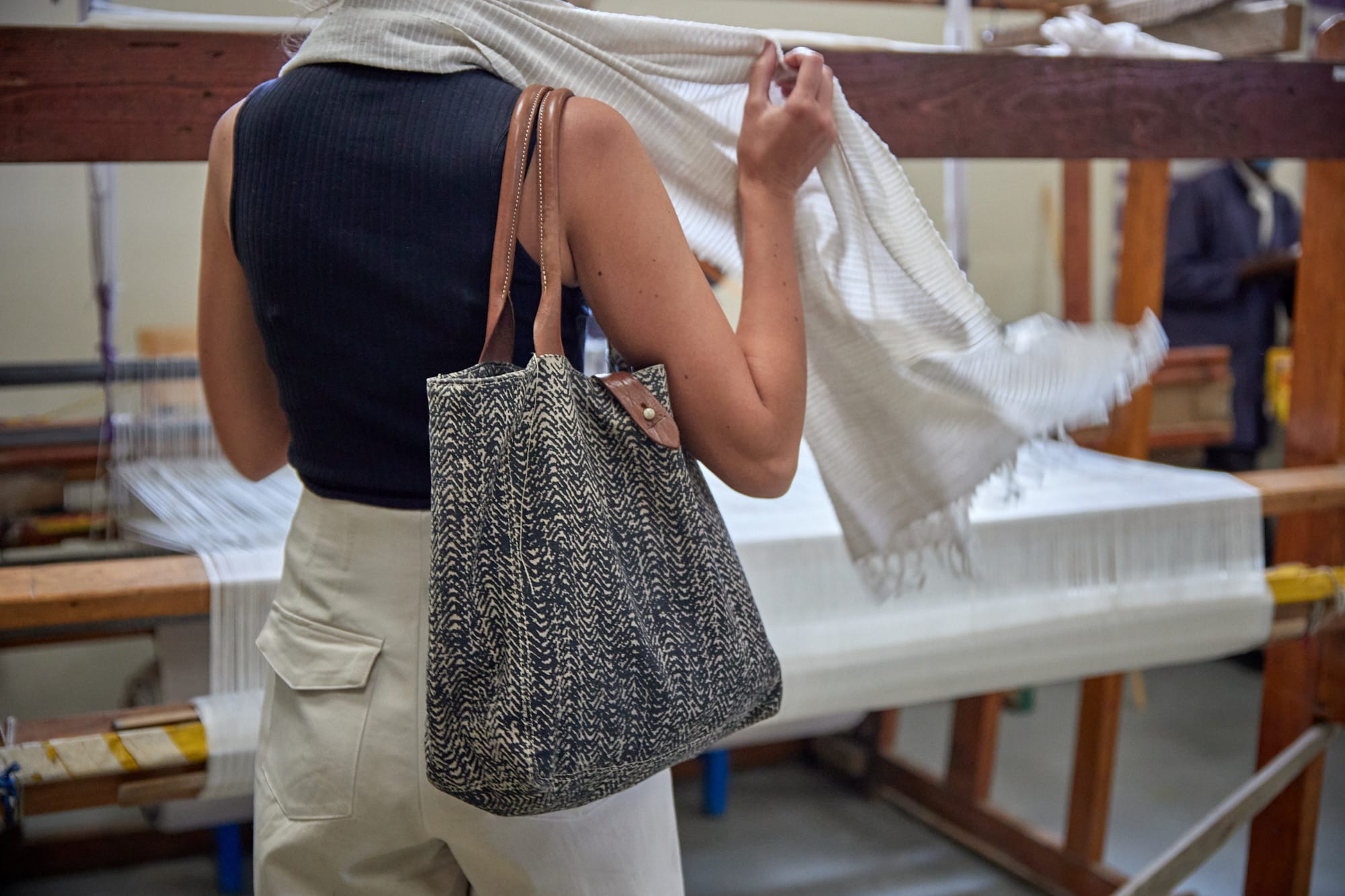
At Sabahar, in Addis Ababa, that journey eventually leads to a loom: wooden parts worn smooth by use, rows of cotton pulled tight, feet working below, hands moving through a sequence that is both precise and difficult to translate into words.
Before the loom there was someone preparing the warp. Before that, someone spinning fiber into thread. Somewhere else, perhaps, somebody dyed it. One person rarely makes a textile alone. This is easy to forget once an object reaches a shop.
On the shelves, cloth becomes orderly. Towels are folded into rectangles. Scarves hang beside one another according to color. Bags wait with their labels attached. The complexity has disappeared into the finished thing: the loom remembers it.
Video by Sabahar PLC
A knowledge held by many hands
Weaving in Ethiopia belongs to a history much older than Sabahar. For generations, cotton was grown, cleaned and spun locally. Women traditionally spun the fiber; men worked the looms. Different regions developed different techniques, weights and uses. Cloth became clothing, shawls, blankets, protection against cold, part of religious observance and ceremony.
The knowledge did not reside in a manual: it moved through families. Hands taught hands. That division of work still leaves its trace in contemporary textile production. A woman may spin cotton; another worker prepares thread; someone measures and arranges the warp; a weaver sits at the loom. The object eventually sold as a single textile is therefore the consequence of several separate forms of intelligence.
This matters because the word handmade has become almost useless. It appears everywhere now: on packaging, websites, hotel shops, airport displays. It usually tells us that a human being has touched something. It tells us almost nothing about what that person knew.
At Sabahar, what becomes interesting is not simply the presence of hands but the specialization contained within them. Spinning is one knowledge; dyeing another; reparing a loom another, weaving another still. They depend on one another: a textile is a small collective act.
Tradition is not stillness
There is a temptation, especially when looking at craft from outside, to believe that preservation means keeping things unchanged. The old loom must remain the old loom. The pattern must remain the old pattern. The artisan becomes valuable precisely because the work appears untouched by modernity.
It is a comforting idea. It is also a dangerous one: a craft that cannot change risks becoming something performed for visitors rather than practiced for life. It moves from the economy into the museum; from knowledge into demonstration.
Sabahar has taken a different approach. The company grew from Ethiopian weaving traditions but began introducing contemporary design, different fibers, new textures and modifications to the equipment itself.
Weavers accustomed to particular kinds of looms learned to work with others. Familiar skills were applied to silk, linen and wool. Structures became more complex; products moved beyond the forms for which Ethiopian handweaving had traditionally been known.
None of this makes the work less traditional. It reveals something more interesting about tradition: it has always survived by adapting. The question is therefore not how to protect a craft from change.
The better question is what kind of change allows the people who possess that knowledge to continue using it. Preservation is not the opposite of change. Sometimes change is what allows a tradition to remain alive.
Video by Sabahar PLC
The economics of remembering
There is another romantic idea worth abandoning: craft does not survive because we admire it. People can praise weaving, photograph weaving, write books about weaving and declare it cultural heritage; none of those things necessarily allows a weaver to pay rent, educate a child or plan what will happen next year.
For a skill to remain alive, someone must be able to build a life around practicing it. This is where the story of Sabahar becomes less about textiles and more about work.
Traditional spinners and weavers have often worked within informal economies. Employment can be irregular; security can be fragile. And inherited occupations do not automatically carry social prestige simply because outsiders consider them culturally important.
Weaving communities in Ethiopia have also experienced forms of marginalization and prejudice. The craft may be admired while the person practicing it occupies a much less comfortable position.
That contradiction should make us suspicious whenever we use the word heritage too easily. Heritage for whom? A tradition cannot meaningfully be called precious if the people responsible for carrying it are expected to remain economically precarious in order to preserve its authenticity.
Sabahar's contribution is therefore not that it “saves” Ethiopian weaving. The language of rescue would misunderstand both the artisans and the work. What it attempts to create is infrastructure around knowledge.
That means: regular production, access to markets, new technical possibilities, a working environment in which skills inherited from previous generations can become part of contemporary economic life. There is nothing particularly nostalgic about that: it is business. And perhaps that is precisely the point.
What color requires
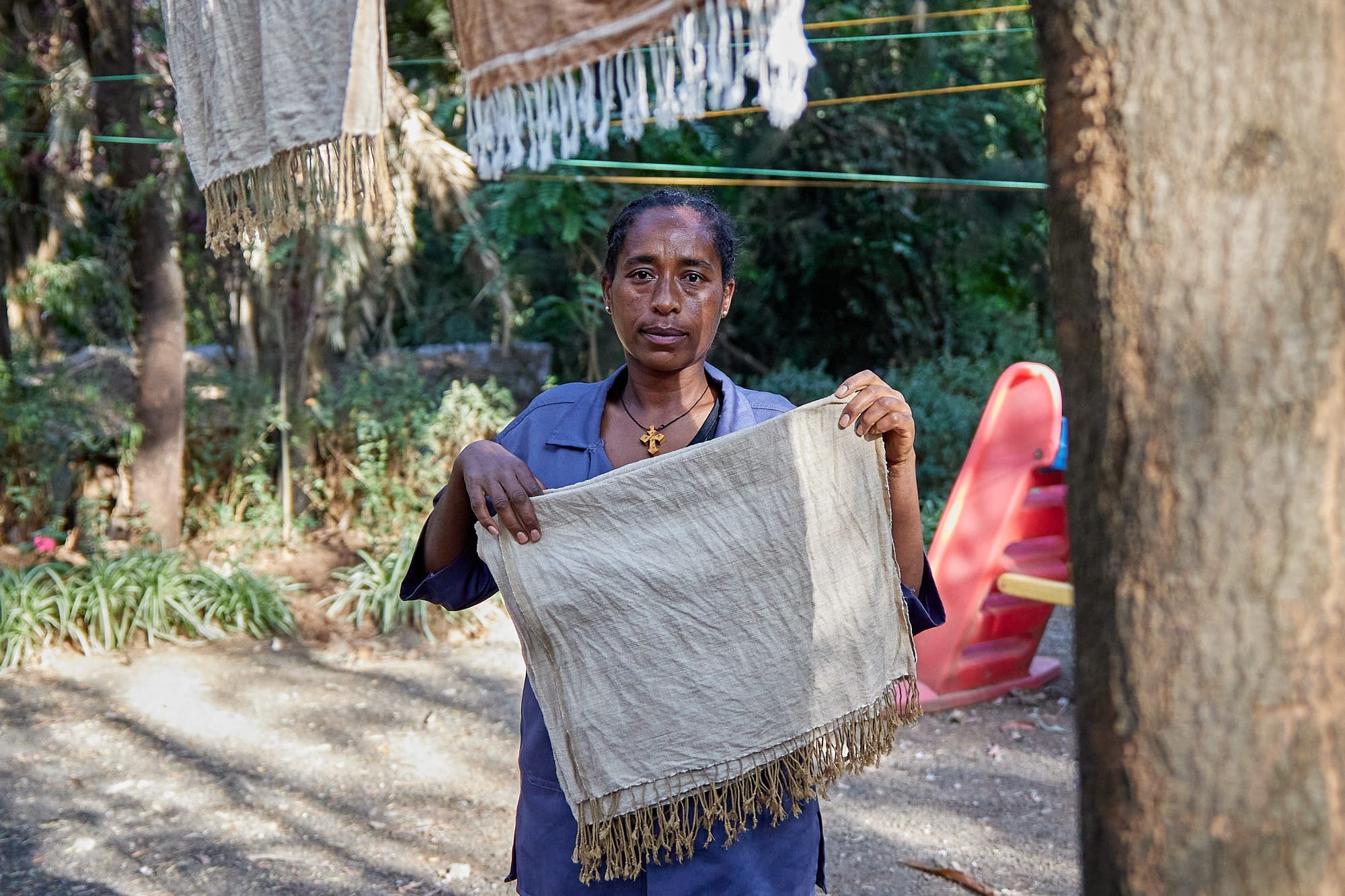
In the garden at Sabahar, thread hangs to dry. Some of the colors arrive through processes that would be recognizable almost anywhere in contemporary textile production; others come from experiments with materials much closer to home: coffee, onion skins, flowers, plants, seeds, insects.
Dyeing is slow work. Thread has to be prepared and washed before it takes color. Temperatures matter. Timing matters. Afterwards come rinsing and drying. Here again, the finished textile conceals its own history.
A red scarf does not explain the pot in which its thread was submerged. A pale length of silk gives no immediate account of the water used to wash it. The object remains silent about heat, fuel, waste and labor.
Sabahar has spent years trying to make these invisible parts of production less damaging: solar energy contributes to heating water; biogas is used in dyeing; water can be treated and reused; natural fibers remain central to production.
These choices matter, but perhaps not in the way contemporary fashion marketing often presents them. “Sustainability” has become another word in danger of losing its meaning.
The more useful question is simpler: what does making this object actually require? Where did the fiber come from? Who processed it? How much energy was necessary? Where does the water go afterwards? Who knows how to repair the process when something goes wrong?
Once those questions are asked, environmental responsibility stops being an adjective attached to a product. It becomes part of the architecture of production.
From the loom to the shop
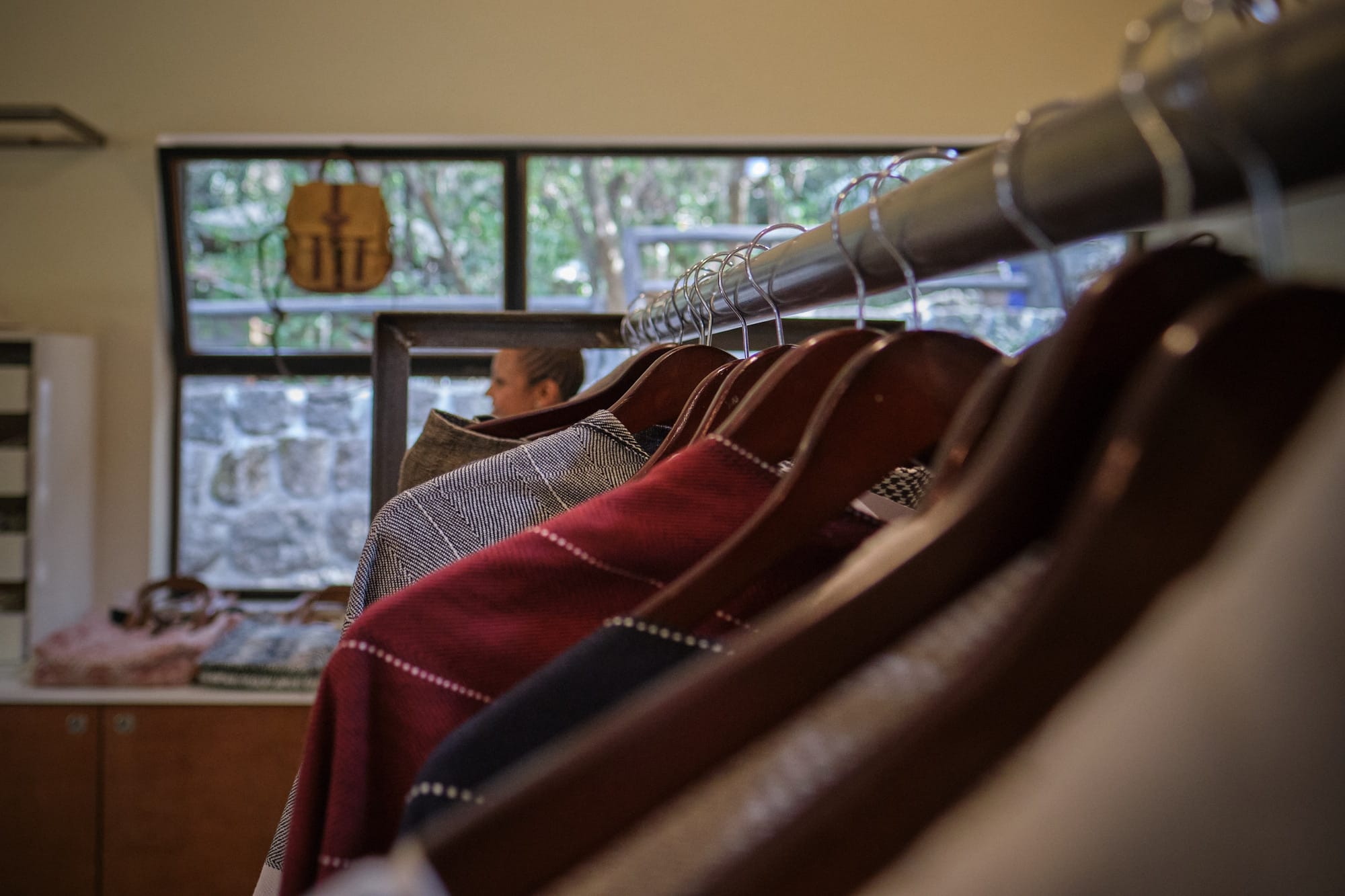
A short distance from the workshop, the Sabahar shop offers a strangely compressed version of the entire story. Here the difficult work becomes beautiful again.
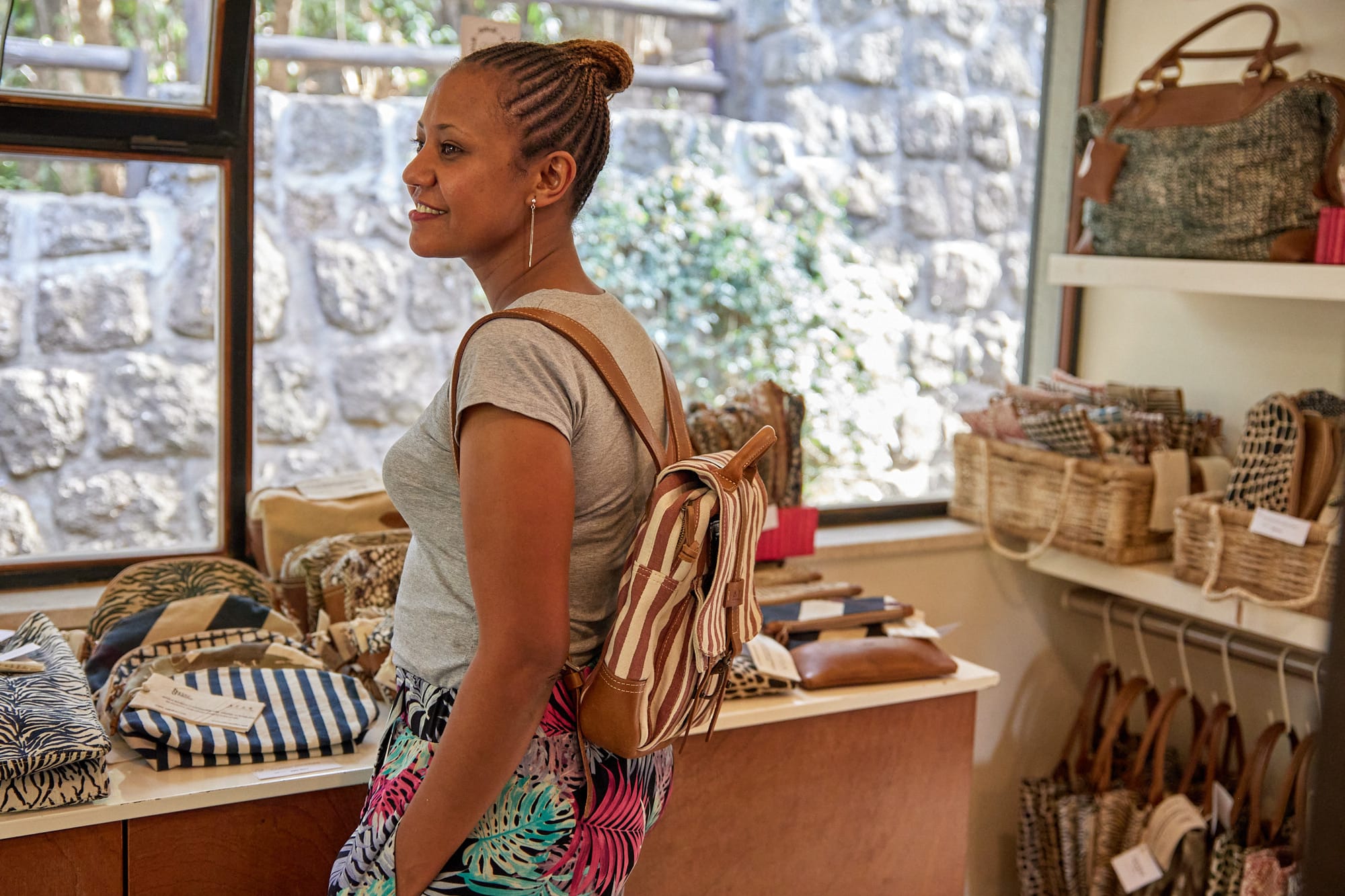
Scarves form walls of reds, creams, blues and earth colors. Towels lie in careful stacks. Textures that required hours of repetitive movement can be inspected in seconds. There are also objects made by other Ethiopian businesses. Among them are AFAR bags.
The relationship makes sense. Sabahar and AFAR work differently and produce different things, but both operate within a question that runs through contemporary Ethiopian craft: how can local materials and inherited skills enter global markets without being reduced either to inexpensive labor or to an exotic idea of Africa?
An AFAR bag hanging among Sabahar textiles is therefore more than a collaboration between two businesses: it is evidence of an ecosystem.
Materials move; knowledge moves; companies exchange products; workshops specialize, designers interpret; craftspeople transform. Shops bring these different histories together.
What arrives before the customer as an object is actually a network. And perhaps this is why the shop should come at the end of the story rather than the beginning. If you begin there, you see things; if you arrive there after the workshop, you see labor. The difference changes the object.
The future is woven in the present
There is no guarantee that a craft will survive merely because it has existed for centuries. Children do not inherit an obligation to continue their parents' work. Younger generations may reasonably want different professions, different lives, different forms of recognition. Economies change; cities change; expectations change.
Tradition has no automatic claim on the future. It must earn one. That may require better tools; new designs; new markets, different ways of organizing work. It may require abandoning some practices while protecting others. It certainly requires accepting that artisans themselves are not historical artifacts.
They live in the same present as everyone else. This is what makes places such as Sabahar important to observe. Not because they offer a reassuring story in which an ancient tradition is rescued from disappearance, but because they expose the much harder negotiation underneath: how to allow knowledge to move forward without severing it from the people and places that gave it meaning.
Back at the loom, none of this is particularly abstract. The threads are stretched across the frame. The shuttle passes. The cloth grows almost imperceptibly, one movement after another. What looks like repetition is actually construction. And that may be the most useful way to understand tradition itself. Not as something kept behind glass: as something still being made.
Editorial note: AFAR, which sponsors A Bag of Stories, has an ongoing commercial relationship with Sabahar. This story was independently written and edited by Ayzoh!.


Member discussion