


The Street and the Gathering
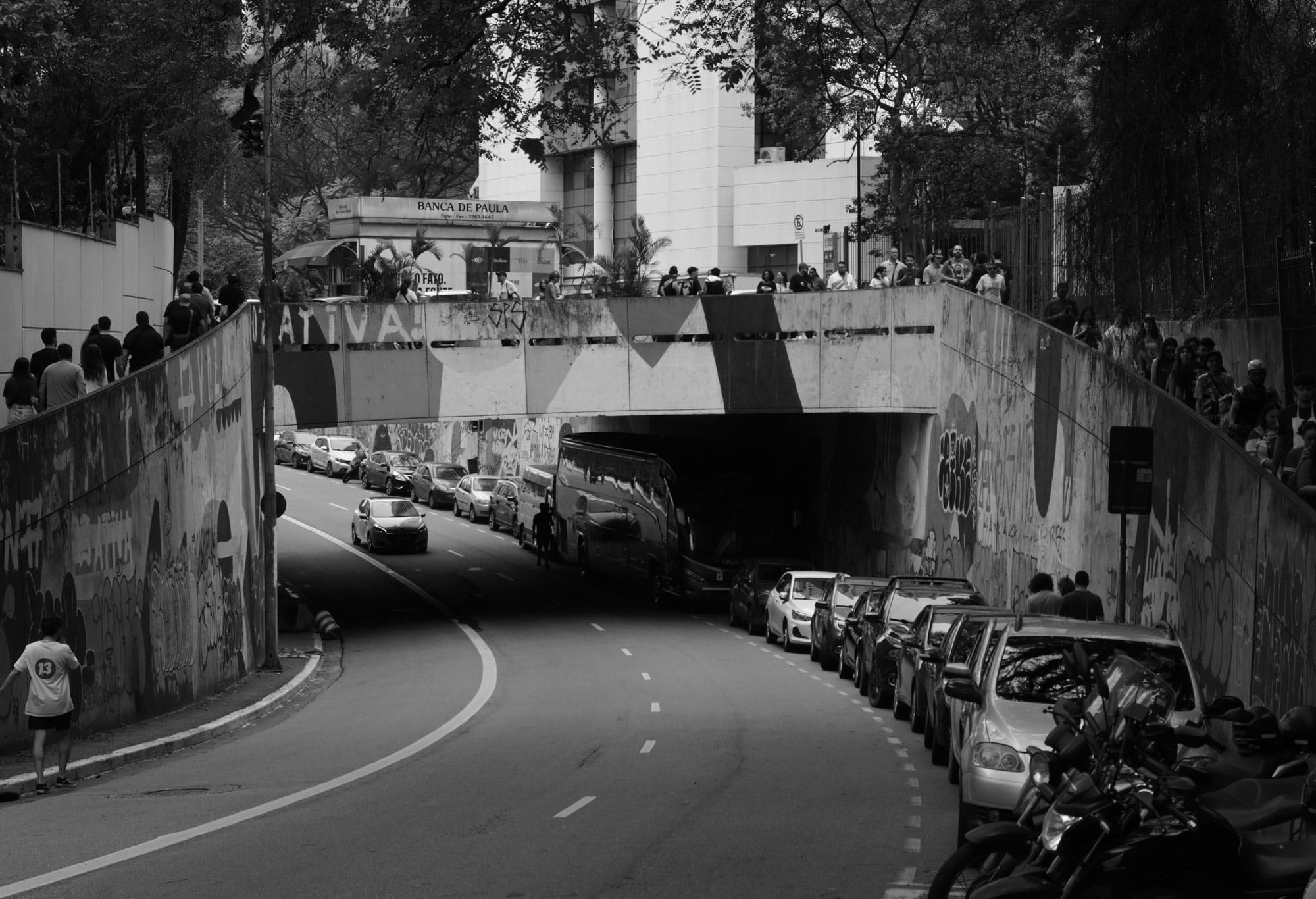
There is a photograph in Neil Wildin's series in which the demonstration appears almost to have disappeared. A road curves beneath a concrete overpass, cars line the walls, a large vehicle occupies part of the shadow, and pedestrians move along the upper level, where trees interrupt the geometry of the buildings.
The photograph contains none of the usual elements through which political demonstrations are recognized: no prominent banners, no slogans, no mass of people filling the frame.
It shows instead the physical structure of a city, with its separate levels, its ordinary traffic, and its capacity to accommodate different activities within the same few meters.
On October 11, 2026, Avenida Paulista was the setting for the Marcha pela Democracia, a demonstration supporting the reelection of President Luiz Inácio Lula da Silva, organized in the tense interval between the two rounds of Brazil's presidential election.
Lula was facing Senator Flávio Bolsonaro, who had finished ahead in the first round on October 4; the final vote was scheduled for October 25. The gathering brought together political parties, social movements, students, supporters of different organizations, and people who had come independently.
The avenue, one of São Paulo's principal commercial and cultural thoroughfares, became a place where thousands of citizens could express political positions in the presence of one another.
Wildin was there without an assignment or any affiliation with the organizers. His professional background was in business consulting, although photography had accompanied him for years; while living in England, he had also worked commercially, photographing the architecture and interiors of historic cathedrals and abbeys.
After moving to Brazil, he decided to concentrate his photographic practice on contemporary society and the people who inhabit public spaces. The change in subject is significant, although the buildings remain.
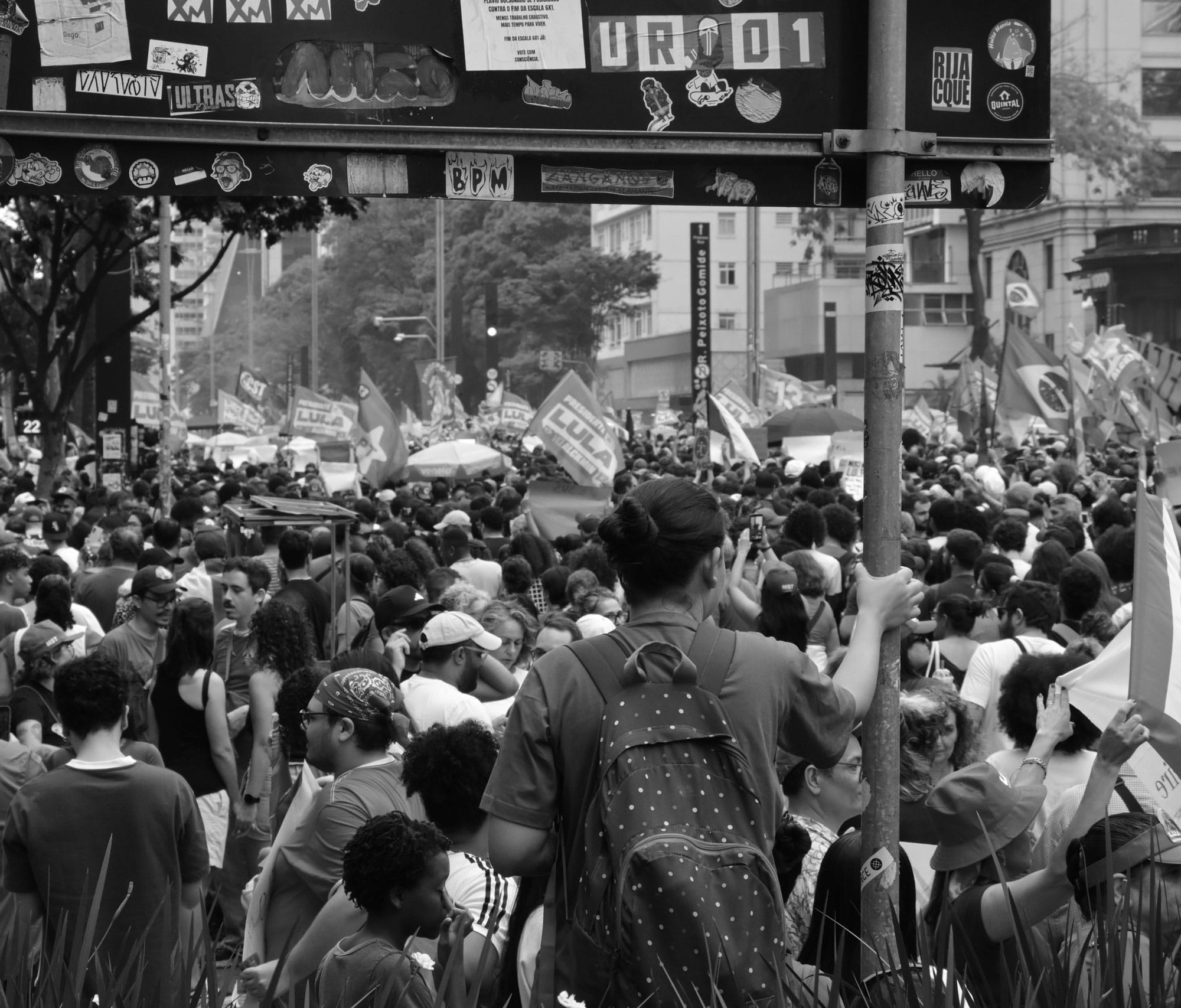
Throughout these fourteen photographs, architecture is an active part of the composition: façades, crossings, trees, signs and street furniture establish the physical boundaries within which people assemble, move and express themselves. The structures were there before the demonstration and will remain after the flags have been taken away.
Avenida Paulista has a long history as a place of public demonstrations, a street on which political claims acquire physical dimensions because bodies occupy space normally given over to traffic and commerce.
Wildin's photographs allow us to observe that transformation without losing sight of the city around it. The crowd is large, but the photographs repeatedly return us to the scale of a single person.
Making Ourselves Visible
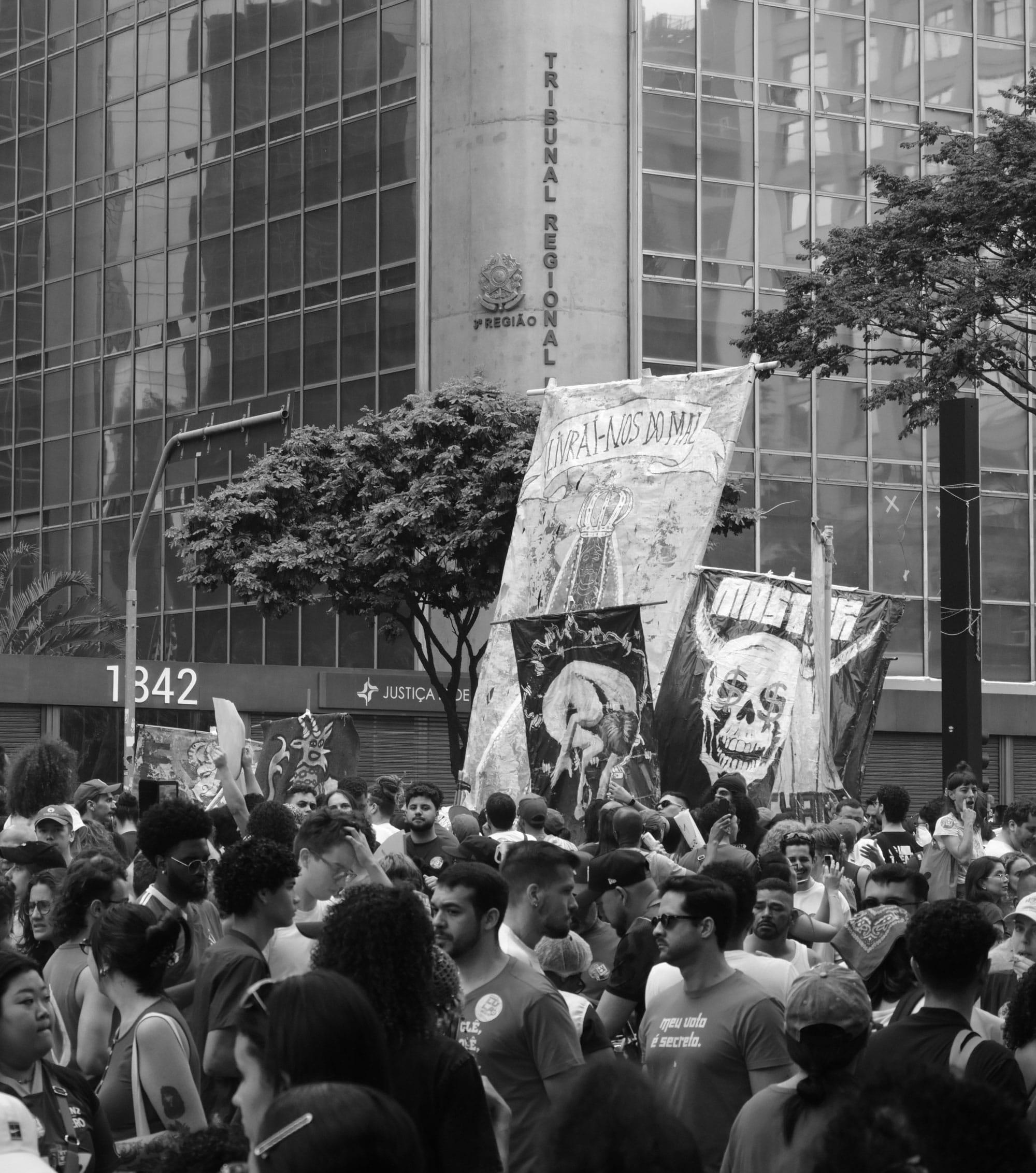
A political demonstration has its own visual language. Flags identify movements and parties, signs carry statements that must remain legible above surrounding heads, and raised arms make gestures visible to people standing farther away.
Participants become part of a collective gathering while finding different ways to express their presence within it.
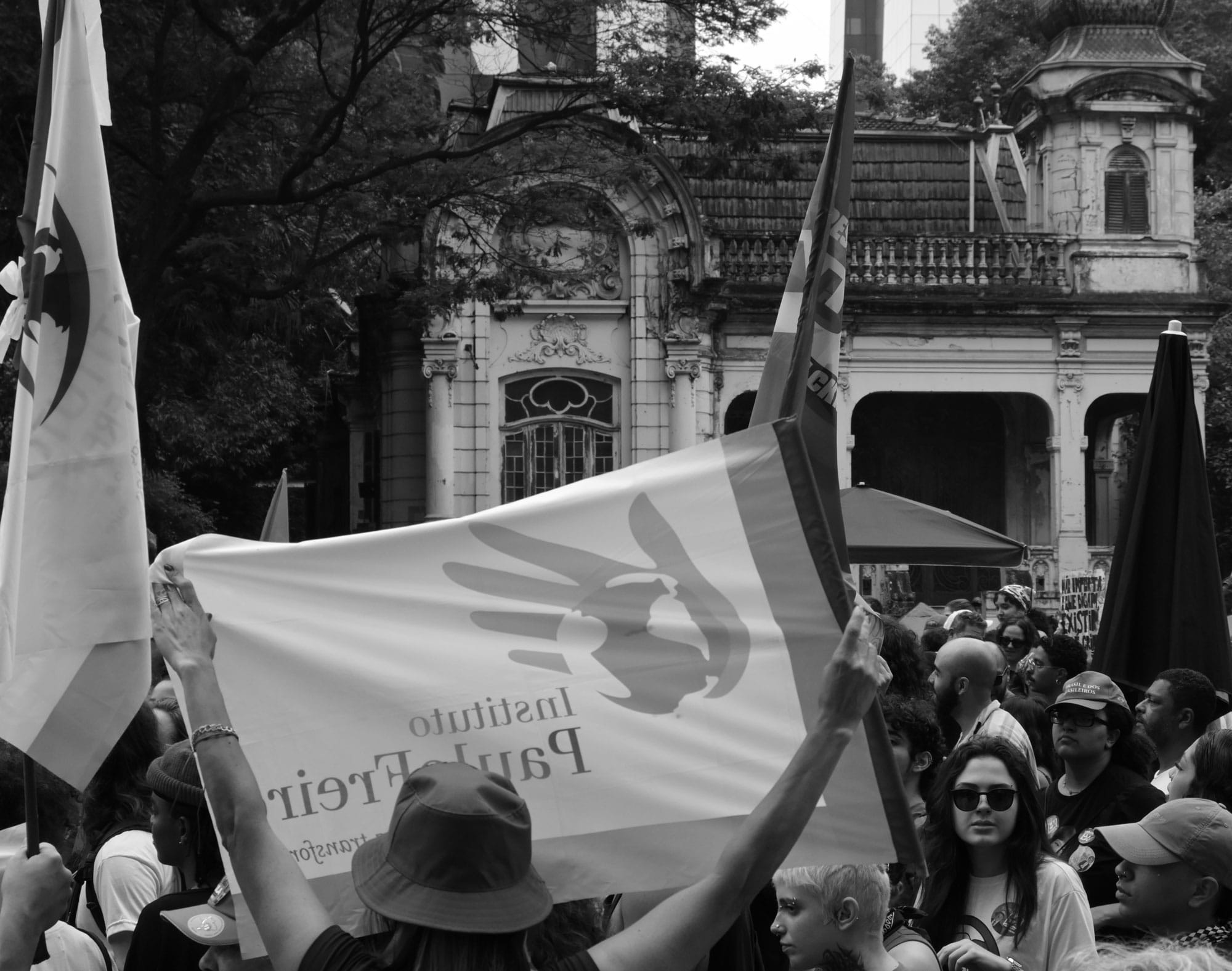
In one photograph, a large flag stretches across the foreground, partially concealing the people behind it. A historic building stands across the street, its decorated façade framed by the branches of mature trees.
The image contains several forms of public expression accumulated in one place: architectural ornament, political symbolism and the movements of people passing through the scene.
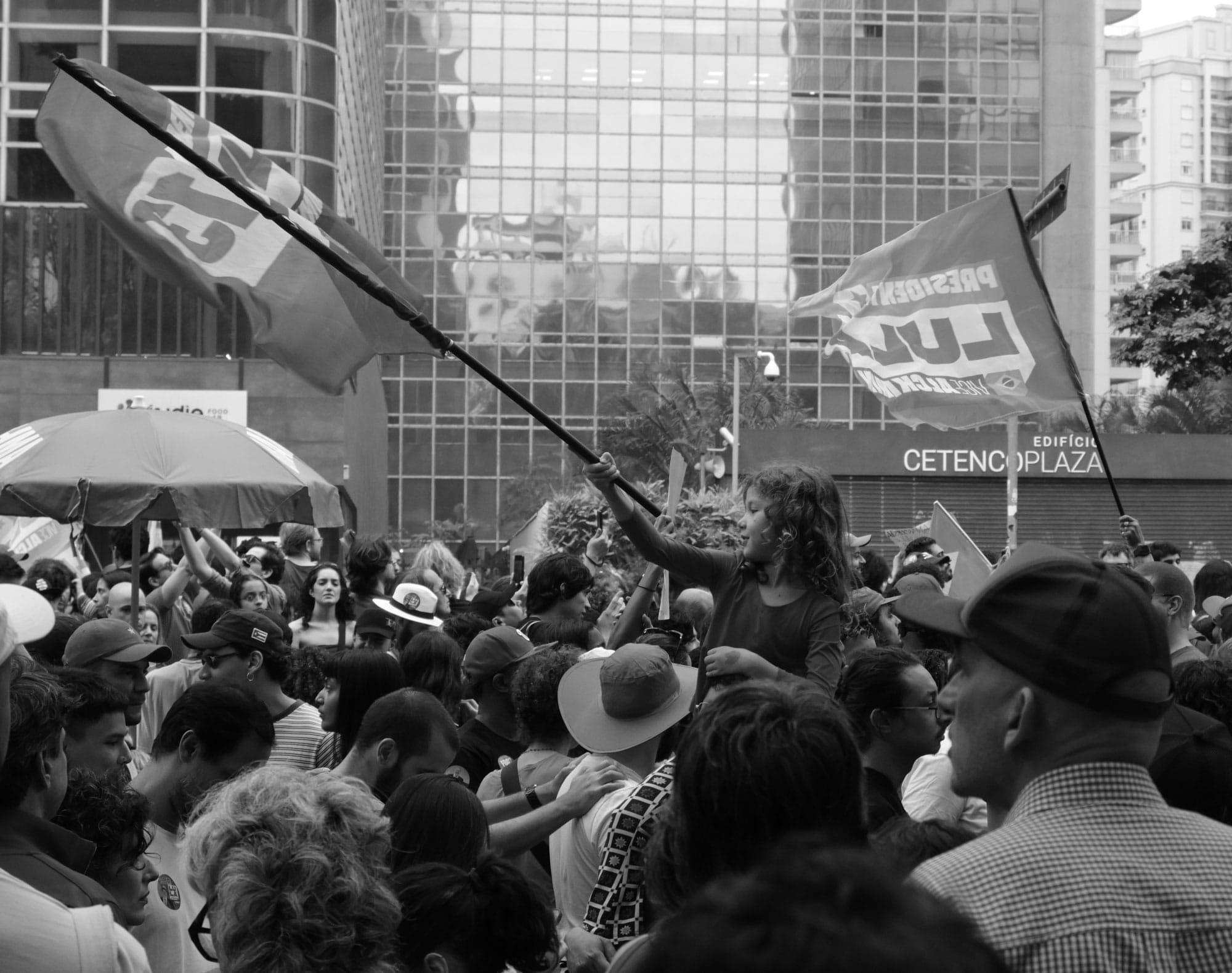
Elsewhere, a participant is raised above the crowd and holds a flagpole diagonally across the picture. The figure has a clearer outline than many of the surrounding faces, although the photograph offers little information about the circumstances of that person's participation.
What we can see is an action: someone has found a position from which to raise a flag above the heads of others. The image records the gesture and the arrangement of bodies around it. Everything beyond that requires additional knowledge.
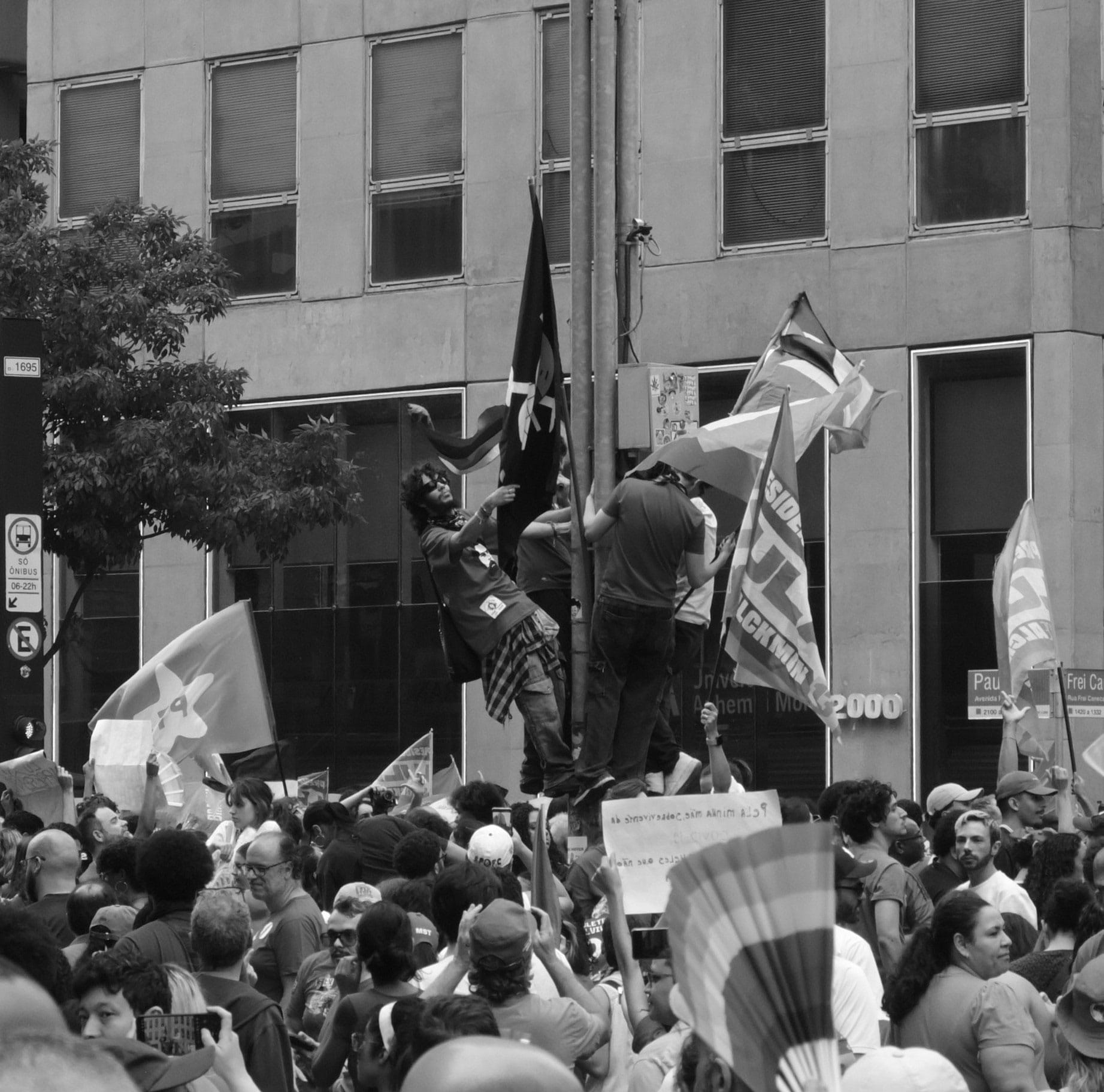
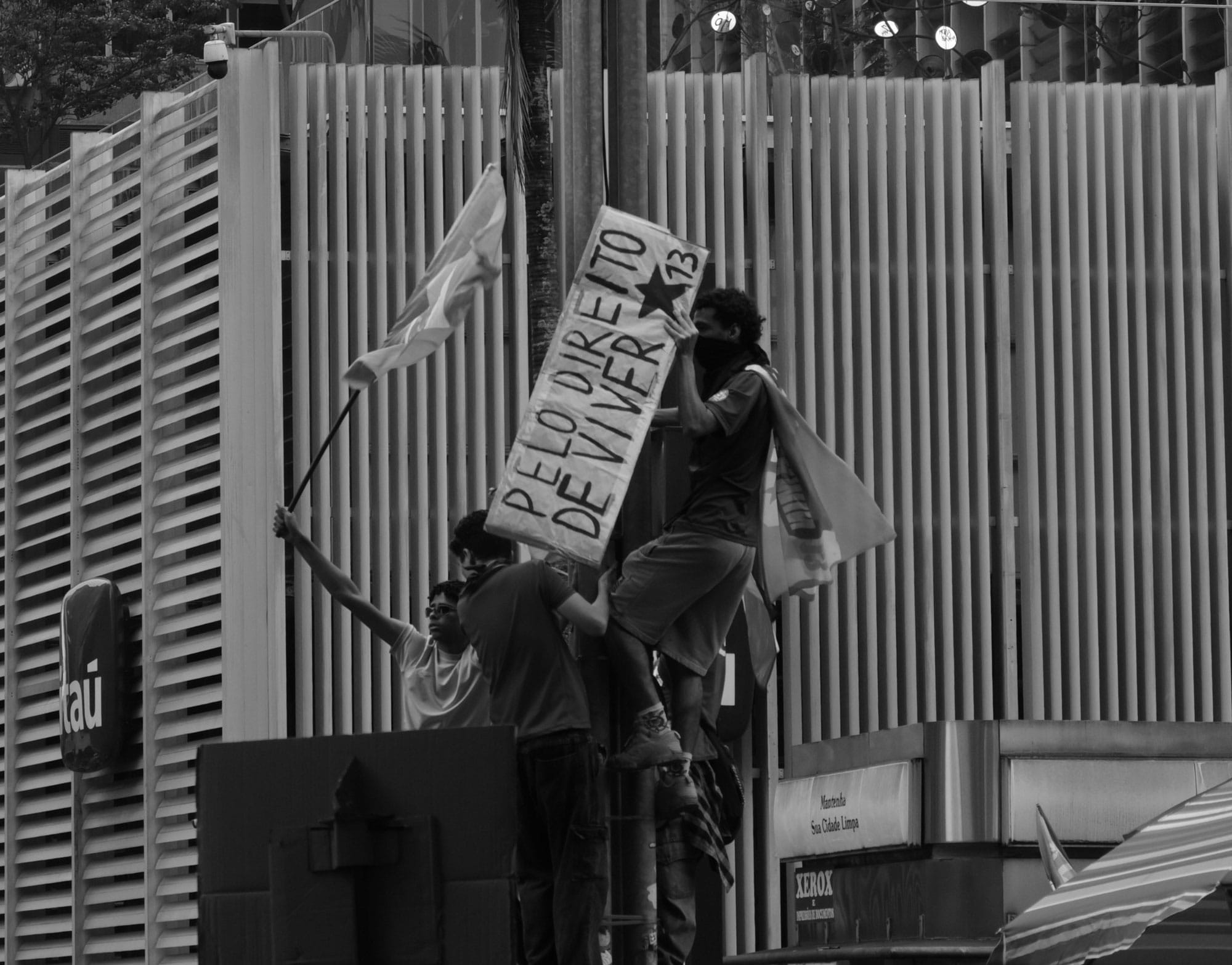
Another photograph shows people climbing around a street pole, lifting themselves above the demonstration and maneuvering their flags into position.
Their bodies are caught in a moment of physical effort. The surrounding crowd continues beneath them, while the regular windows of the building behind provide a rigid geometric background to the irregular movements in the street.
These photographs are concerned with visibility, one of the practical conditions of political participation. At a large gathering, it is difficult to make an individual voice heard or a message seen.
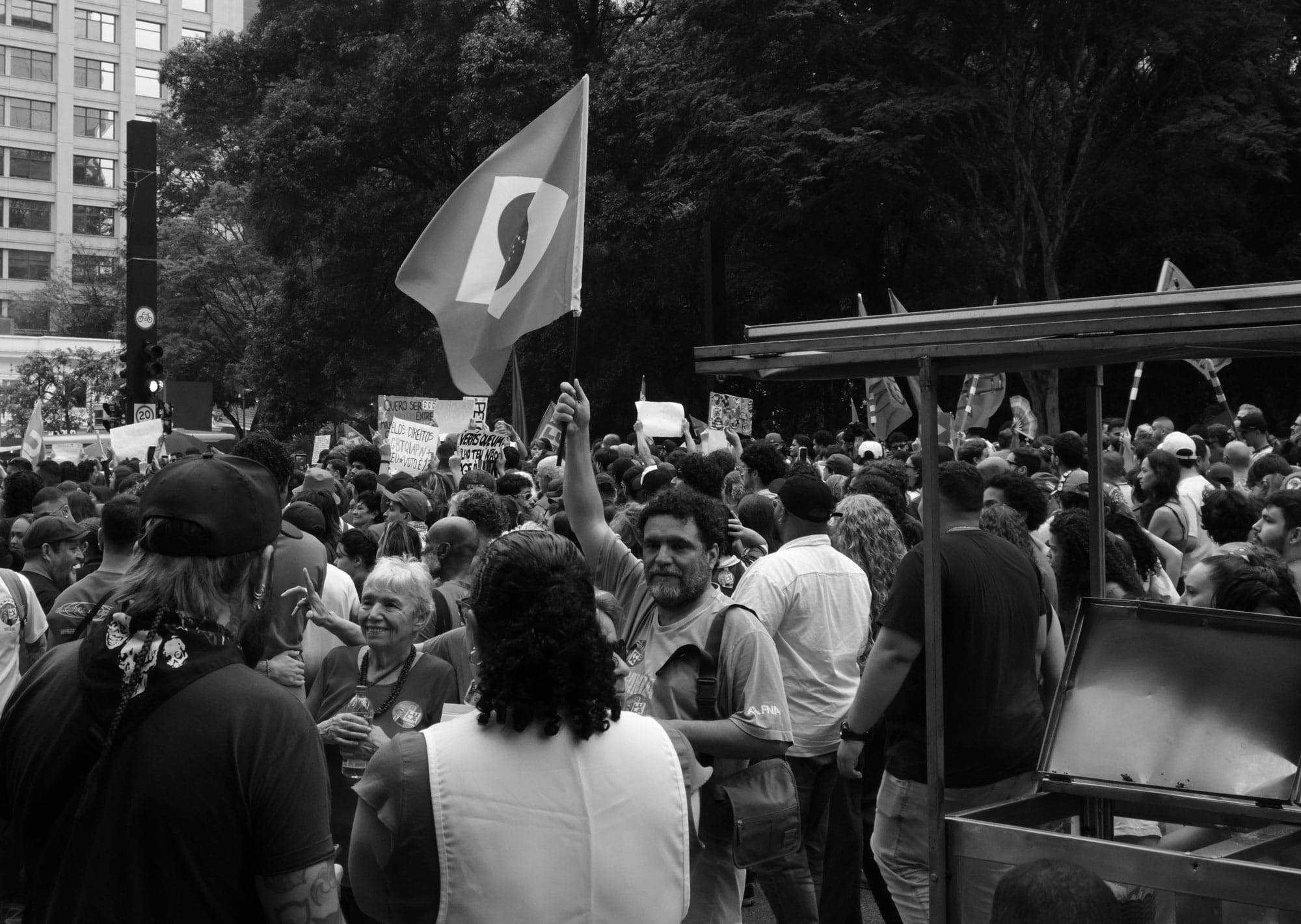
A raised flag extends the reach of its bearer; a sign places words where strangers can read them.
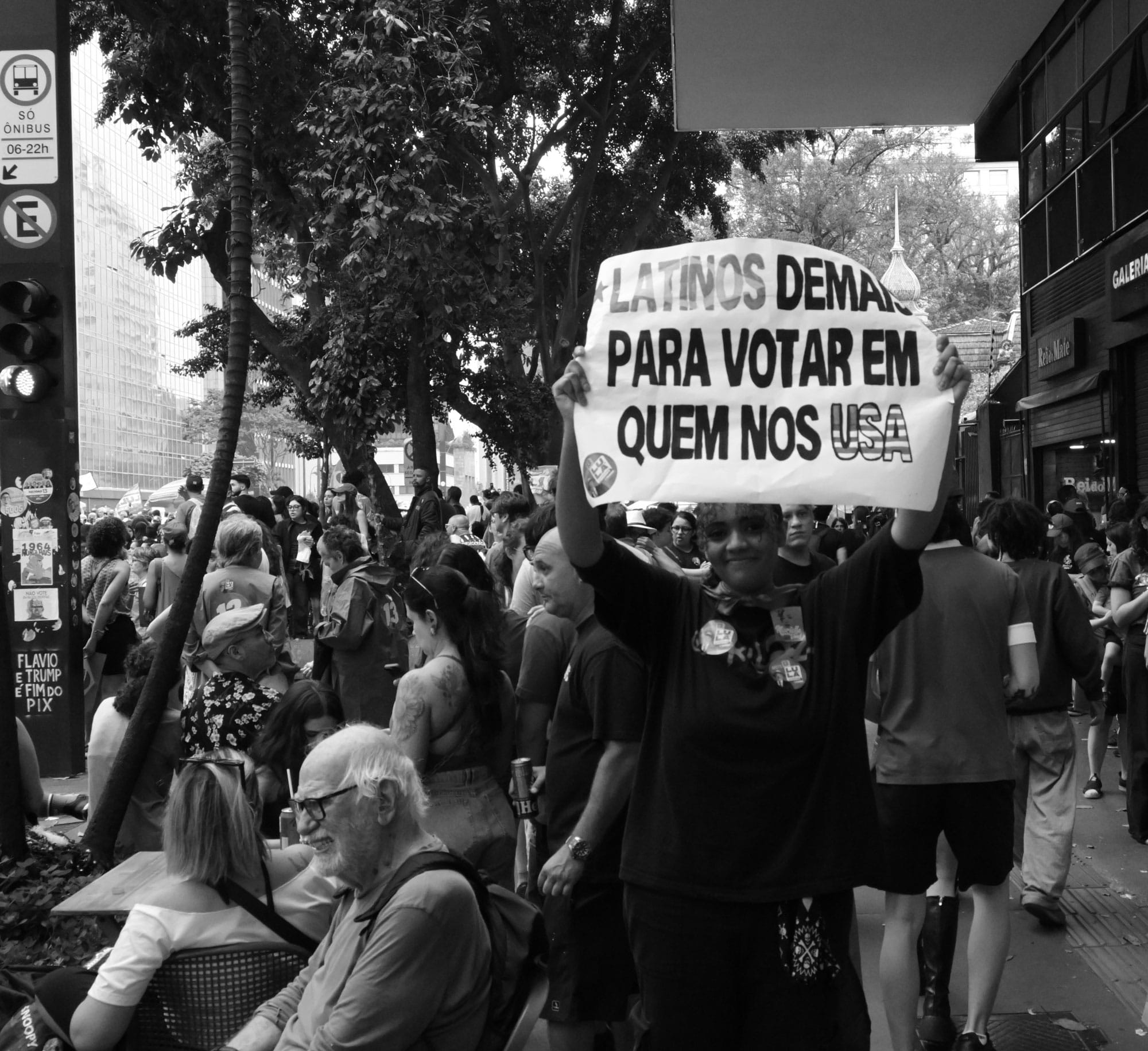
One demonstrator holds a large message overhead: LATINOS DEMAIS PARA VOTAR EM QUEM NOS USA. The Portuguese sentence, with its deliberate emphasis on USA, brings questions of Latin American identity and political relations into a Brazilian electoral gathering. It is a statement made publicly, intended to be encountered by people beyond its author.
Wildin photographs the sign and the person holding it, but the photograph cannot tell us the full story of its creation, the experiences behind its words, or the conversations it may have provoked. The message is visible; its personal history is not.
This distinction matters: a demonstration provides abundant political information, but it does not make every participant's life or intentions available to a photographer. Documentary work requires the ability to distinguish what has entered the frame from what remains outside it.
Watching the Watchers
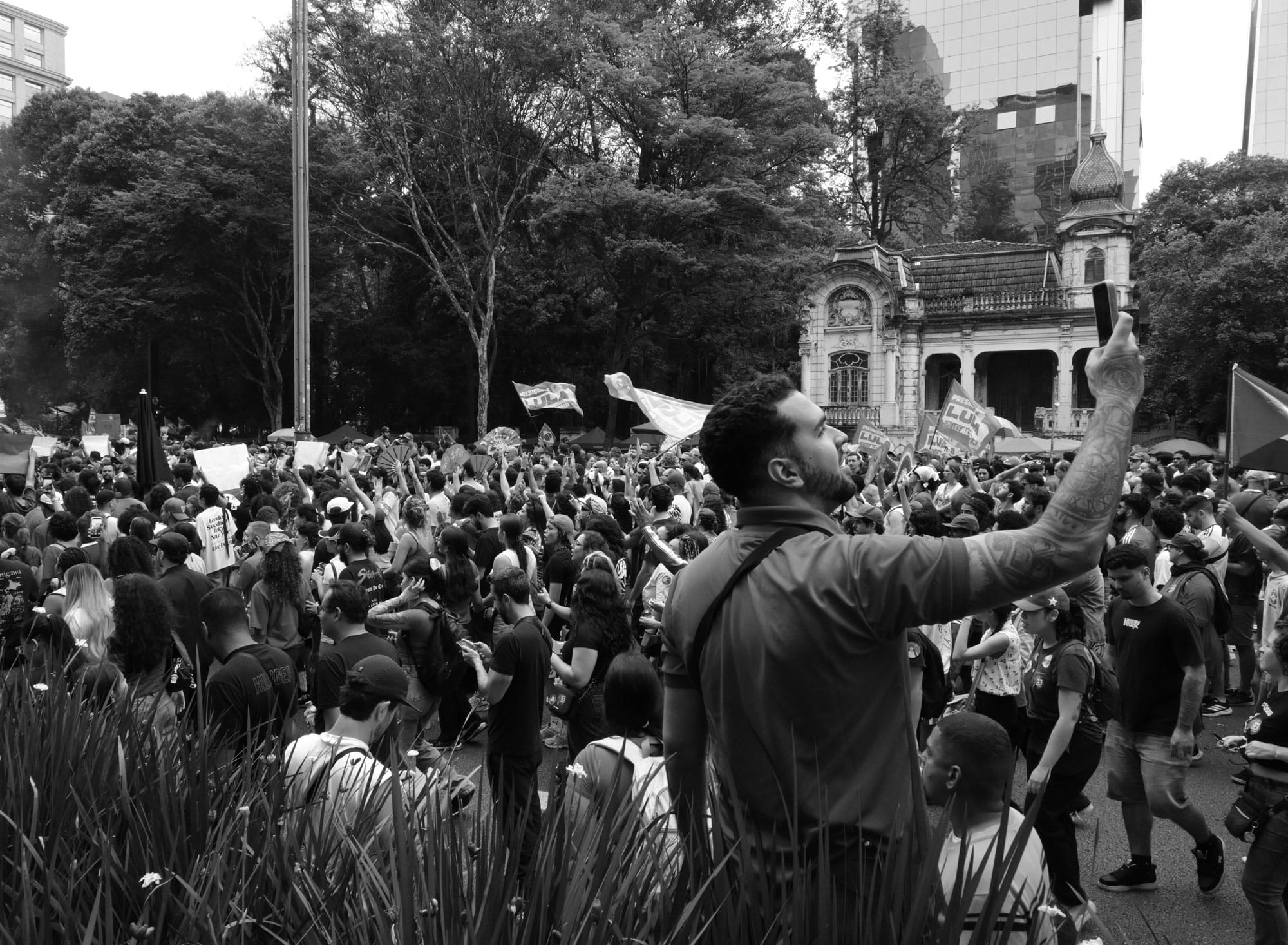
One of the most revealing photographs in the series shows a man holding a mobile phone high above a crowd. His tattooed arm occupies much of the foreground, while behind him flags rise from the gathering and the street stretches toward the trees and buildings in the distance.
He is making an image of an event at the same time that Wildin makes an image in which he appears. Both cameras are directed toward the demonstration, although their positions and resulting pictures will be different.
The photograph establishes that the man raised his phone toward the gathering. It does not reveal what he intended to do with the recording, whether he wished to preserve the afternoon, communicate with someone elsewhere, or share an account of the event publicly. Those are possible explanations, none of which the photograph can confirm.
Wildin returns to this distinction in his project statement, where he asks what documentary photographs actually establish and what viewers merely infer from them. His conclusion is expressed with particular precision:
The photograph records an action, not necessarily an intention.
In another frame, a person seen from behind raises a phone toward the avenue. Buildings recede into the distance, and the human figure creates a foreground through which we are invited to look toward the gathering.
The two photographs reveal something about contemporary public events. Cameras no longer belong exclusively to professional photographers or news organizations; they are carried by participants, passersby and witnesses, each of whom may create a different record of the same afternoon.
The resulting images will not necessarily tell the same story. One may emphasize the size of the crowd, another a particular banner, another the presence of friends, or the experience of standing in a public place during an important political moment.
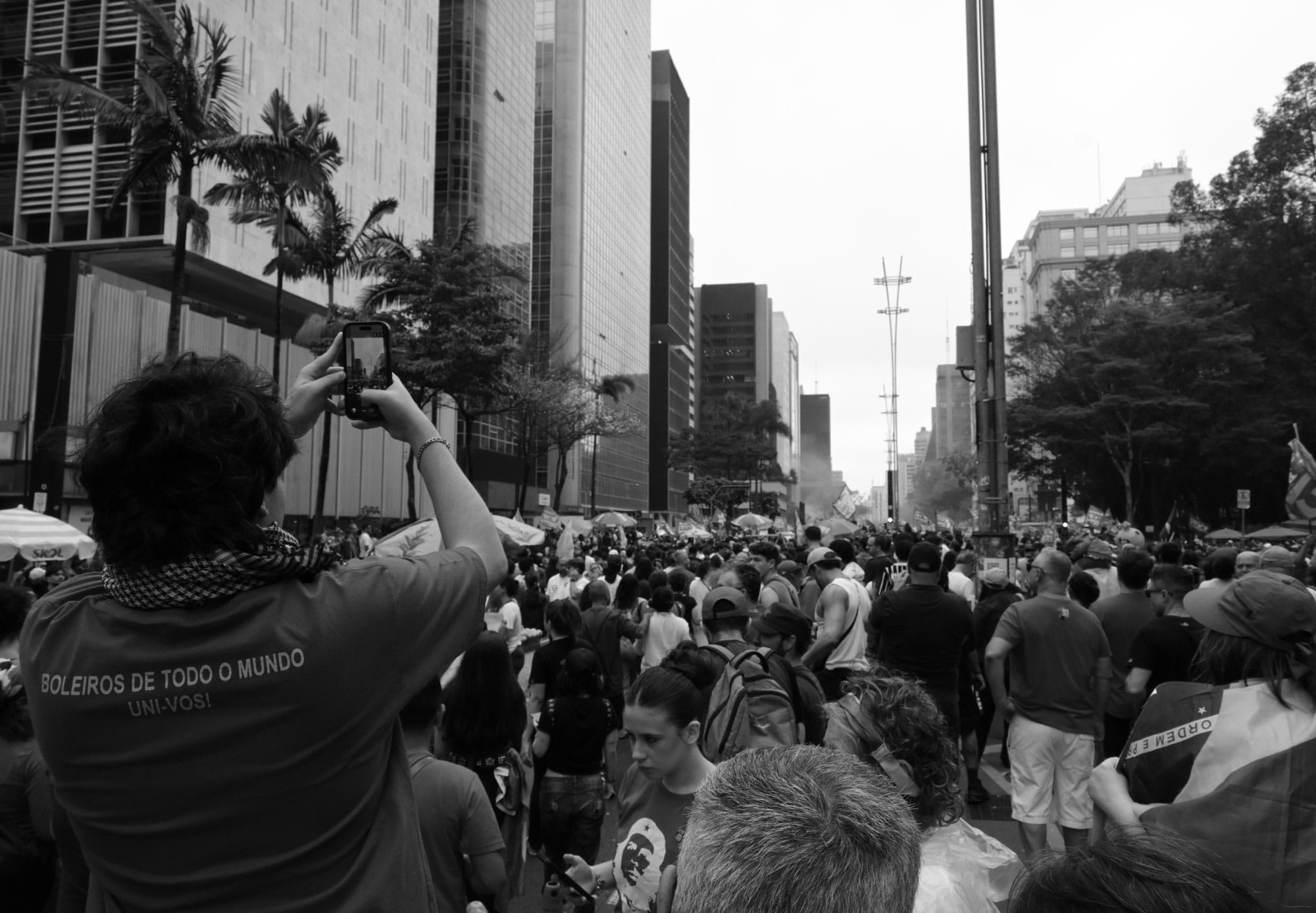
Wildin's own selection is an example of this process. From approximately one hundred frames made that afternoon, he chose fourteen. The photographs are documentary records, but the series is also an editorial construction, shaped by decisions about what to include, what to leave aside and how one image should relate to another.
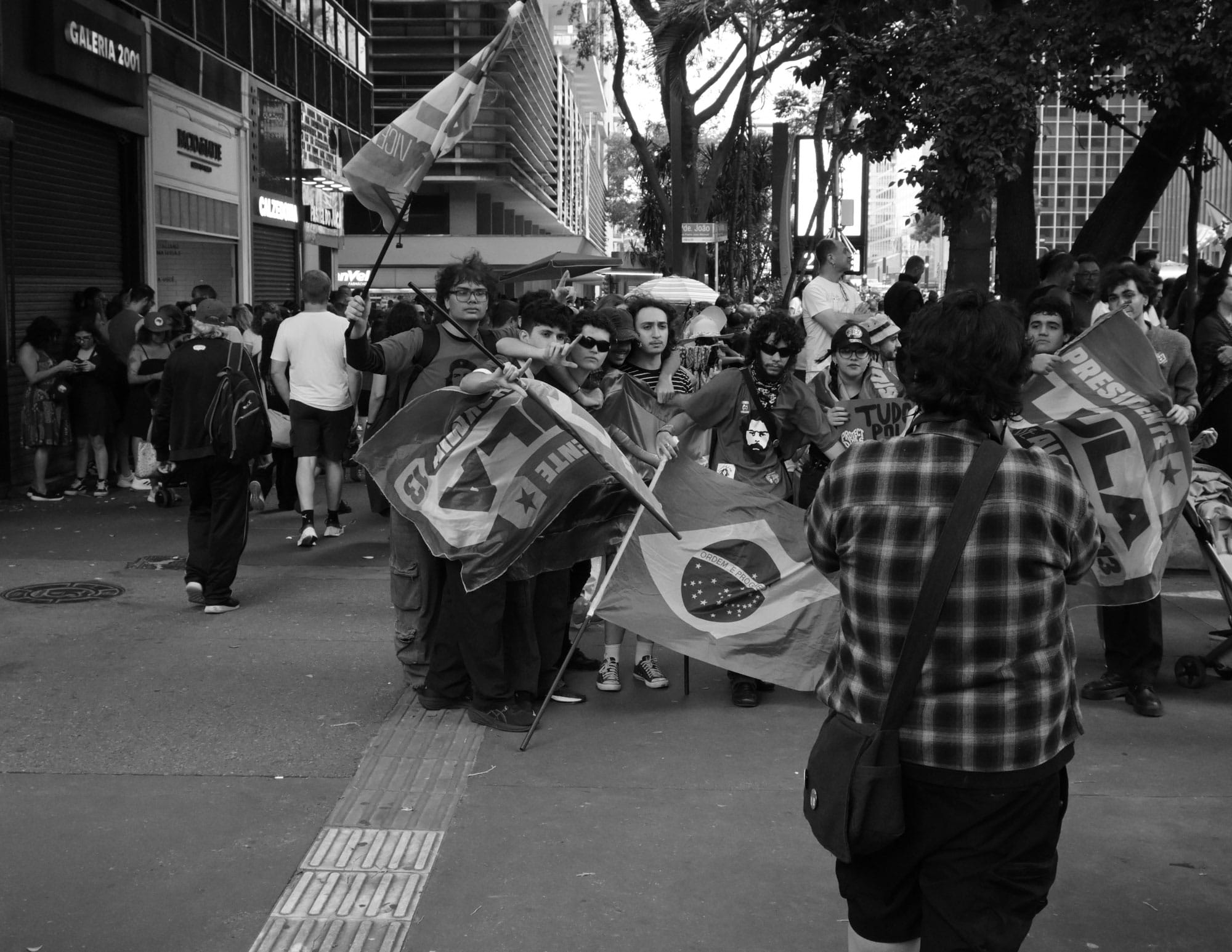
In this photograph, a group gathers behind flags, several people making gestures toward a figure seen from behind in the foreground. The scene has the appearance of a small photographic encounter taking place inside a much larger demonstration. For a moment, attention is directed toward another act of representation.
A camera can document a gathering while remaining part of the relationships through which that gathering becomes visible. The photographer's position is never entirely outside the event.
Between Evidence and Interpretation
The most difficult questions arise after the photographs have been taken. During a public demonstration, photographing the people present may seem straightforward.
They have gathered in a visible place, carrying public messages and participating in an event of political importance. Yet public visibility does not eliminate questions about representation, particularly when photographs move beyond the immediate circumstances in which they were made.
A face photographed among thousands may later appear alone on a screen, accompanied by a caption, a headline or an argument its subject has never encountered.
In Wildin's photographs, some people look toward the camera, while others remain absorbed in the movement of the demonstration. A person may be identifiable through a face, a garment or a distinctive gesture; the surrounding signs and flags may help establish the political context, but they do not necessarily describe that person's convictions in full.
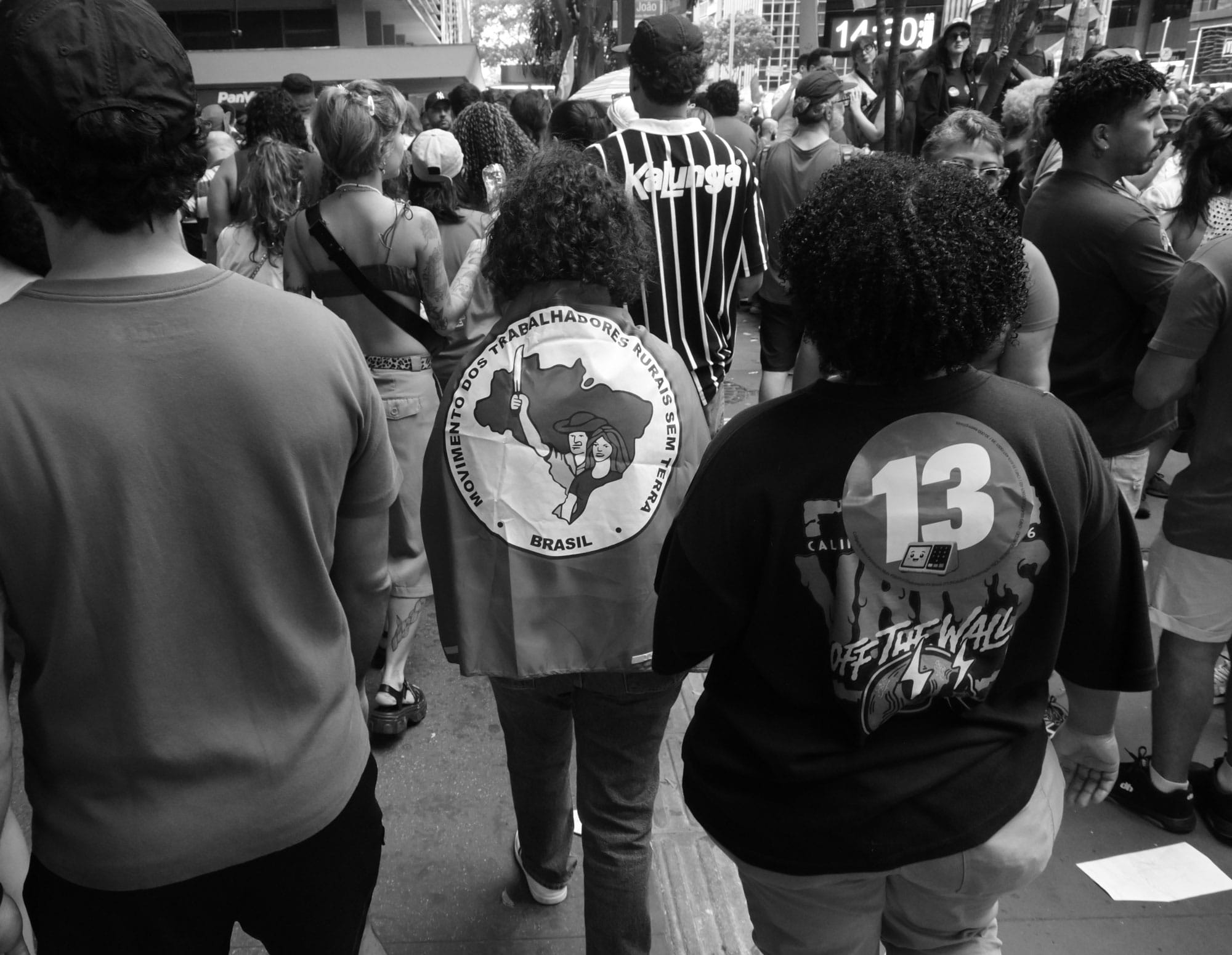
This becomes especially apparent in a photograph made from behind several participants walking through the crowd. One garment bears the emblem of Brazil's Movimento dos Trabalhadores Rurais Sem Terra (MST), the Landless Workers' Movement; another carries different symbols and lettering. The photograph documents the presence of these visual references, while leaving the individual histories of the people wearing them unknown.
Such distinctions are easily lost when images circulate quickly. A photograph can be copied, cropped, separated from its caption or placed beside a commentary that changes the reader's understanding of what is shown. The original frame may remain unchanged, while the claims made around it become increasingly distant from what the photographer actually witnessed.
Wildin has already seen his images enter different editorial settings. Urban Frontier Insights presented The Act of Looking as an observational photographic essay, concerned with the relationship between people and public space. Popular Mais, meanwhile, placed photographs from the demonstration in the context of political commentary about Brazil's electoral future.
These are different uses of documentary material. Their coexistence does not necessarily make either illegitimate, but it demonstrates why the context of publication deserves the same careful attention as the act of photographing.
Here, participants have climbed onto an elevated street structure, holding flags and a banner whose words include PELO DIREITO DE VIVER — for the right to live.
They have made themselves visible in the city and in Wildin's photograph. The political message is part of the evidence; the people holding it remain individuals whose circumstances cannot be entirely understood from a single frame.
A caption should help the reader know what can be known. It should provide the date, place and relevant context, identify visible actions, and acknowledge uncertainty where necessary. Its authority comes from the accuracy of its claims, rather than the confidence of its language.
A Different Perspective
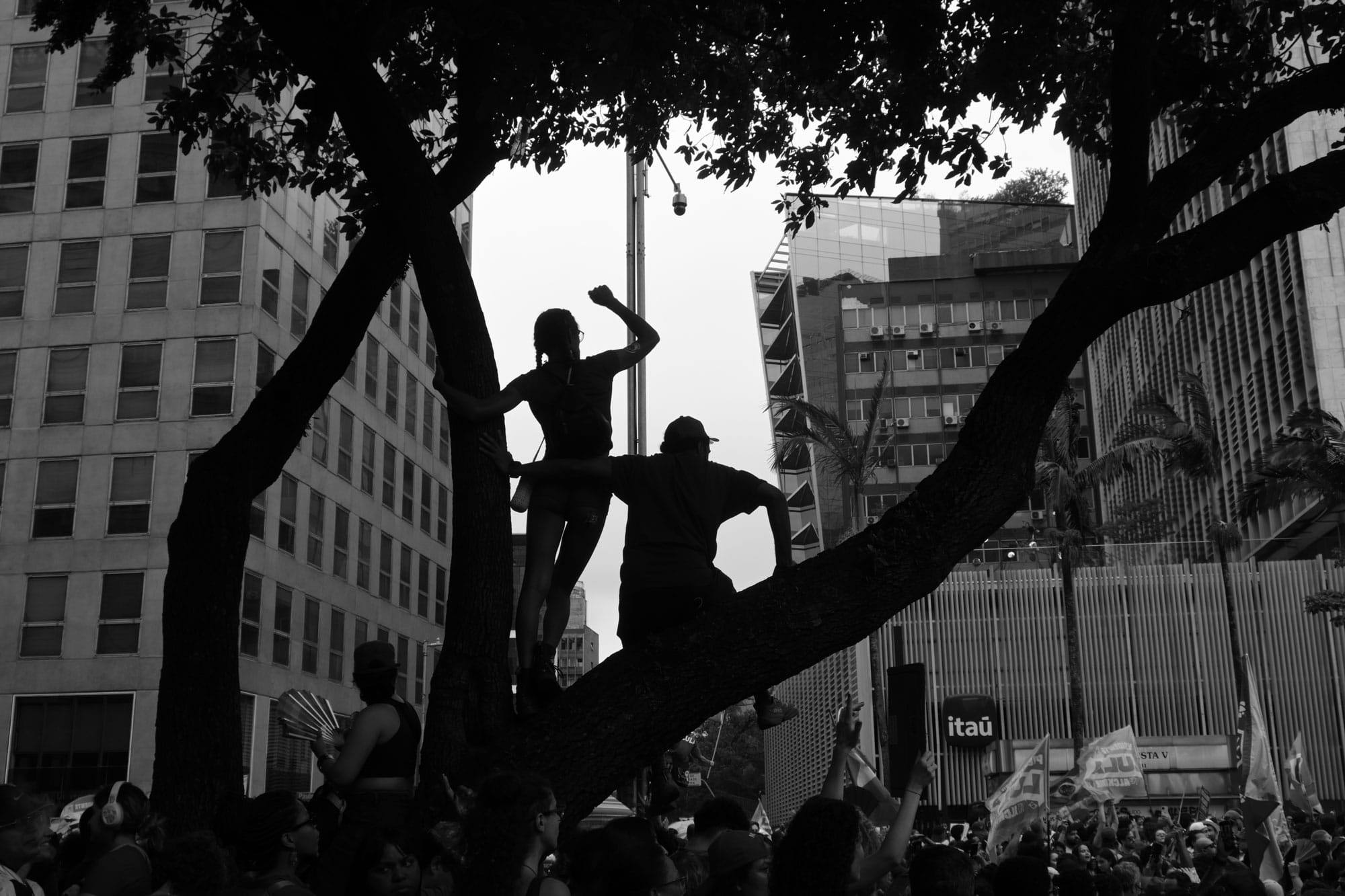
Toward the end of the series, the street offers an unusual vantage point. Several people have climbed into the branches of a large tree. Their figures are dark against the lighter buildings beyond, and one person raises an arm above the crowd below. The thick branches occupy much of the frame, dividing the city into irregular openings through which other details become visible.
It is a remarkable photograph because the demonstration itself has almost disappeared beneath the people observing it. We see the observers, the place from which they look, and part of the urban landscape beyond them. The political gathering continues outside much of the visible frame.
We do not know why the individuals climbed the tree. They may have been seeking a better view, a place above the crowd, or simply a different position within a densely occupied street. The image permits several interpretations without establishing any of them. Its strength comes partly from that uncertainty.
For Wildin, who has chosen to develop his documentary practice through sustained projects and repeated visits rather than isolated encounters, such questions are becoming central to his work. His interest extends beyond the visible subject toward the circumstances in which photographs are made and the ways their meaning changes when they reach new audiences.
The photographs from Avenida Paulista record a particular afternoon in Brazilian political life. They preserve the presence of people who assembled publicly, carrying messages, recording events, meeting others, and making use of a street that belongs to the everyday life of their city.
They also reveal something about the work of the photographer. Every frame is a decision about where to stand, what to include, and what deserves attention. Each decision makes something visible while leaving something else outside the picture.
In describing his practice, Wildin writes: "Looking carefully is a way of listening." Perhaps this is where the lasting value of The Act of Looking lies. Its photographs invite us to observe a political gathering without pretending that observation gives us complete access to the people within it.
They ask us to attend to what is present, to recognize what remains uncertain, and to accept that a documentary photograph can be both valuable evidence and an incomplete account.
The people in the tree have found another place from which to see the avenue. The photographer, somewhere below, has found a place from which to see them. Neither position offers the whole picture.
From the Photographer's Notebook
I was drawn to the relationships between the individual and the crowd, and between the demonstration's temporary occupation of space and the more permanent architecture of Avenida Paulista.
Reviewing the work raised a further question for me: what does a photograph actually establish, and what do we merely infer from it?
I can photograph a man raising his phone to record a demonstration; I cannot know from the image alone whether he is preserving a memory, expressing political conviction or sending a picture to someone elsewhere. The photograph records an action, not necessarily an intention.
Neil Wildin
All photographs: Avenida Paulista, São Paulo, Brazil, October 11, 2026. © Neil Wildin.


Member discussion