


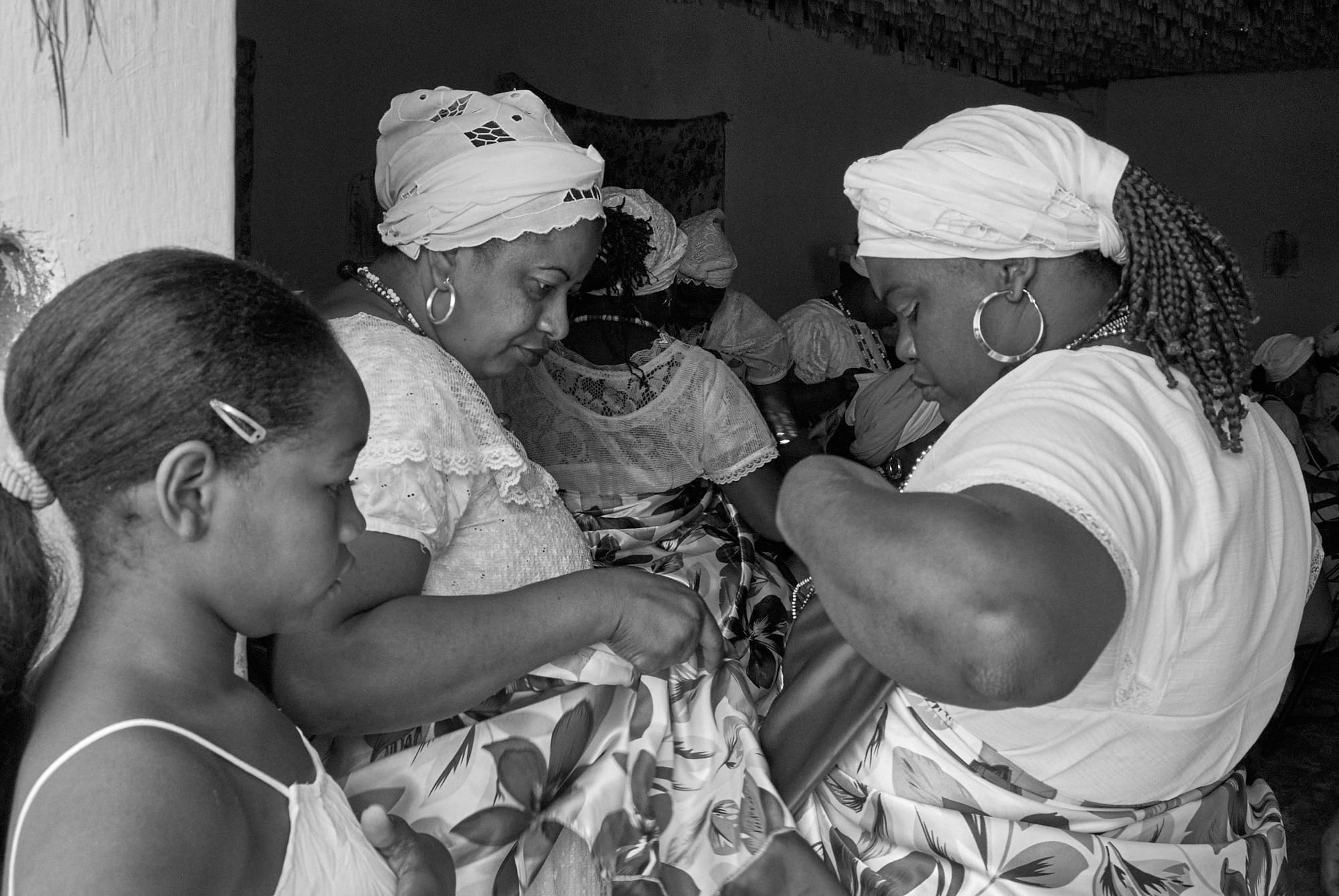
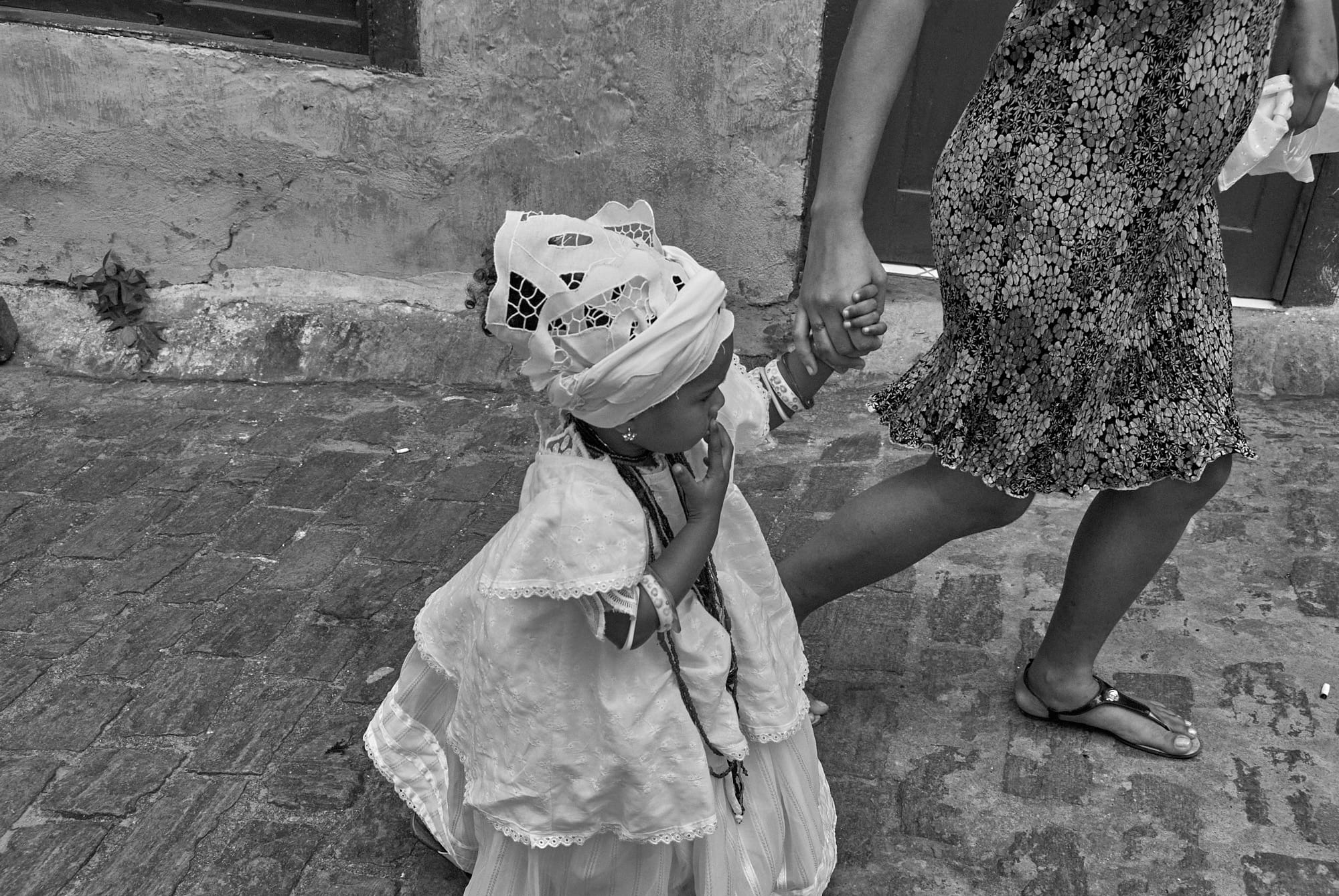
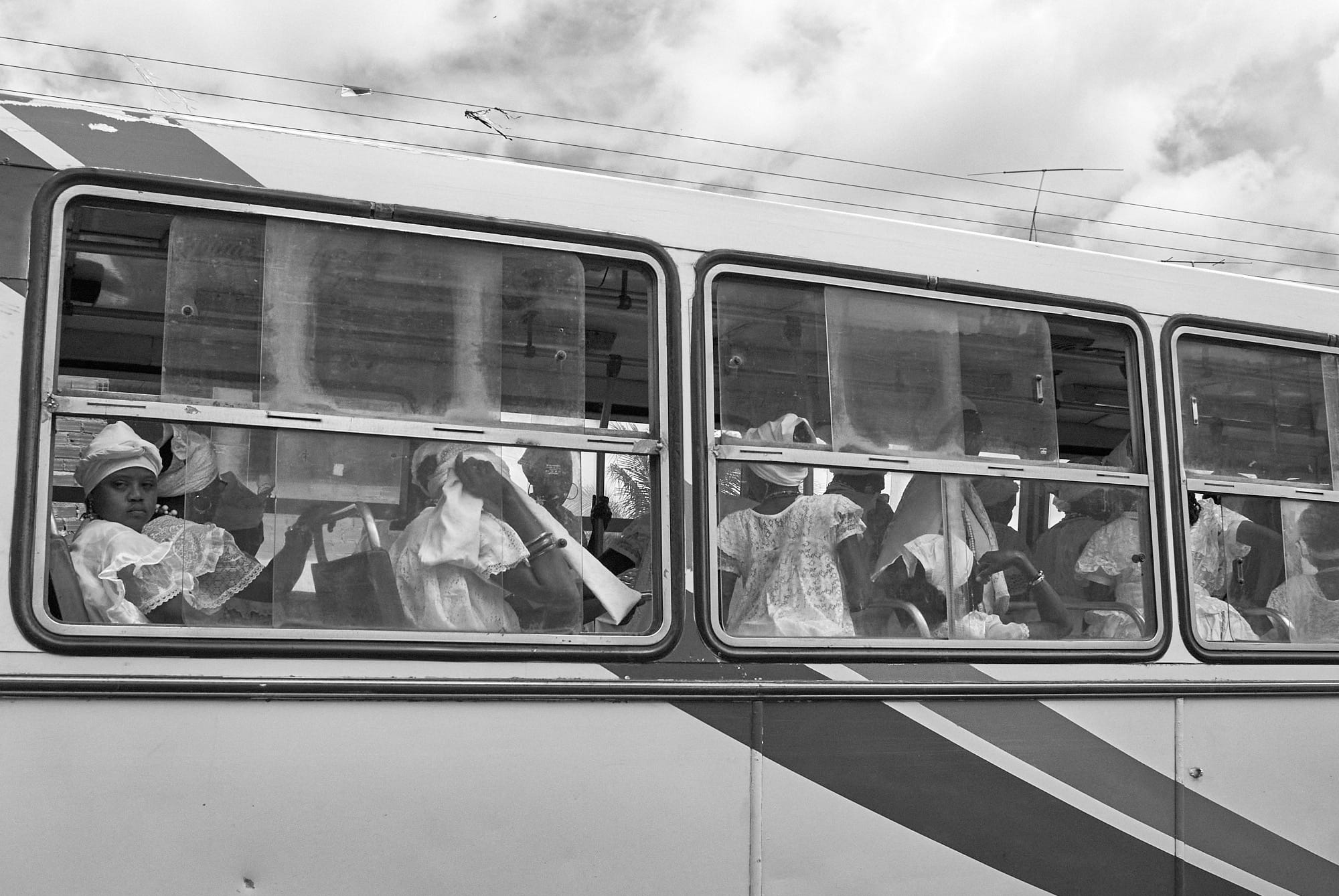
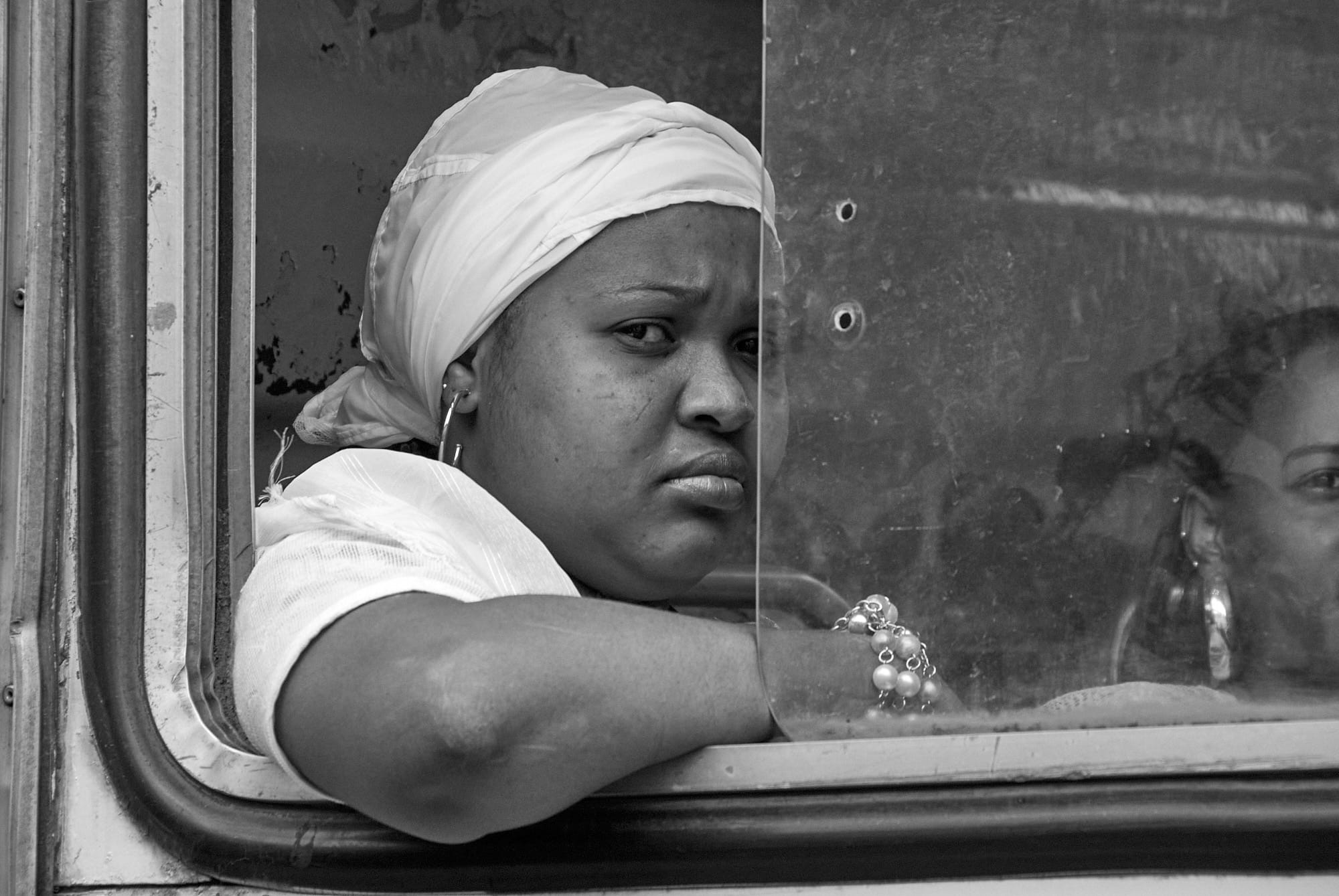
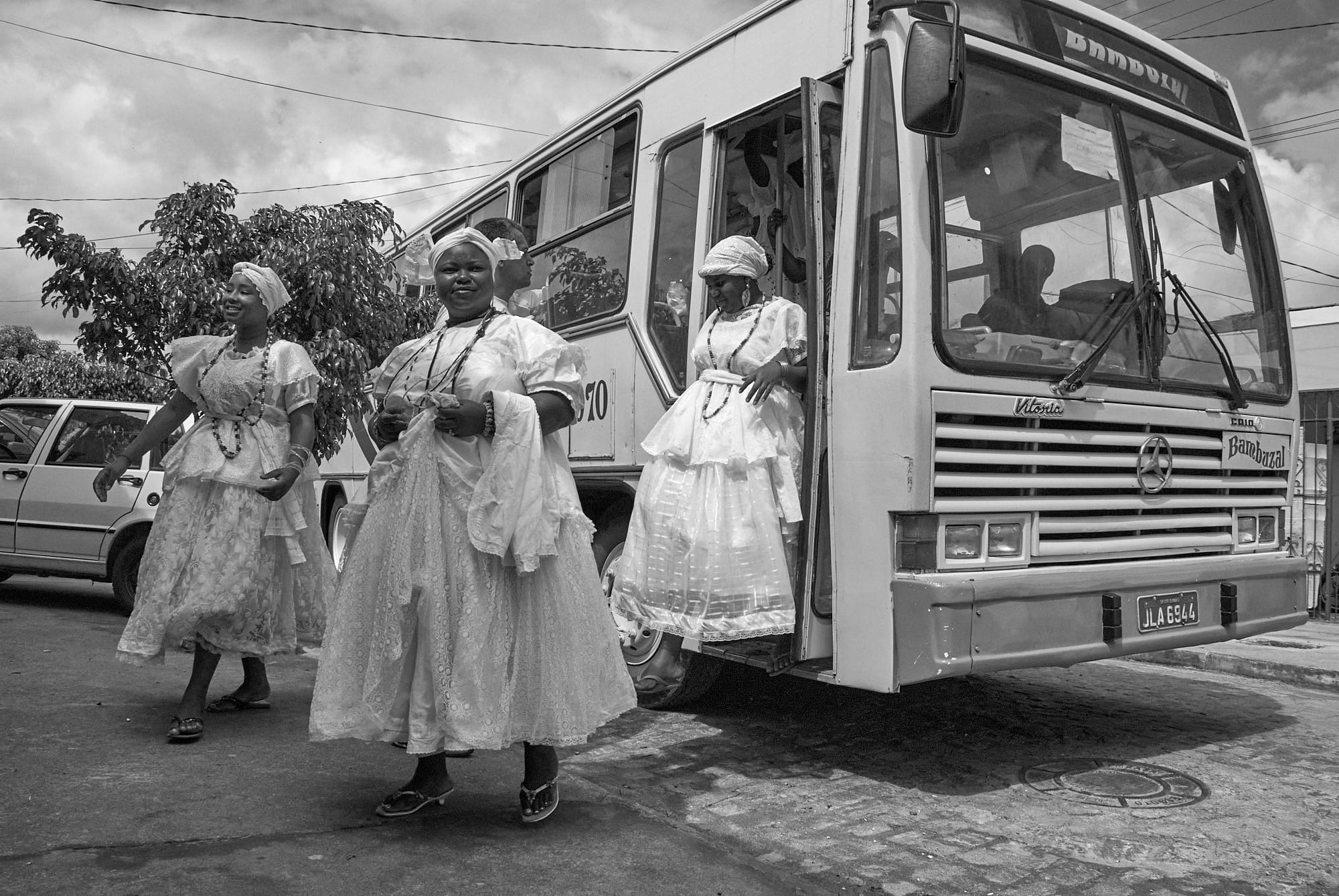
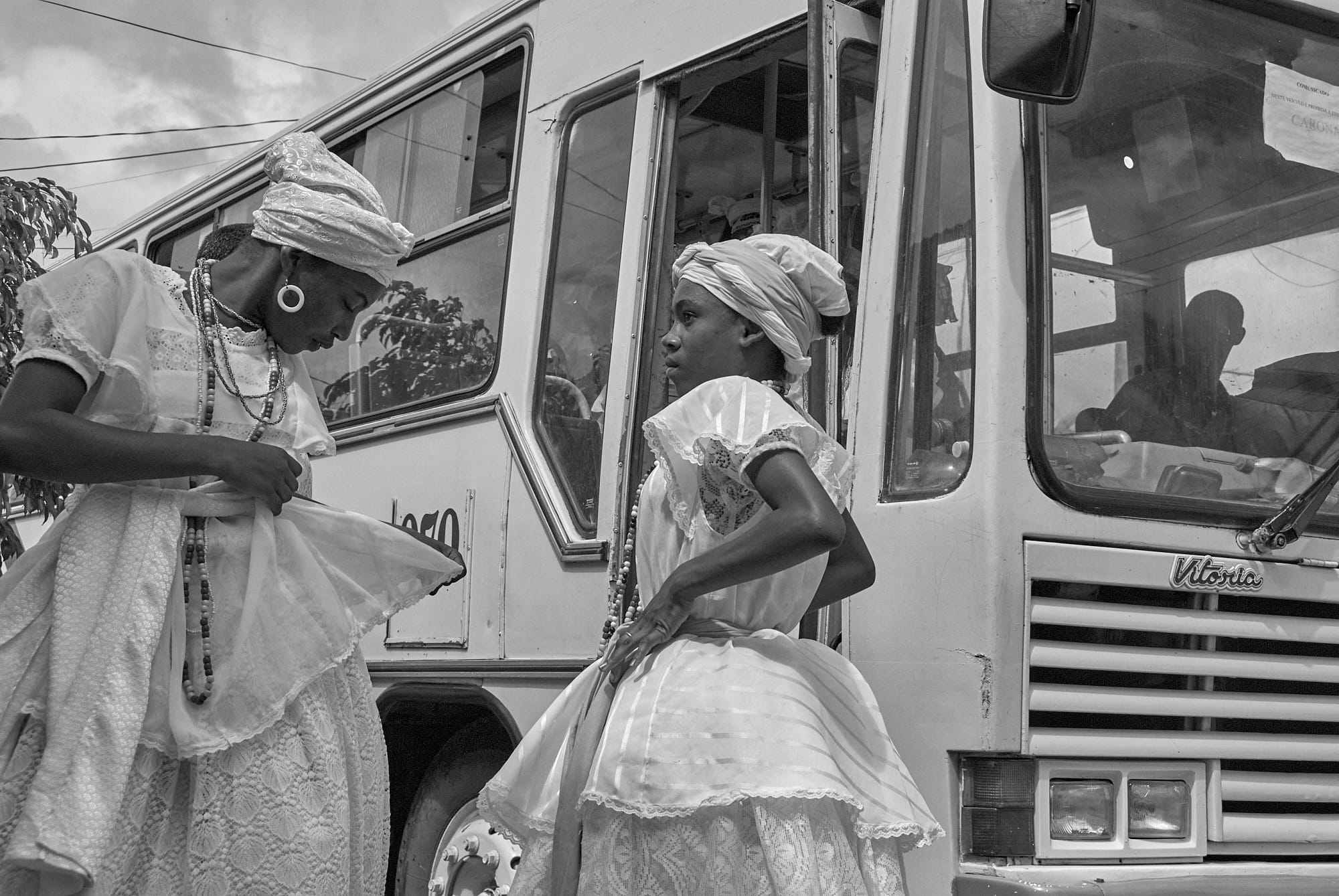
Before there is a procession, there are dresses to arrange. A woman holds another woman’s skirt while the fabric is pulled into place; beads are adjusted, headwraps retied, someone waits beside a bus, someone else leans from its open window.
Later there will be candles, flowers, statues carried through the streets, music, prayers and crowds, but a religious celebration is also made from these smaller gestures, from hands helping other hands prepare.
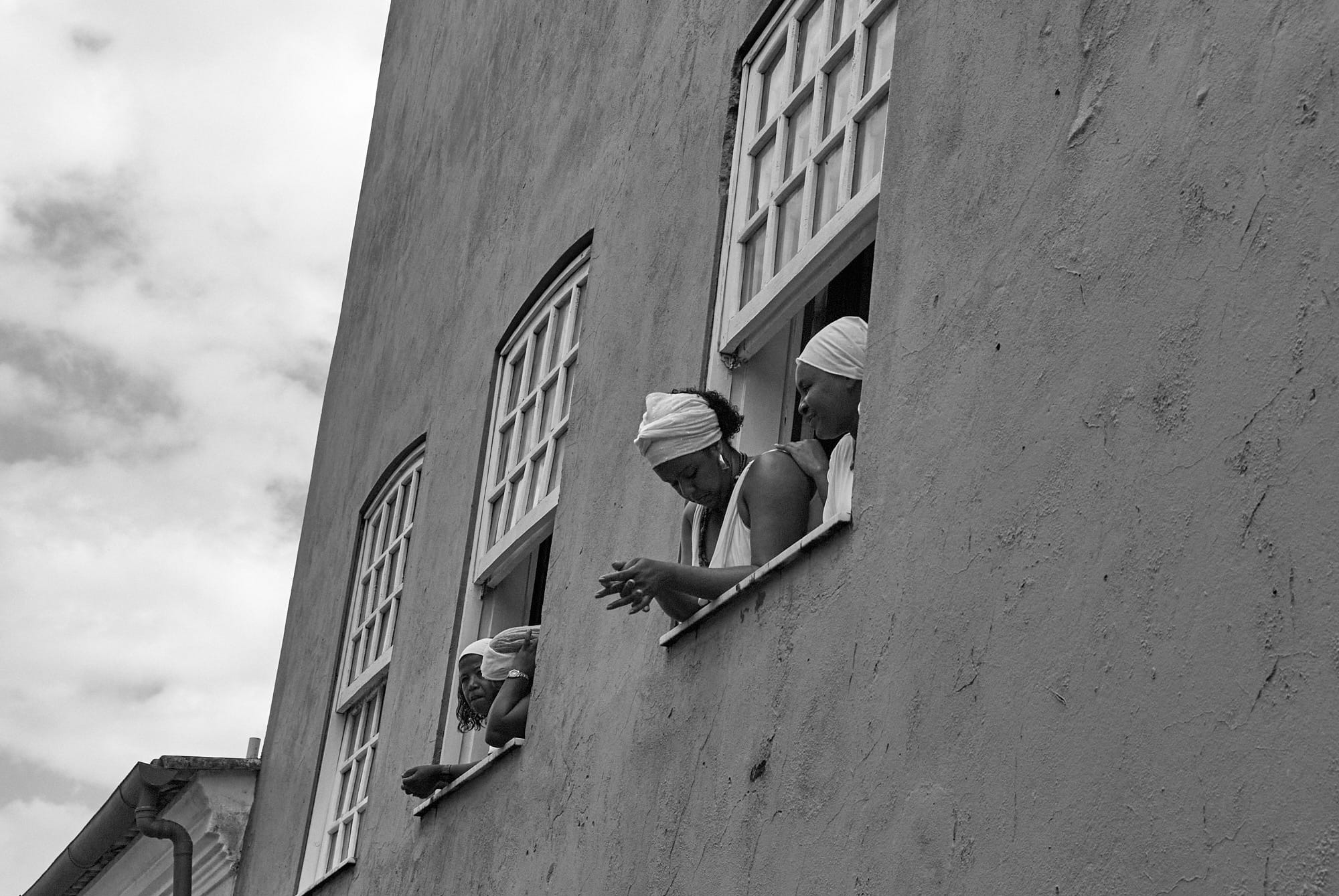
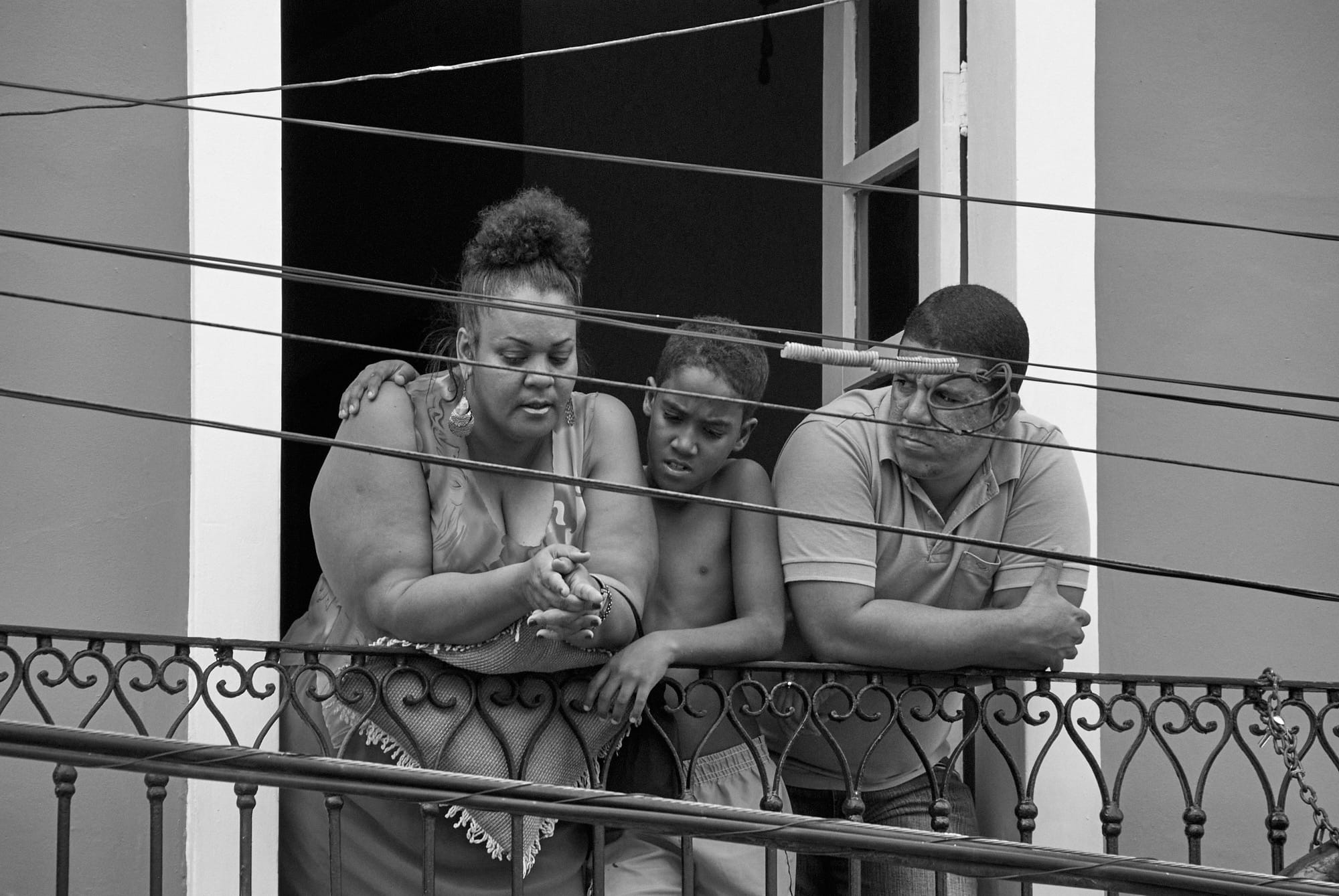
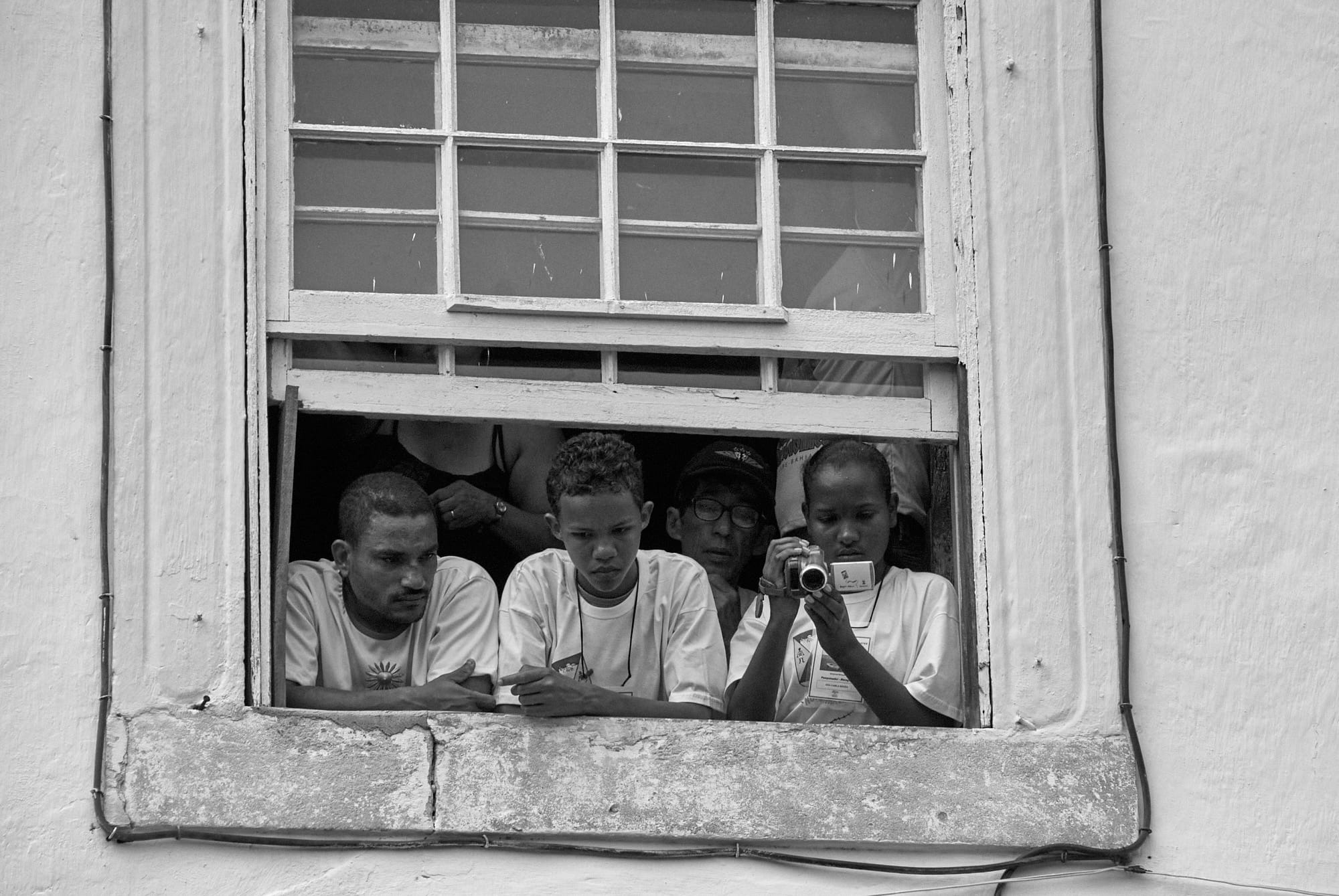
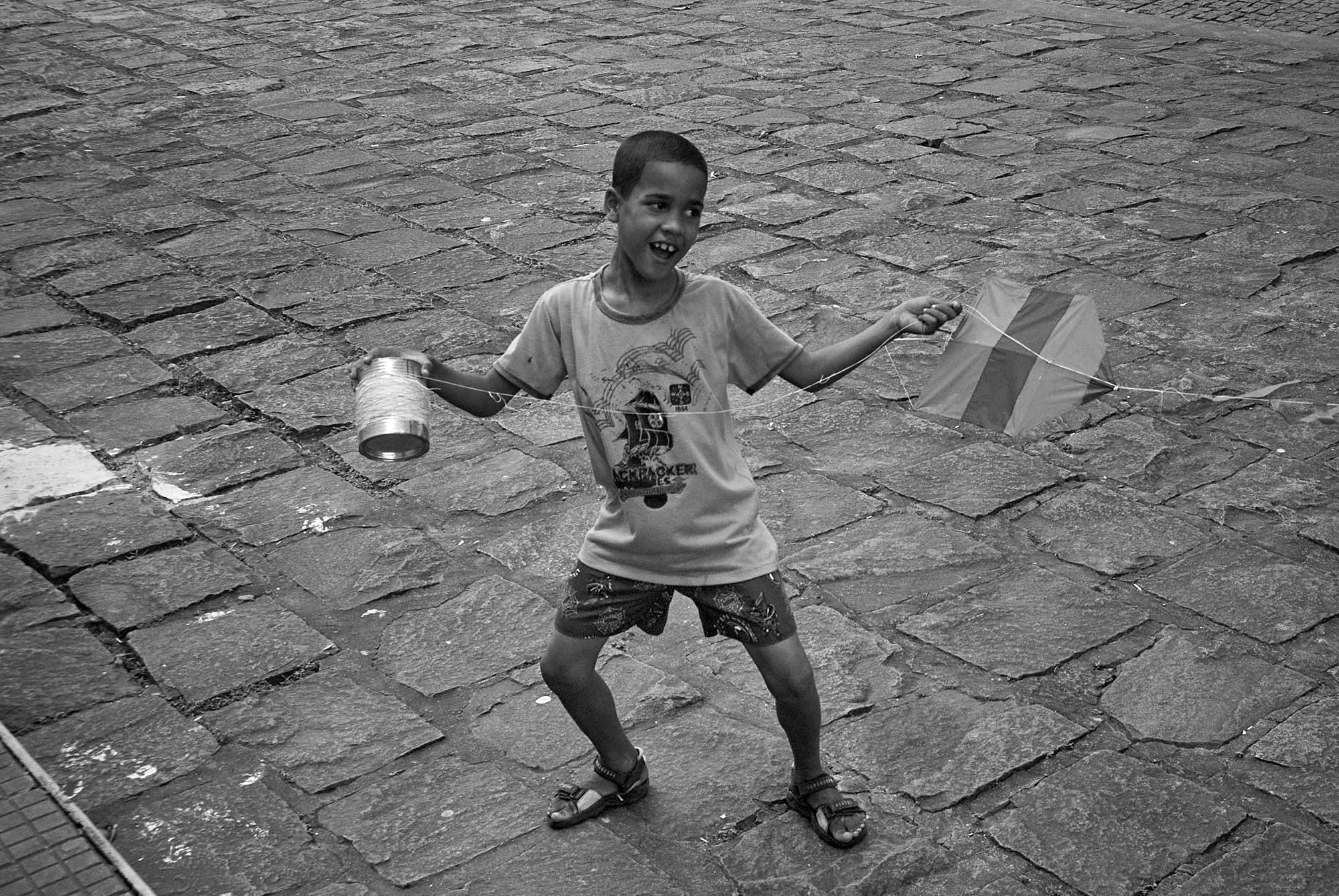
Around them, Cachoeira continues with its day. People appear at windows and balconies; a boy plays with a kite in the street, musicians wait with their instruments, families watch from above, people smoke, talk, photograph one another, disappear into the crowd.
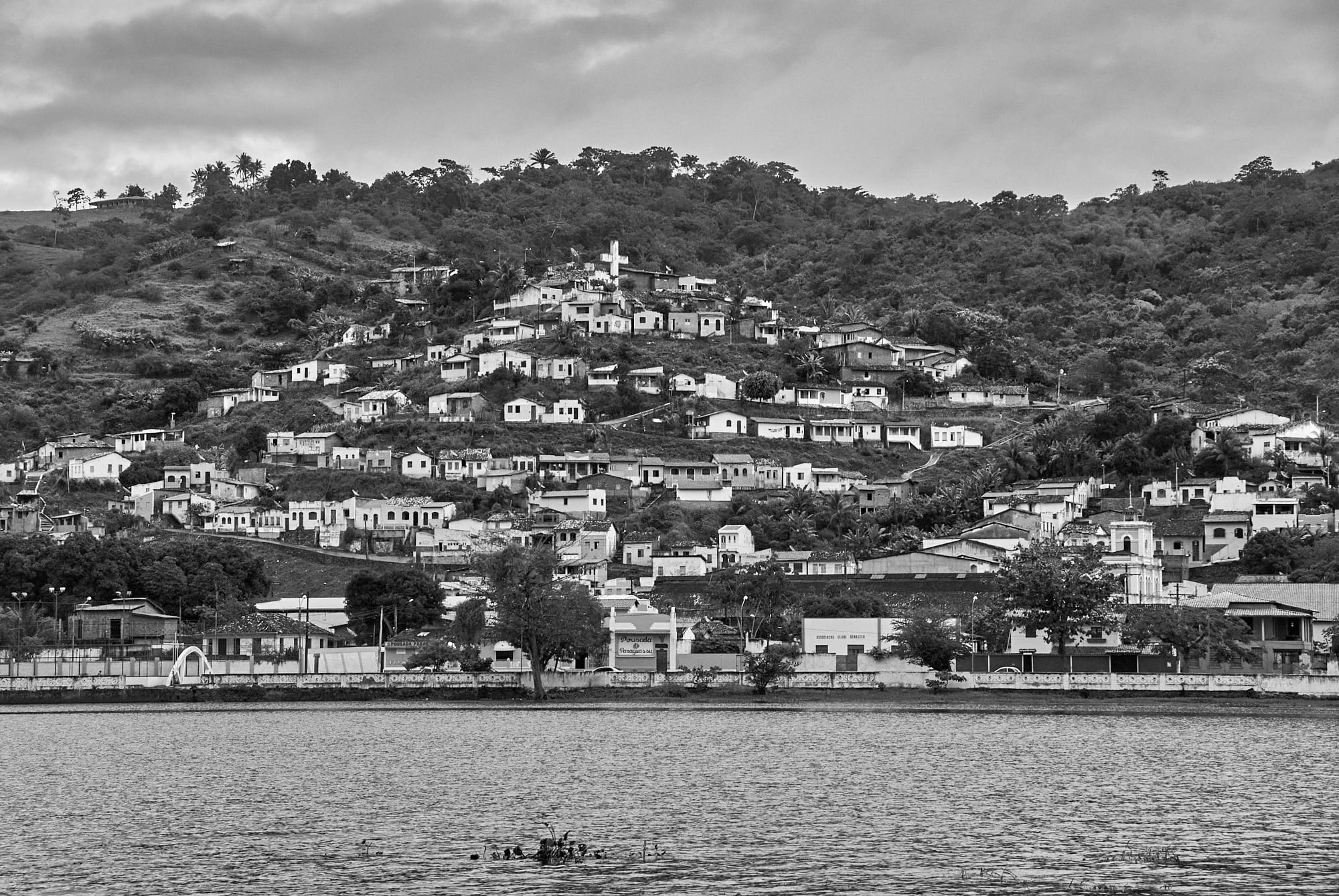
Women dressed in white cross streets where cars are still parked and electrical wires still hang above colonial façades; the sacred does not replace ordinary life, it passes through it.
This is perhaps the first thing worth understanding about the Festa da Boa Morte: it cannot be separated neatly from the city that holds it.
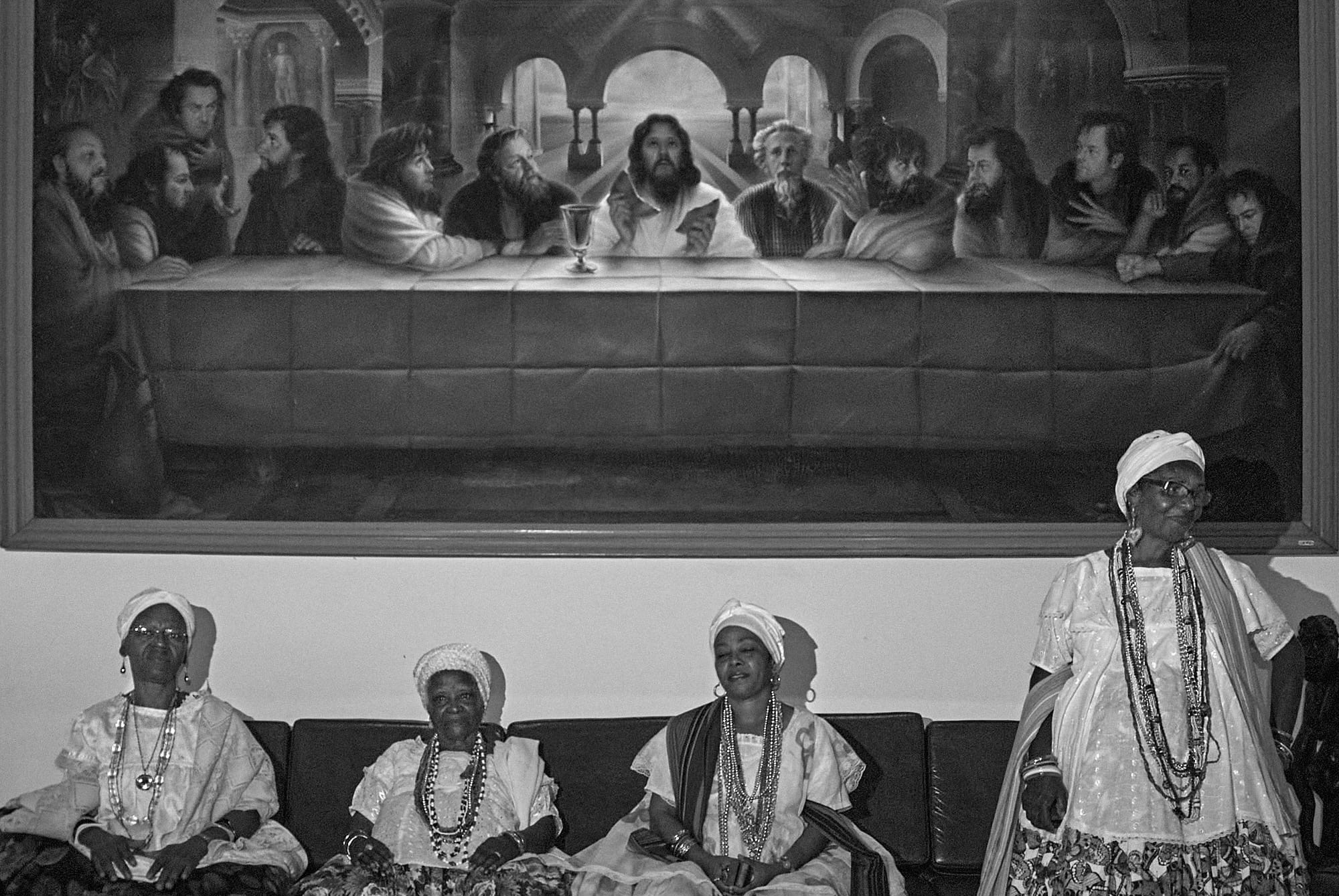
Each August, in Cachoeira, in Bahia’s Recôncavo, the women of the Irmandade de Nossa Senhora da Boa Morte — the Sisterhood of Our Lady of the Good Death — move again through these streets.
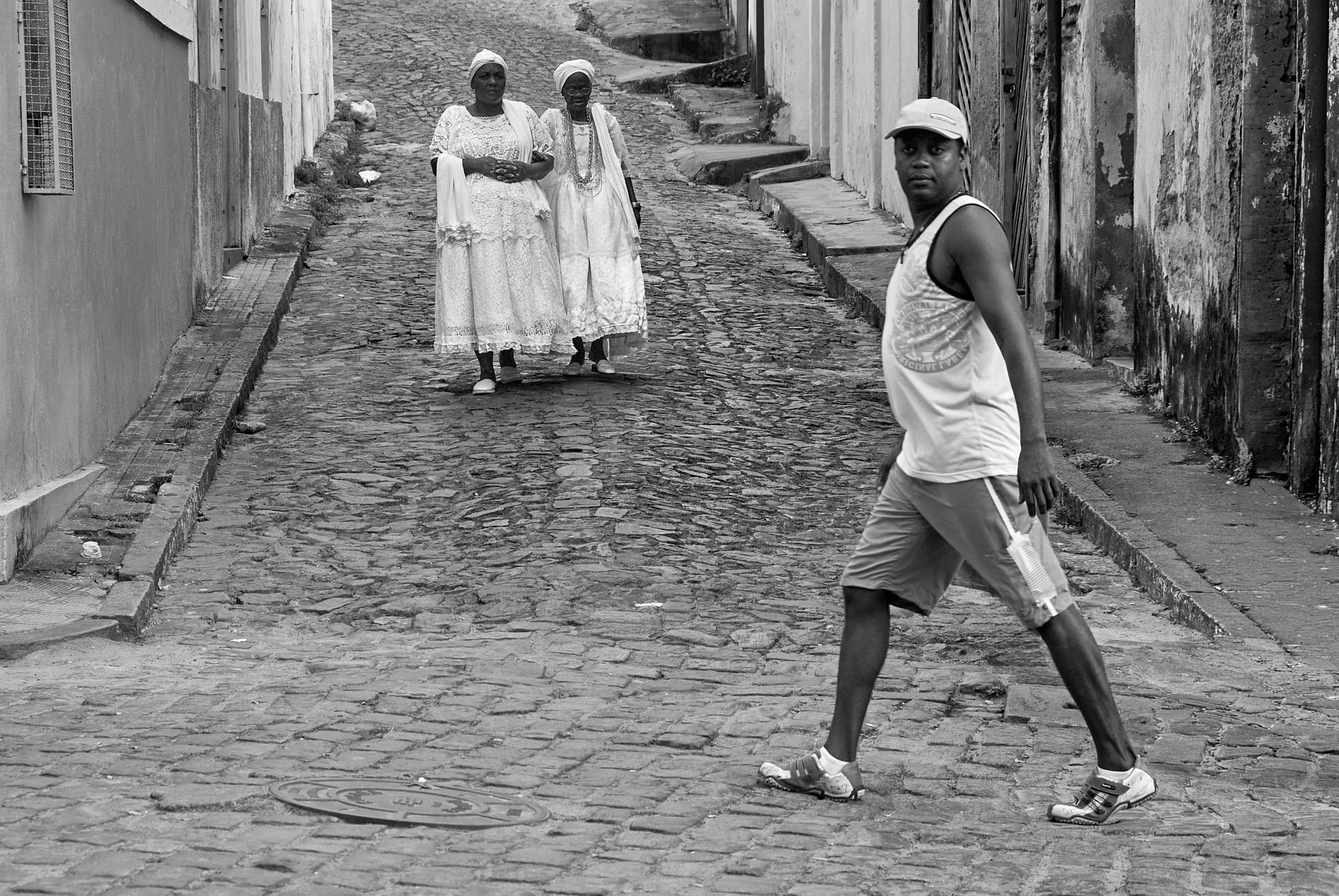
Their celebration follows a ritual sequence centred on remembrance, the death of the Virgin, her Assumption and glory; on August 13 the sisters commemorate those who have died, on the following night they process with the image of Nossa Senhora da Boa Morte.
On August 15 Nossa Senhora da Glória is carried through the town, accompanied by local philharmonic bands. The celebrations continue with communal meals and samba de roda.
A visitor can see all of this. Seeing it, however, is not the same as understanding it. And understanding it does not mean believing that everything must be explained.
A Sisterhood Built by Black Women
The history of Cachoeira is inseparable from the history of the Recôncavo, the fertile region surrounding the Bay of All Saints where sugar and tobacco generated enormous wealth under Portuguese colonial rule.
That wealth depended heavily on enslaved African labor; Cachoeira became an important commercial and river centre within that economy, connecting plantations and inland production with Salvador and the Atlantic world.
The streets through which the sisters walk today therefore hold another geography beneath the visible one: the geography of forced migration, labor, survival and emancipation. It was within this world that Black women created the Irmandade da Boa Morte.
Its precise beginnings resist the simplicity we often demand from historical narratives. Official heritage documentation in Bahia records an earlier association with Salvador’s Church of Barroquinha and notes that oral tradition places the Irmandade’s arrival in Cachoeira around 1820; the sisters themselves preserve a tradition connecting the devotion to a plea by African women to Our Lady of the Good Death for an end to slavery.
What matters is not to turn an uncertain founding date into a convenient legend, but to understand what these women built.
Religious confraternities were among the few institutional spaces available to Black people in slaveholding Brazil, yet the Boa Morte was distinctive in being organised by women.
It created a network of spiritual obligation, mutual assistance, social recognition and material support in a society structured to deny Black women almost every form of formal power.
Bahian heritage research also records the Irmandade’s role in helping enslaved Black women obtain freedom, including through the purchase of letters of manumission. This detail changes the meaning of the word sisterhood.
It was not simply a devotional association where women prayed together; faith became infrastructure. Money could be gathered, relationships activated, funerals organised, members protected, memories kept, obligations transmitted.
Religion was not detached from material life because, for women living under slavery and its aftermath, material life could never be detached from questions of dignity, autonomy and survival.
The Irmandade endured because it was able to make community tangible. Two centuries later, that may be one of the most radical things about it.
The Space Between the Virgin and the Orixás
Visitors are often told that the Boa Morte is an example of religious syncretism, a meeting between Catholicism and Candomblé. The description is not wrong, but it can become dangerously easy.
It encourages us to imagine two separate religions that were once placed side by side and then mixed together, as though cultures were ingredients and history were a recipe. The lived reality is more complicated.
Research on the Irmandade describes women who have historically participated both in Catholic devotion and in Candomblé; academic work likewise stresses the relationship between the confraternity, Marian worship and Afro-Brazilian religious practice.
That relationship was shaped inside a society in which enslaved and free Africans and their descendants had to negotiate institutions controlled by others, while preserving spiritual systems, social structures and forms of knowledge of their own.
But it would be another simplification to say that Catholicism was merely a disguise and that an untouched African religion survived underneath it. Cultures do not pass through centuries unchanged, nor does survival require purity.
What developed in Bahia belonged to the people who created it there: African memories and cosmologies, Catholic devotions, Brazilian history, violence, adaptation, invention and continuity all became part of a religious world that cannot be understood simply by separating what is “African” from what is “European.”
The women of the Boa Morte did something more sophisticated than choose between identities offered to them by history; they inhabited several worlds and made those worlds their own.
This is also why a visitor should resist the impulse to decode every object, gesture or correspondence.
Tourism has taught us to value access. We want the hidden room, the secret ritual, the local explanation, the experience unavailable to everybody else; increasingly, the word authentic has become part of that economy, promising that if we travel far enough, or pay enough, the world will finally reveal itself without mediation.
But there are traditions in which opacity is not a failure of hospitality. Some knowledge belongs first to the people who carry it. Respect sometimes means being welcomed without believing that welcome gives us ownership.
The People at the Windows
There is another way of understanding the Boa Morte, and it appears at the edges of the celebration. Look away from the procession for a moment.
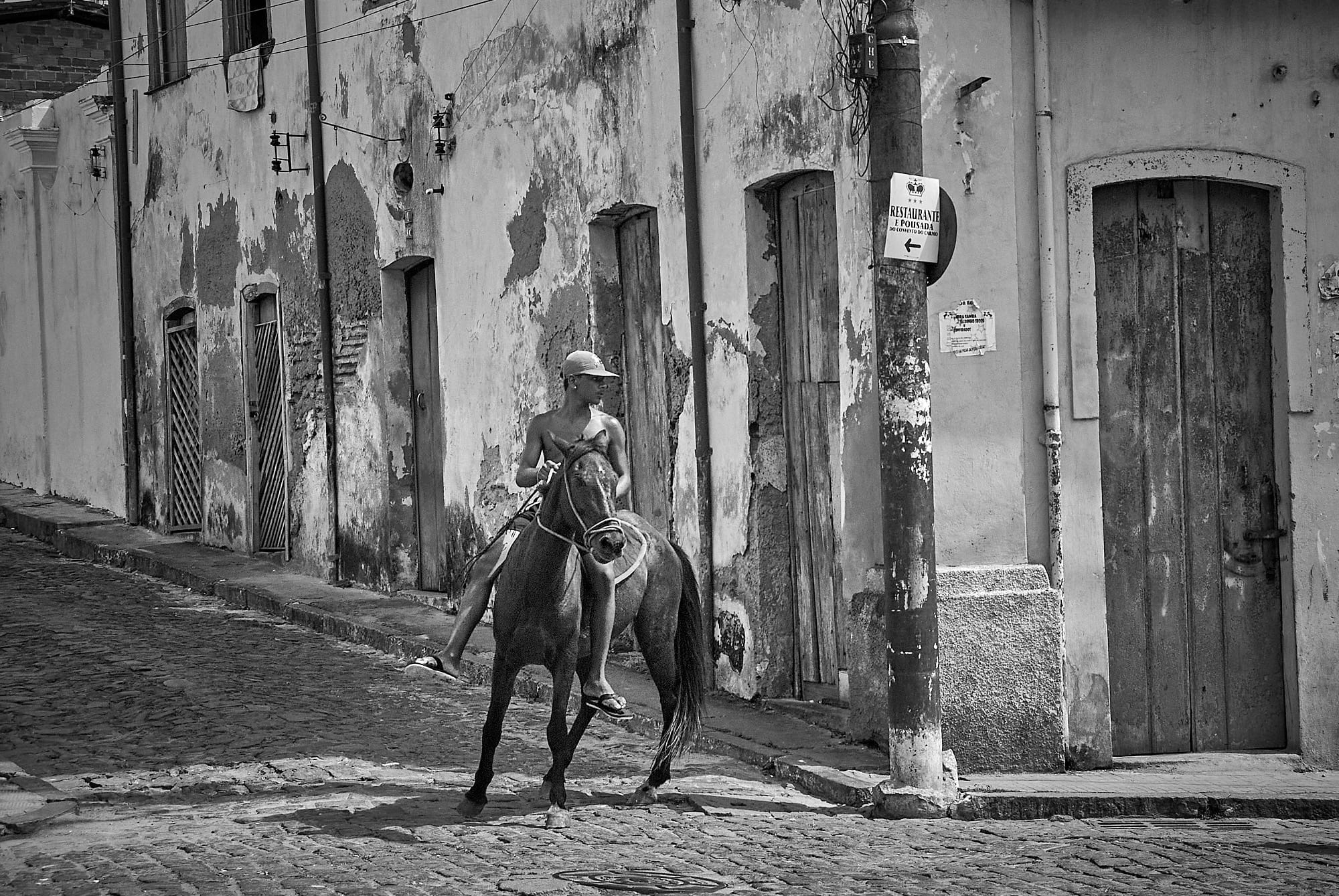
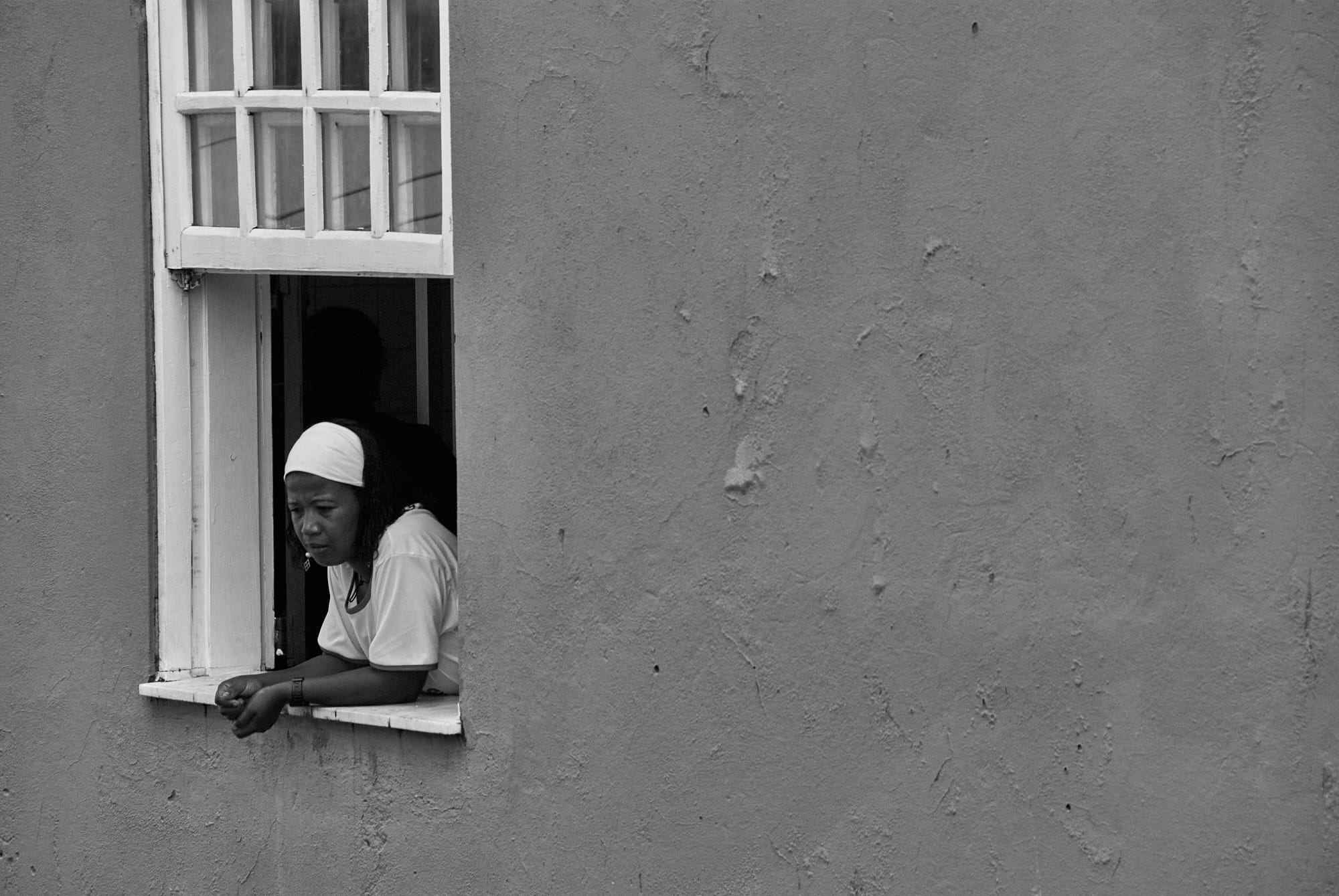
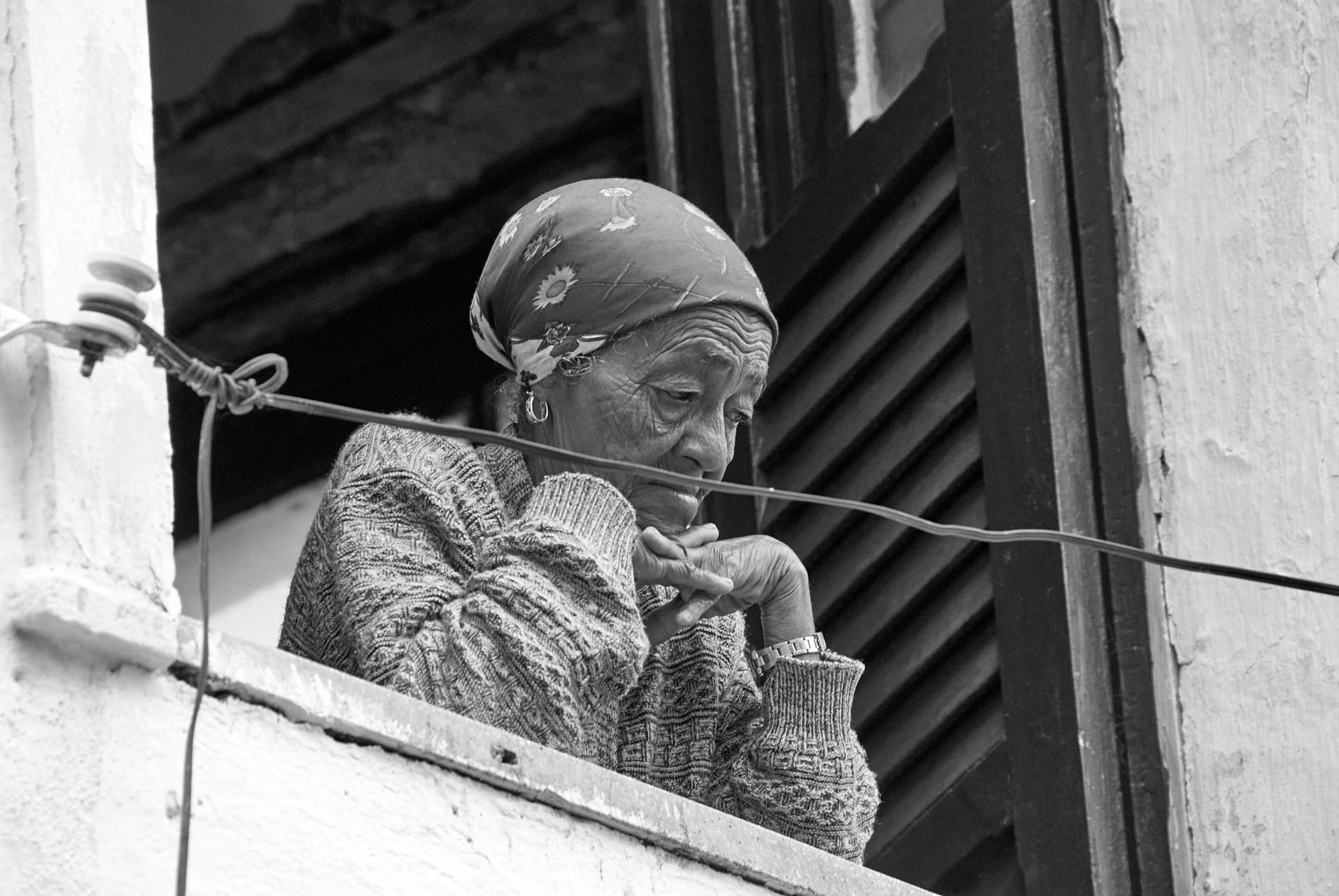
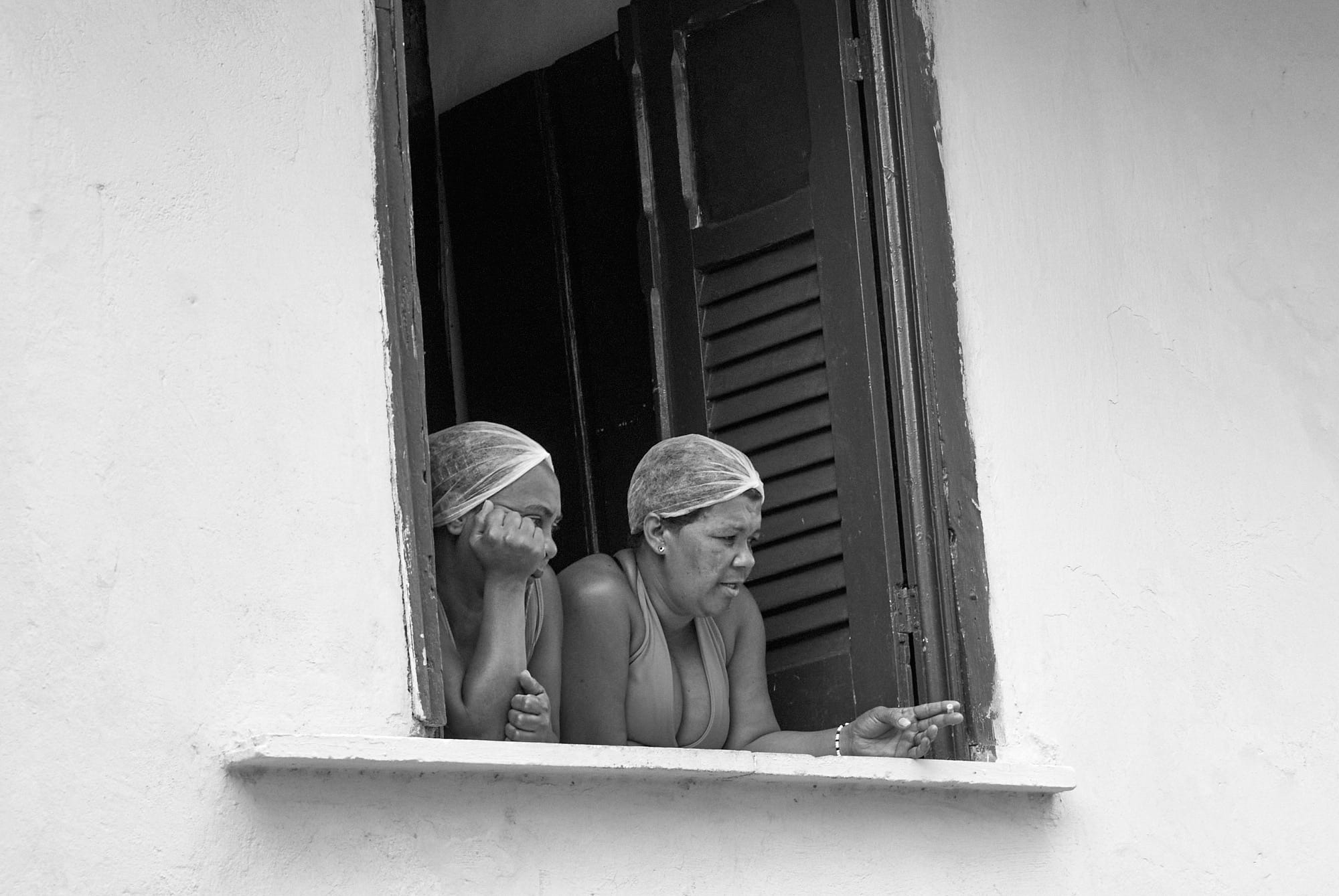
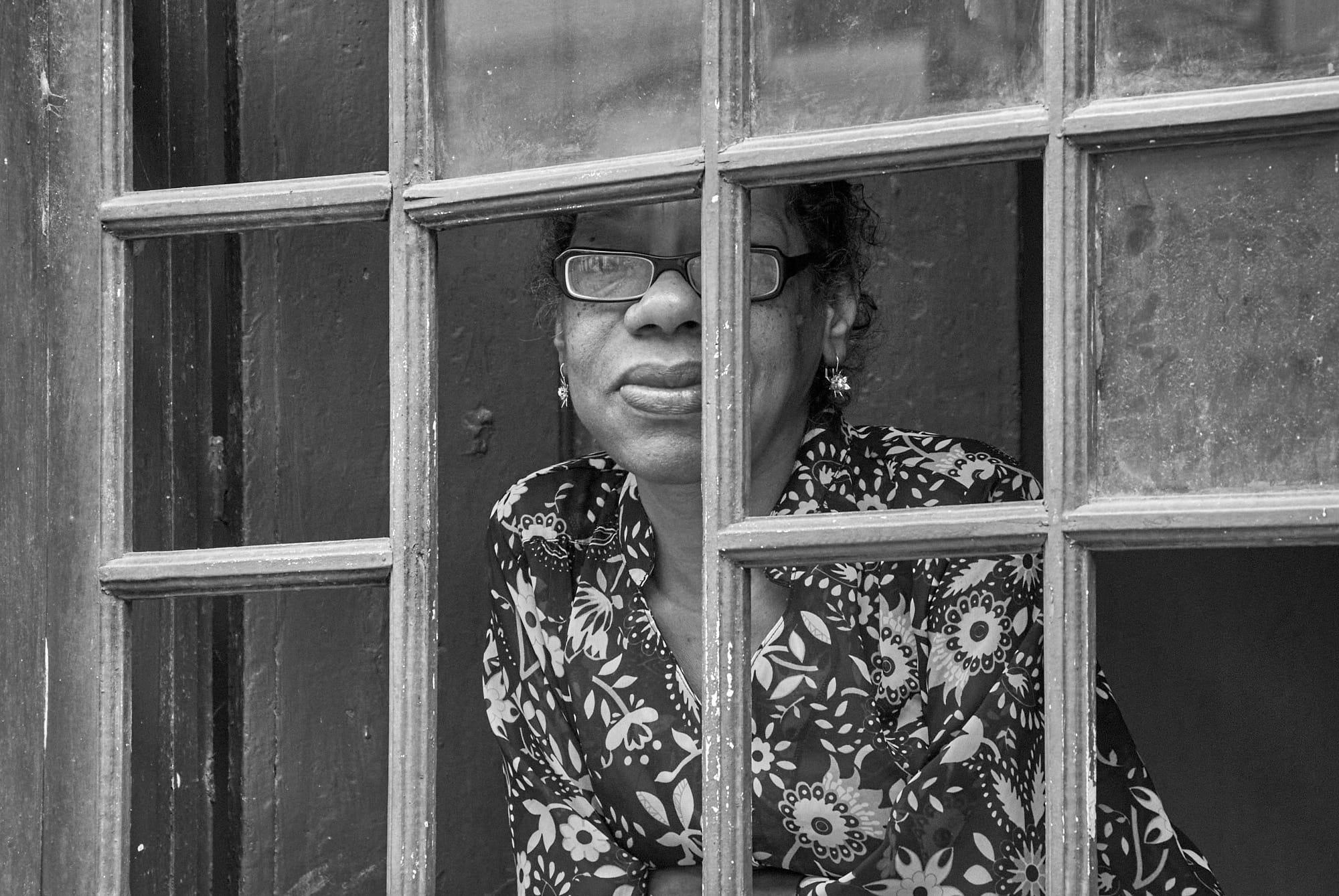
A woman watches from an open window, resting her chin on her hands; somewhere else, several people lean out together from the upper floor of a building. A family stands behind the cables crossing a balcony. A child holds an umbrella. Another boy walks down an empty street carrying a homemade kite and a tin of string.
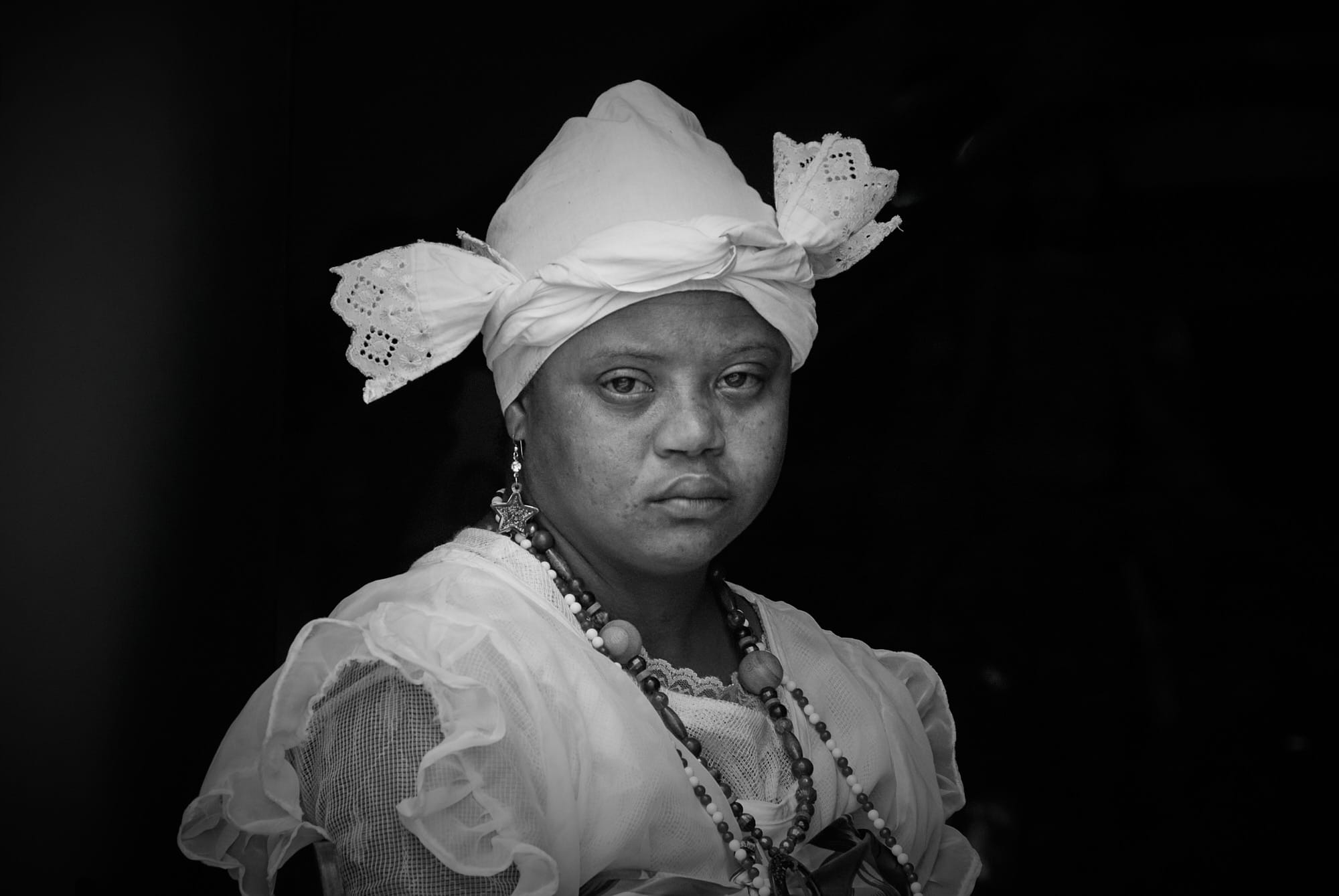
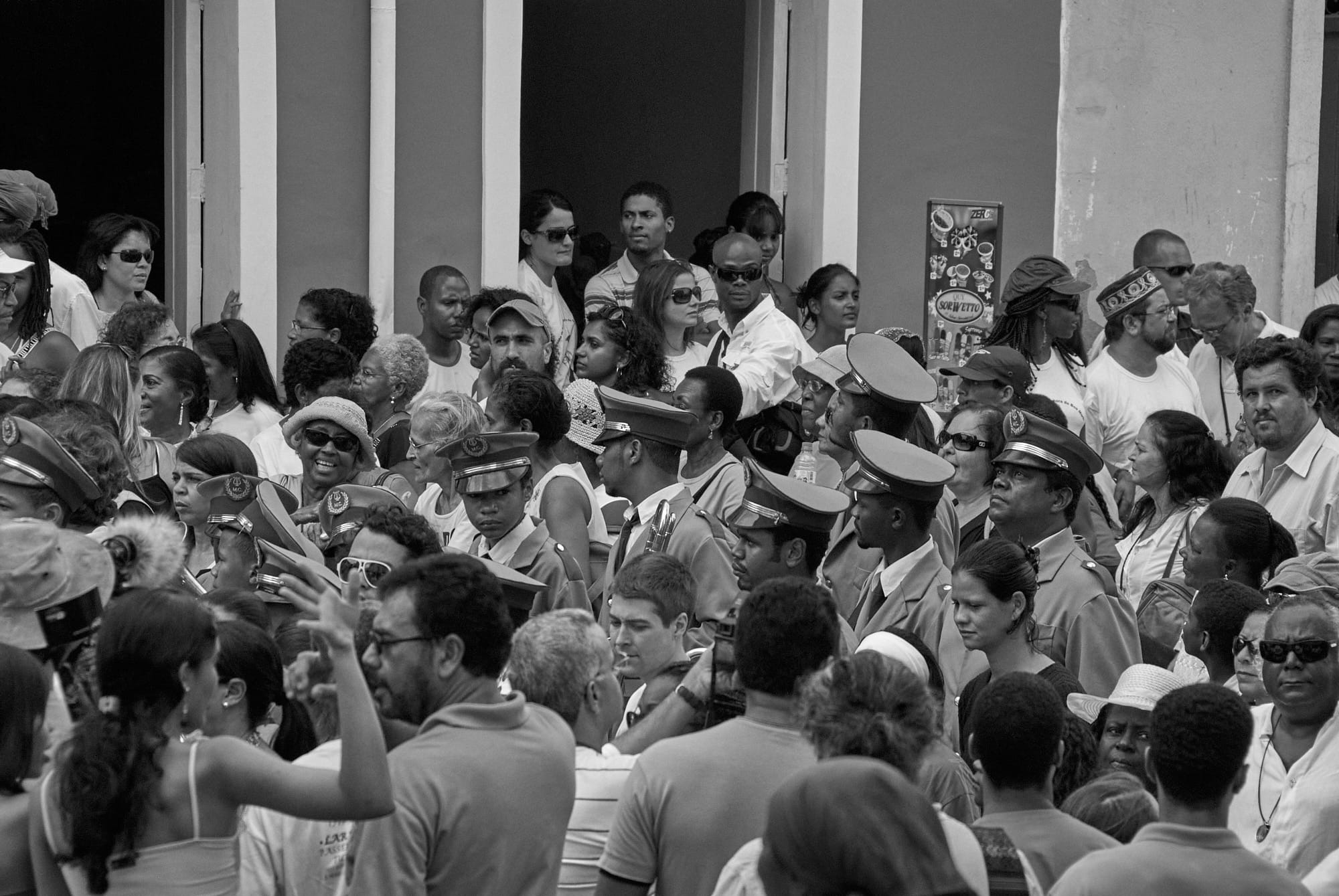
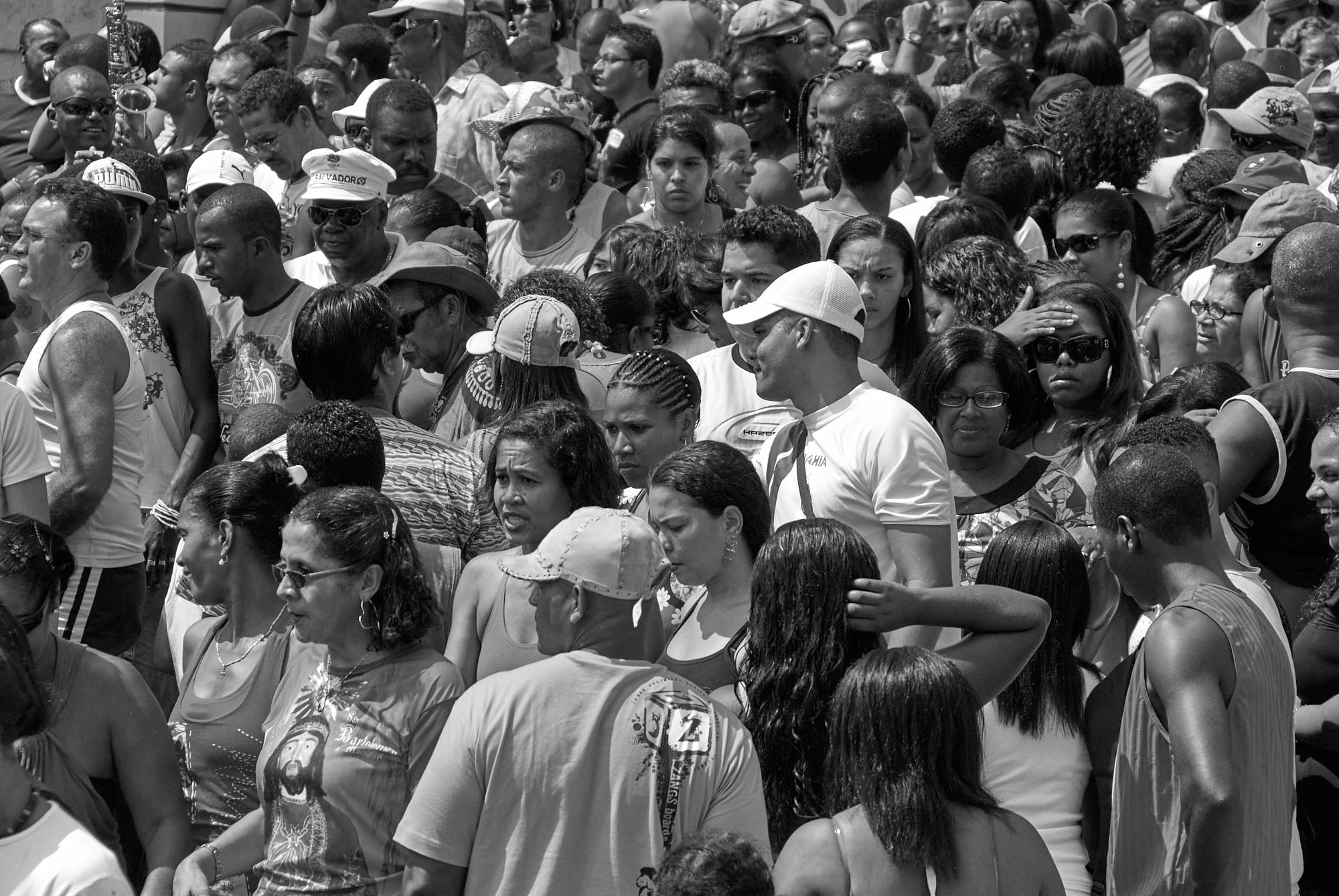
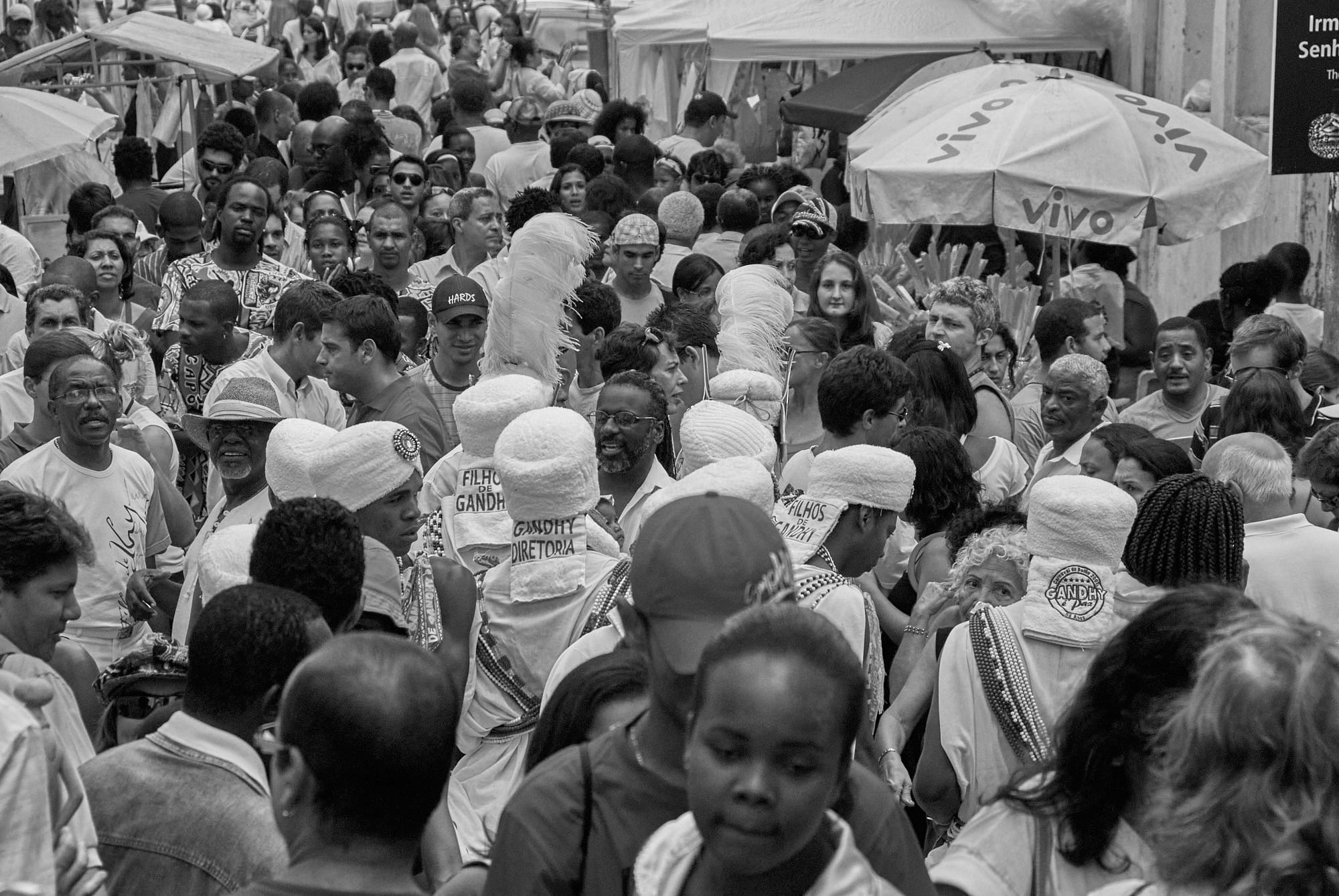
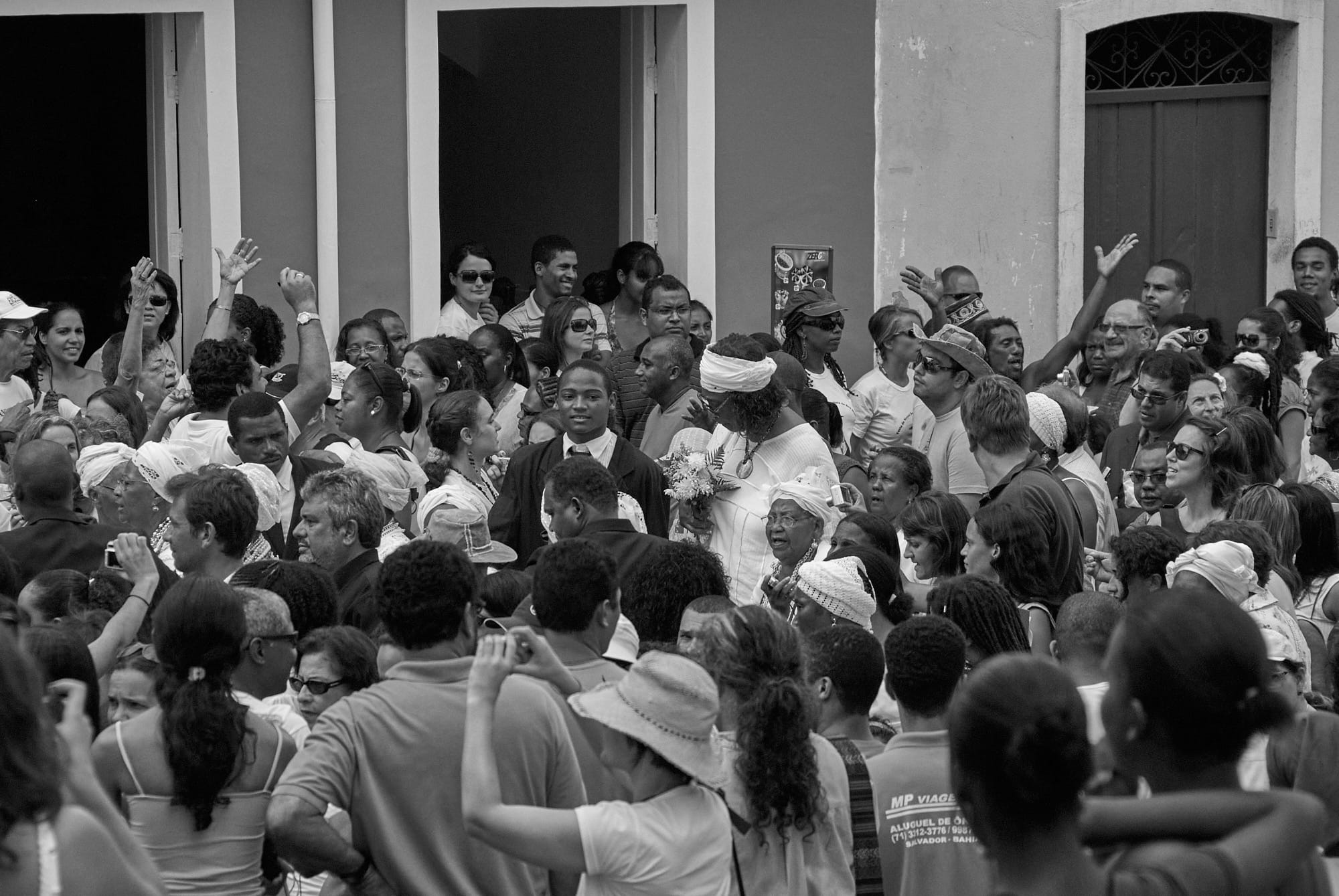
Then the crowd closes again. There are musicians and uniforms, cameras raised above heads, white dresses emerging between ordinary clothes; Indigenous participants pass through the gathering, children move beside adults, elderly women wait, young people laugh.
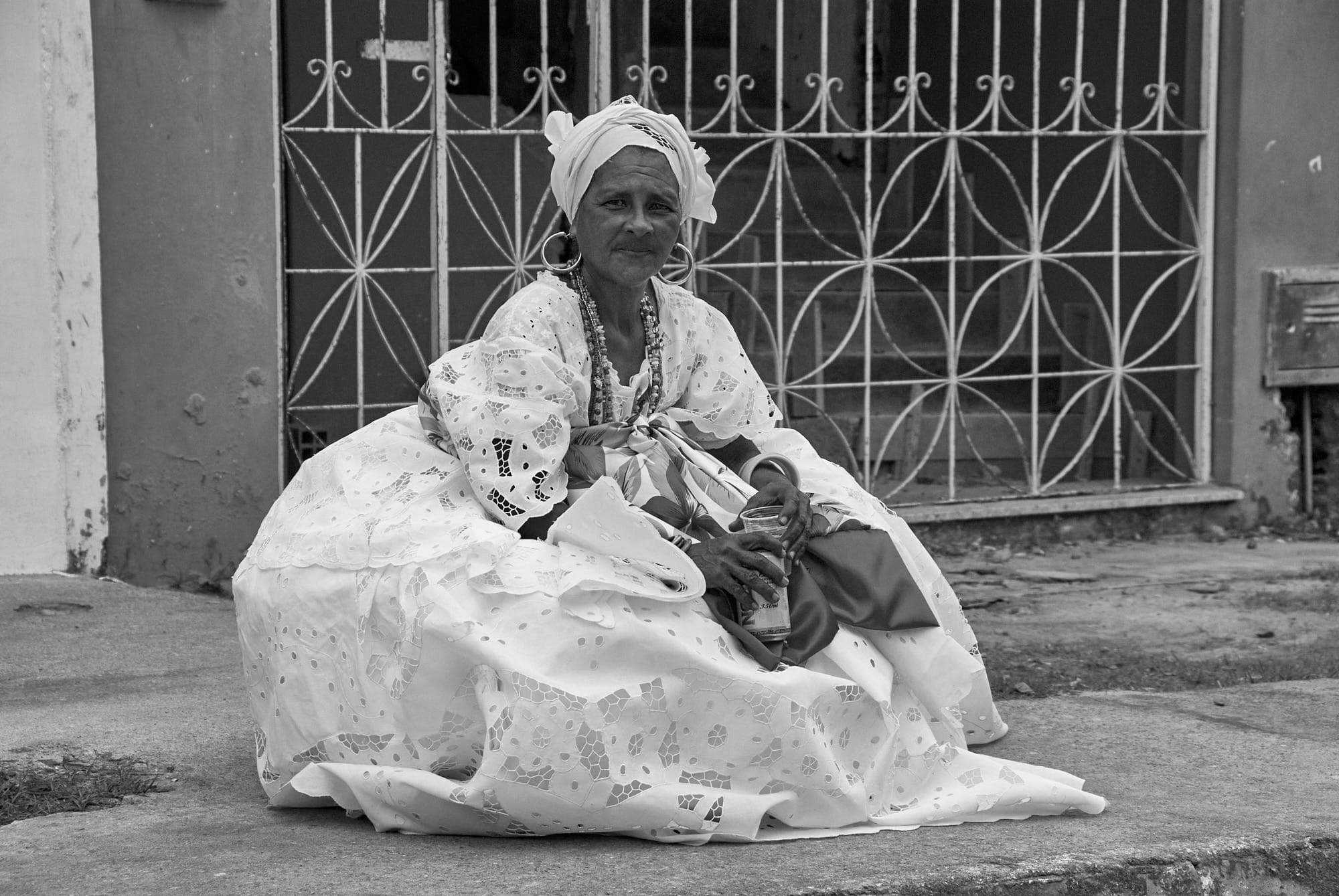
In one moment the Virgin rises above the crowd, covered in flowers; in another, a woman of the Irmandade sits on the pavement with a drink in her hands.
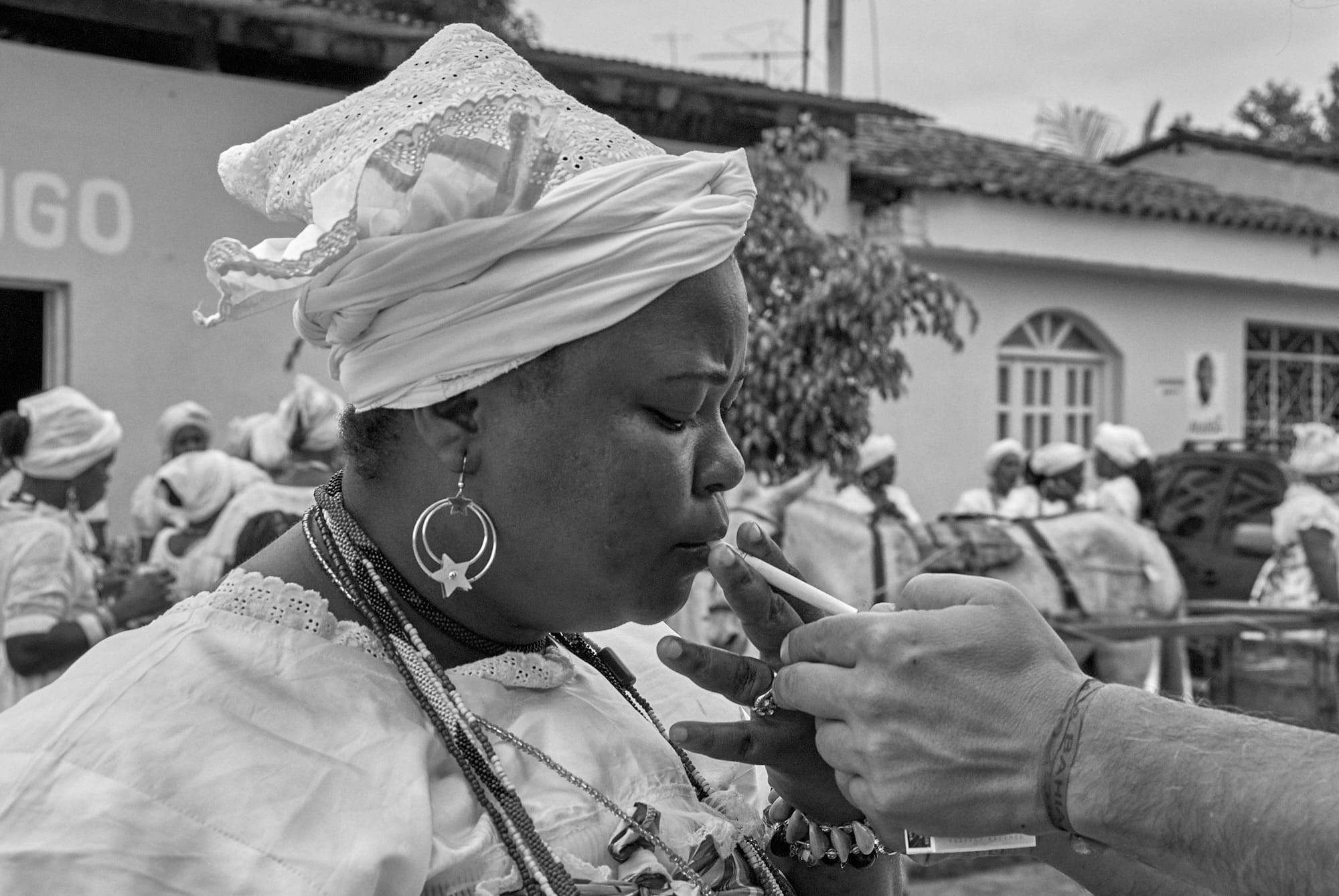
Later, someone lights another woman’s cigarette. Nothing remarkable happens, which is precisely why the moment matters.
The easiest way to make a photograph of a religious tradition is to search constantly for the exceptional: ceremonial clothing, dramatic gestures, sacred objects, expressions of devotion.
The result can be visually powerful and still tell a very poor story, because people gradually disappear behind the symbols that make them interesting to outsiders.
Claudio Maria Lerario’s photographs of the Boa Morte keep moving in the opposite direction.
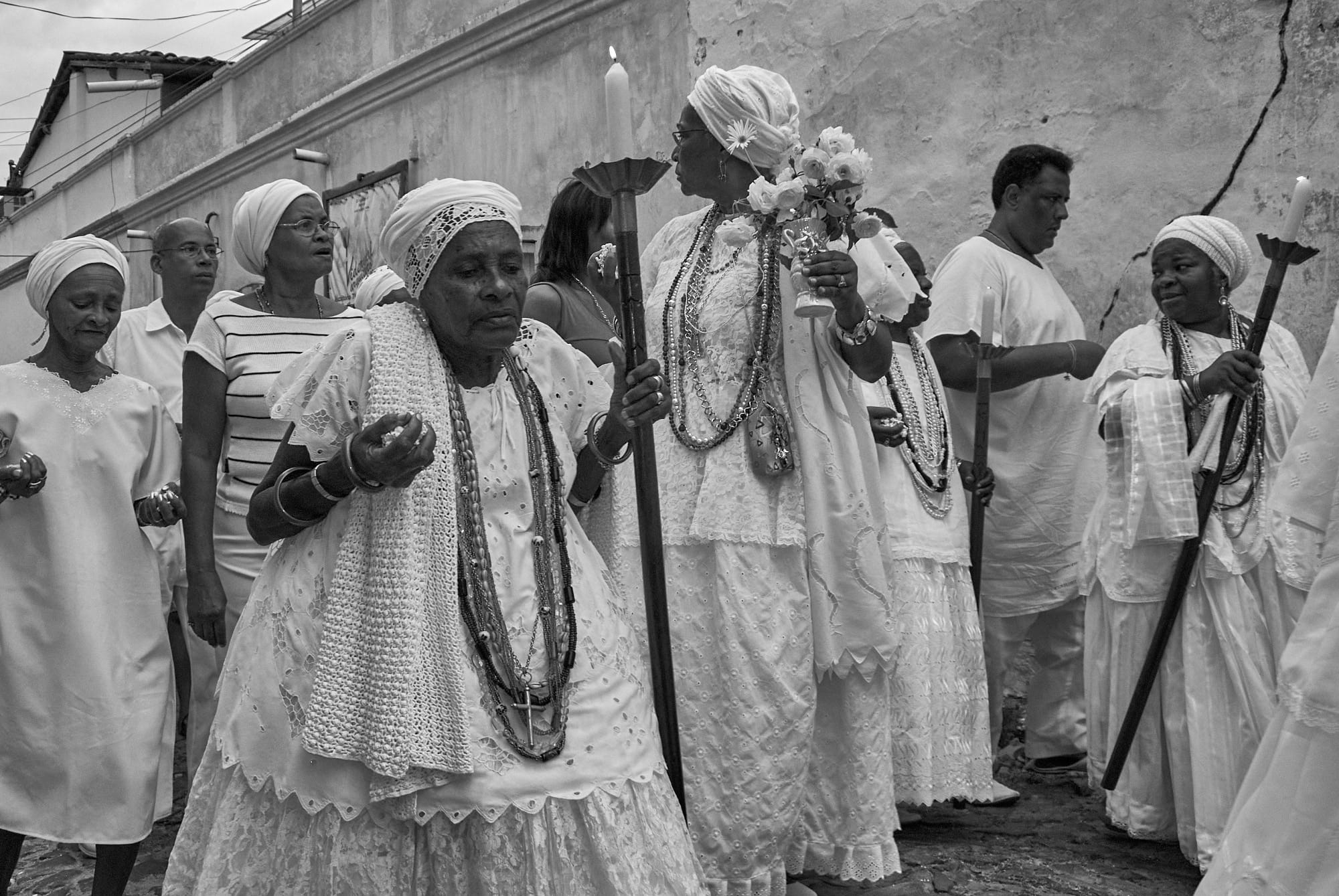
The ceremony remains important, but the camera repeatedly wanders toward everything that refuses to become ceremony: waiting, fatigue, curiosity, friendship, traffic, children, windows, buses, gestures between women.
The Irmandade is not isolated from Cachoeira and presented as an ethnographic object; it remains inside a town inhabited by people who have errands to run, relatives to meet, cigarettes to smoke and children to watch.
That distinction matters because cultures are most easily exoticised when we photograph only the moments in which people appear different from us.
A ritual can be extraordinary and the people participating in it can still have ordinary lives. In fact, the two truths need each other.
The Problem With “Authentic”
I work in travel, which makes the question more uncomfortable rather than less. People travel because they want to encounter something beyond themselves; this desire is not shameful, and I would not have devoted my work to travel if I believed otherwise. A journey can disturb assumptions, create relationships, expose us to ways of organising life that we had never imagined.
But tourism has also become extremely skilled at converting difference into merchandise.
We sell hidden places, untouched communities, secret traditions, authentic encounters; the vocabulary itself should make us suspicious, because a living community cannot remain “untouched” while simultaneously being packaged for our arrival.
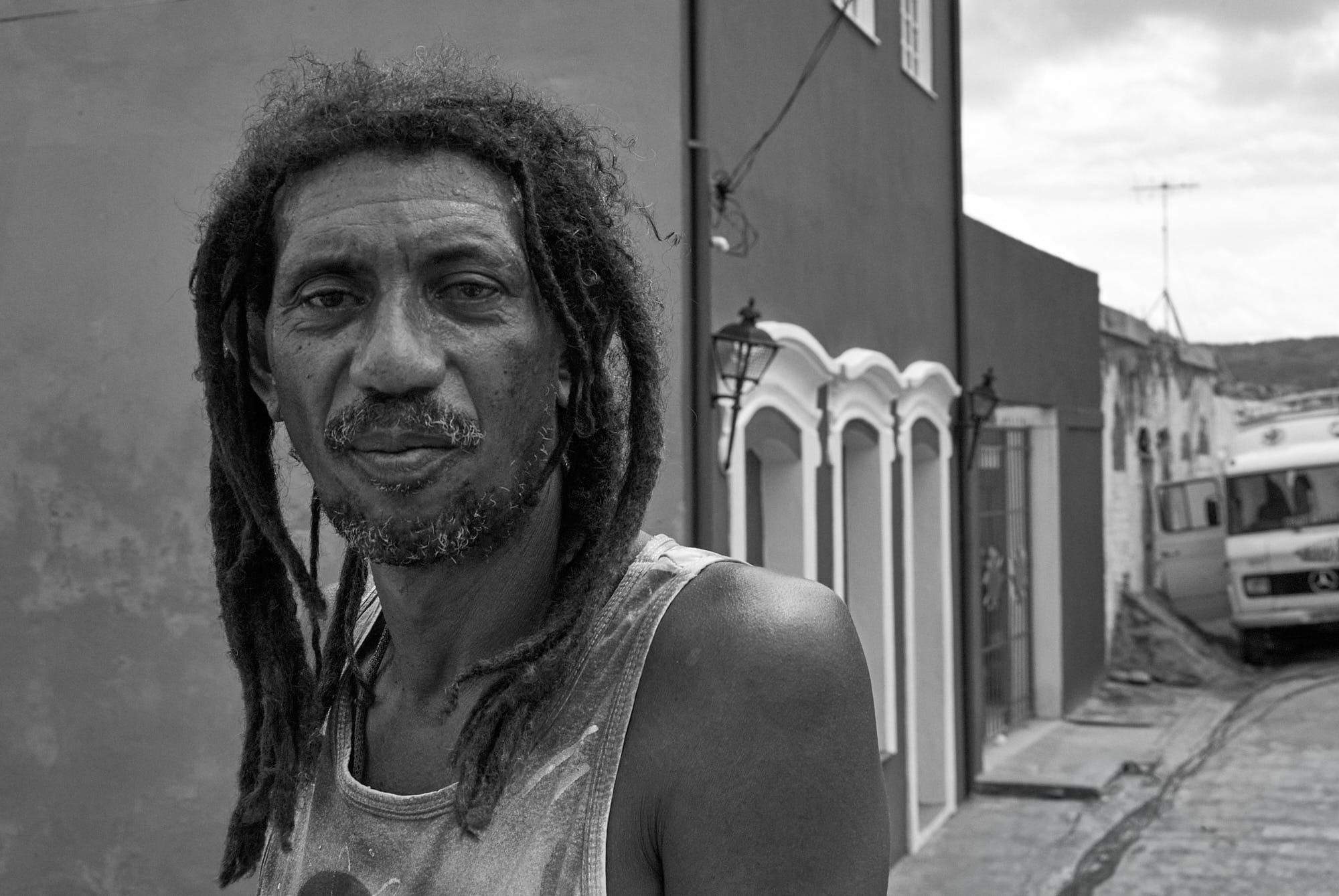
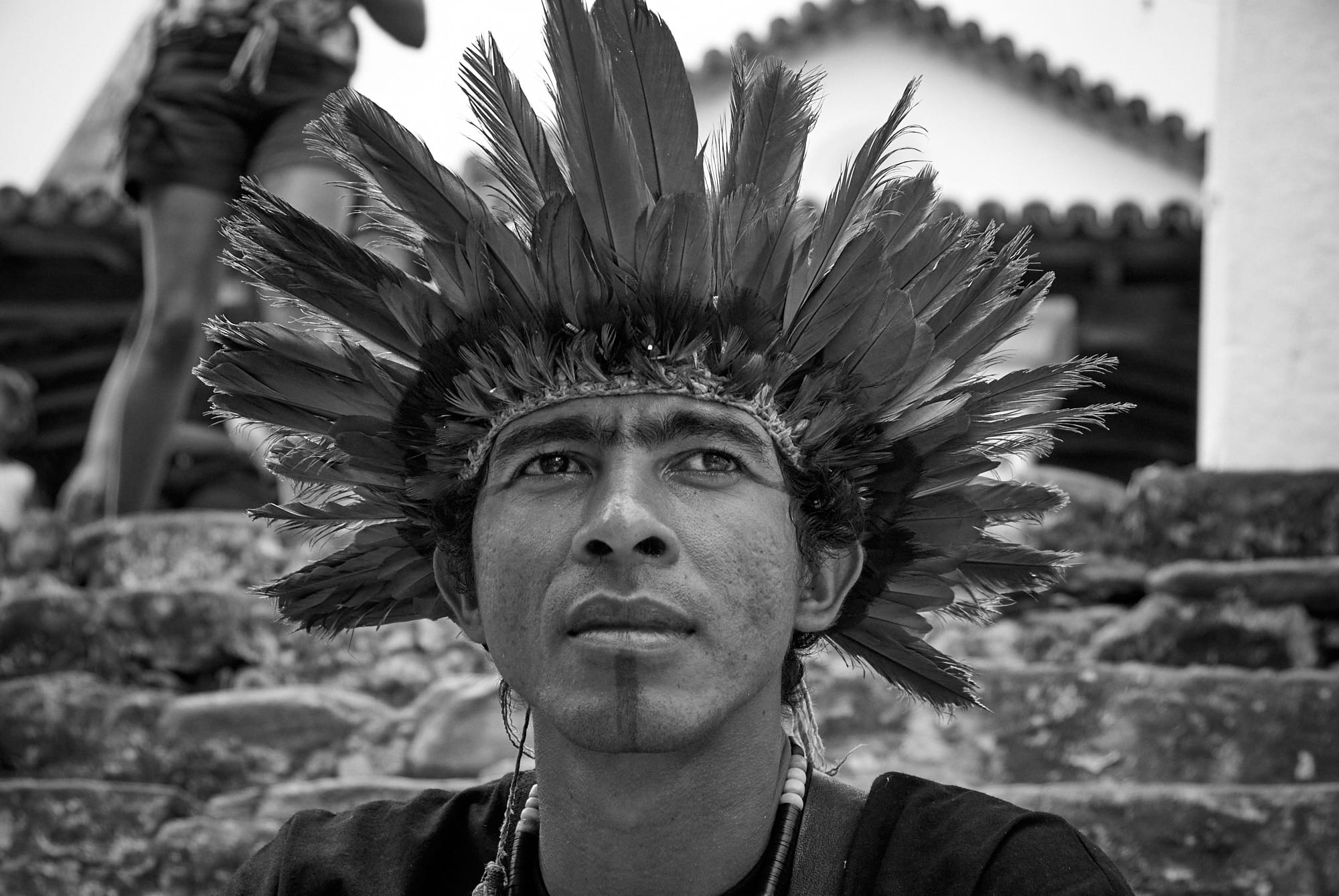
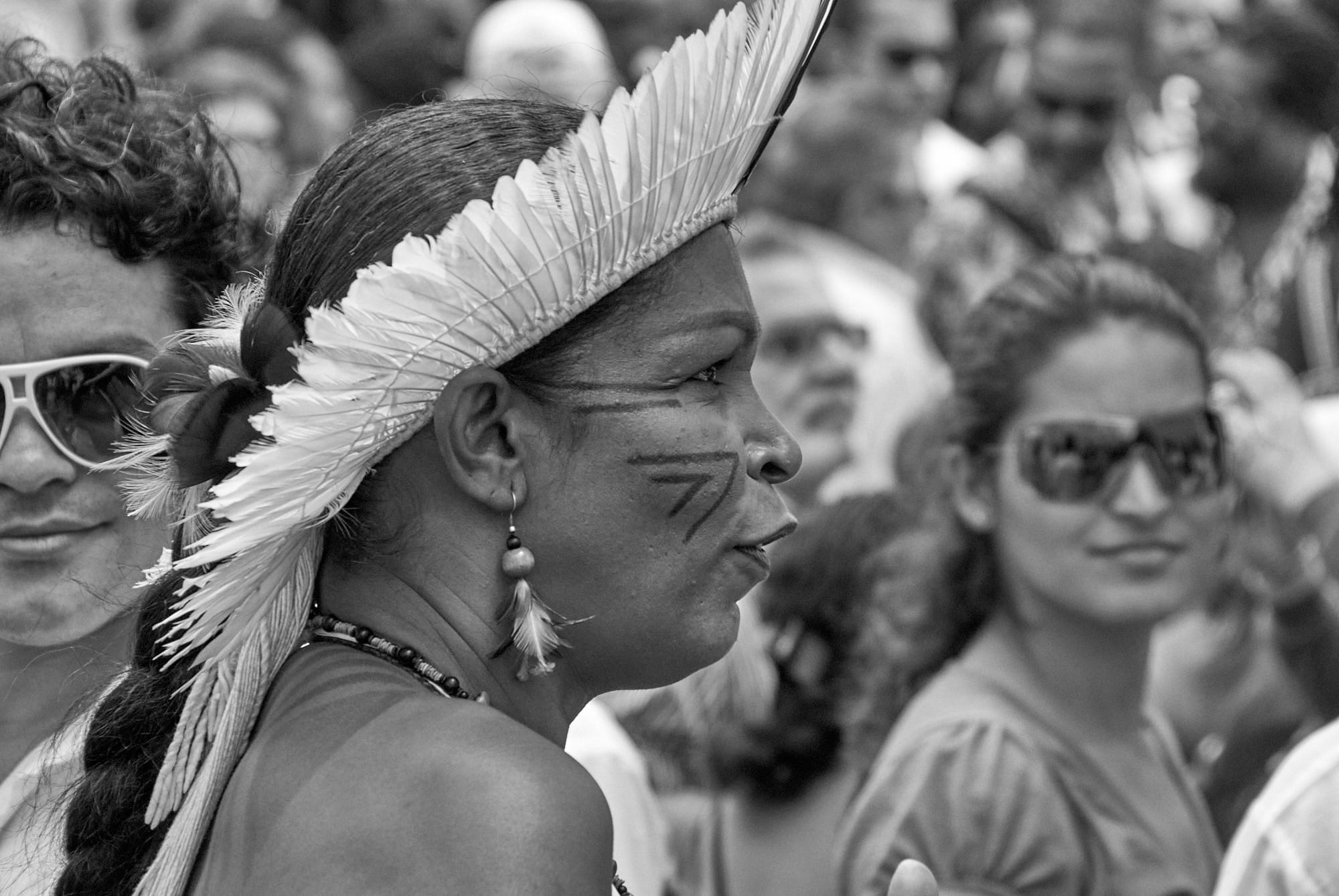
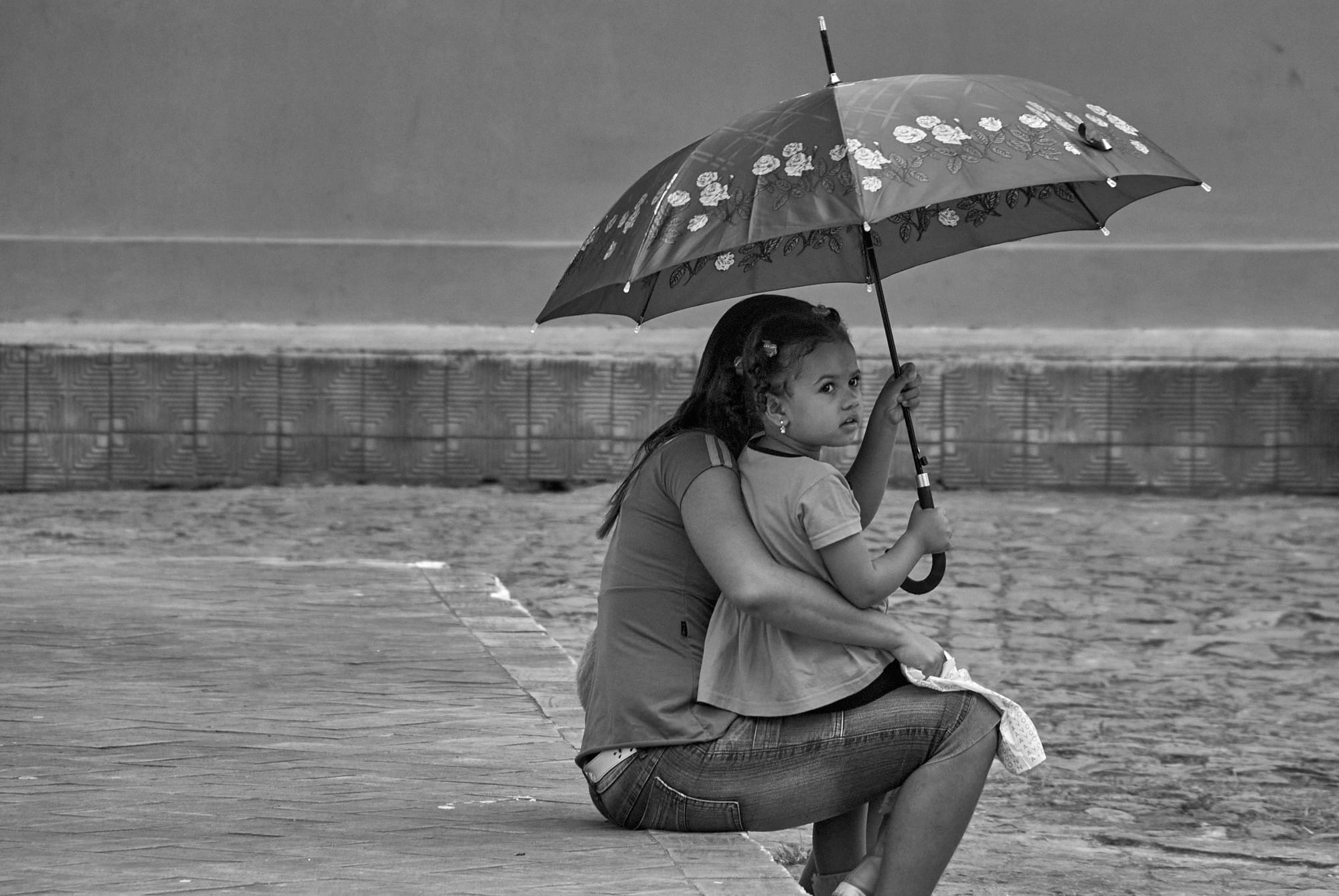
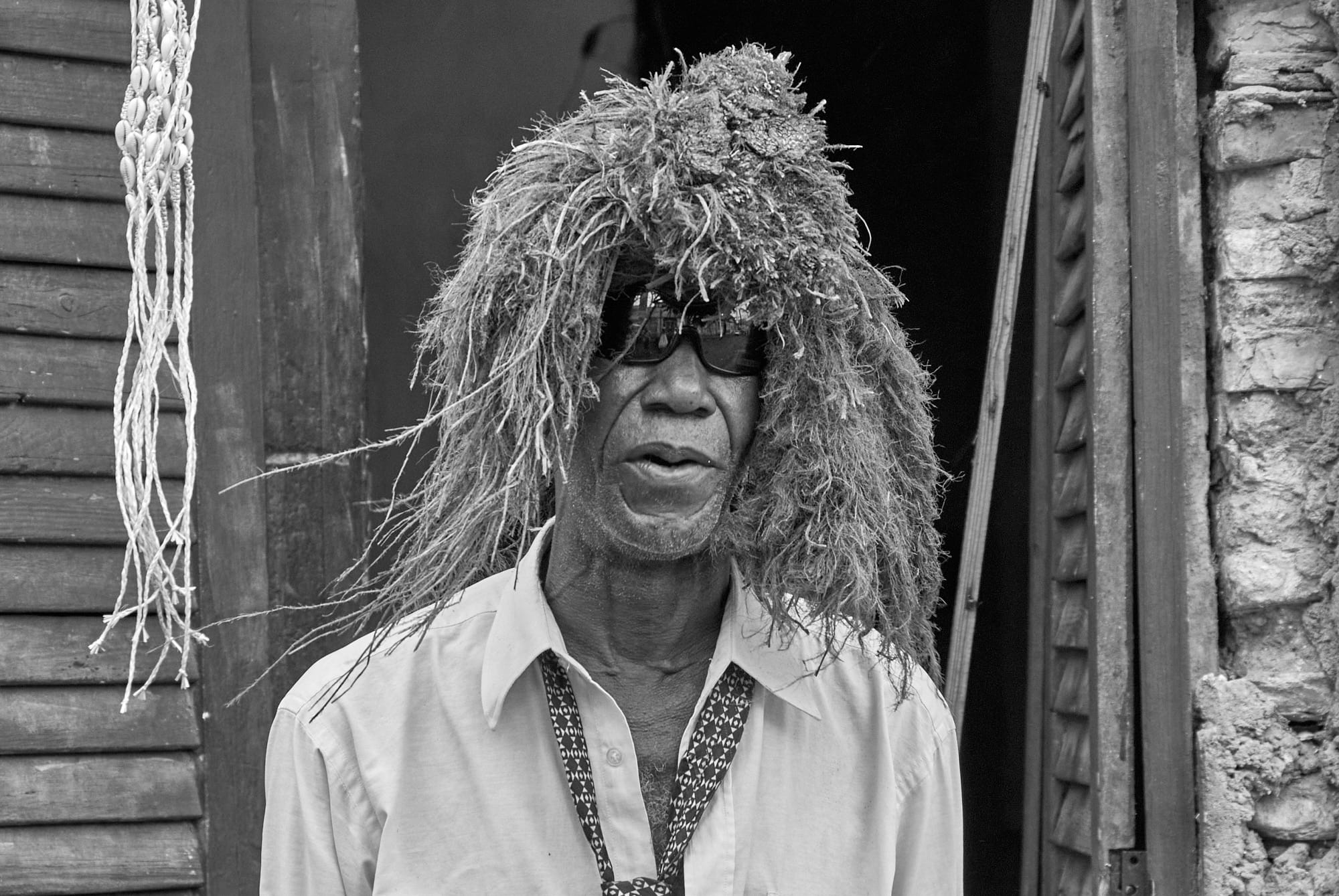
The Festa da Boa Morte attracts visitors from Brazil and abroad and has become one of Cachoeira’s most visible cultural events; the celebration has also been officially recognised since 2010 as part of Bahia’s intangible cultural heritage.
Recognition can help safeguard memory and increase respect, yet visibility always brings another question with it: what happens when something created for reasons of faith, community and historical continuity also becomes something people travel to see?
There is no simple answer, and pretending that visitors should stay away would be another form of paternalism. Communities are perfectly capable of deciding how they want to receive outsiders; tourism can support local economies, strengthen cultural institutions and create encounters that matter to both sides. The issue is not whether we go. The issue is how we arrive.
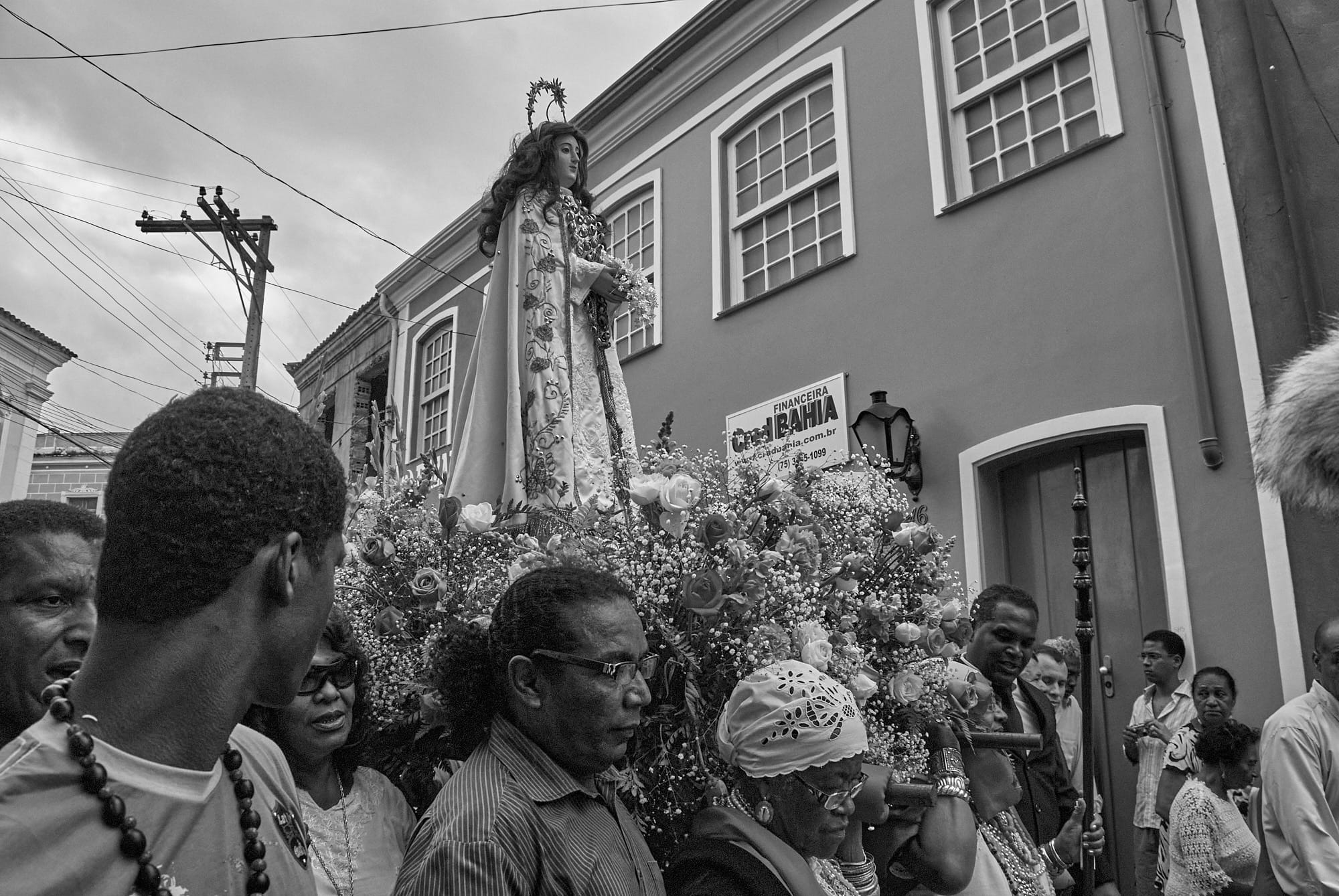
To attend the Boa Morte responsibly means resisting the idea that Cachoeira has been waiting for us. The women are not there to complete our Brazilian experience.
The streets are not scenery, Candomblé is not folklore, the white dresses are not costumes in the theatrical sense, and the Irmandade does not exist because outsiders have finally discovered its beauty.
It existed before our arrival; it will have work to do after we leave. That simple awareness changes almost everything.
You begin to ask before photographing rather than assuming that public space means unlimited permission; you learn when a religious moment requires distance, when a camera becomes intrusive, when curiosity can remain unanswered.
You spend money locally because a place is not merely something to consume visually; you listen to the people who live there rather than looking only for the interpretation that confirms what you already hoped to find.
And perhaps most importantly, you stop measuring a journey by how much access you obtained. Sometimes the deepest encounter is the one in which a boundary remains intact.
A Good Death
The name can sound unsettling when translated literally: Boa Morte, the Good Death. Yet within the celebration, death is not treated simply as disappearance.
The ritual moves from remembrance toward glory; the sisters who have died are recalled, the death and dormition of Mary are commemorated, then Nossa Senhora da Glória emerges into the streets. The structure itself refuses a final rupture between those who were here and those who came before.
This is why the Irmandade is ultimately difficult to understand if we see it only as a religious festival. It is an institution of memory.
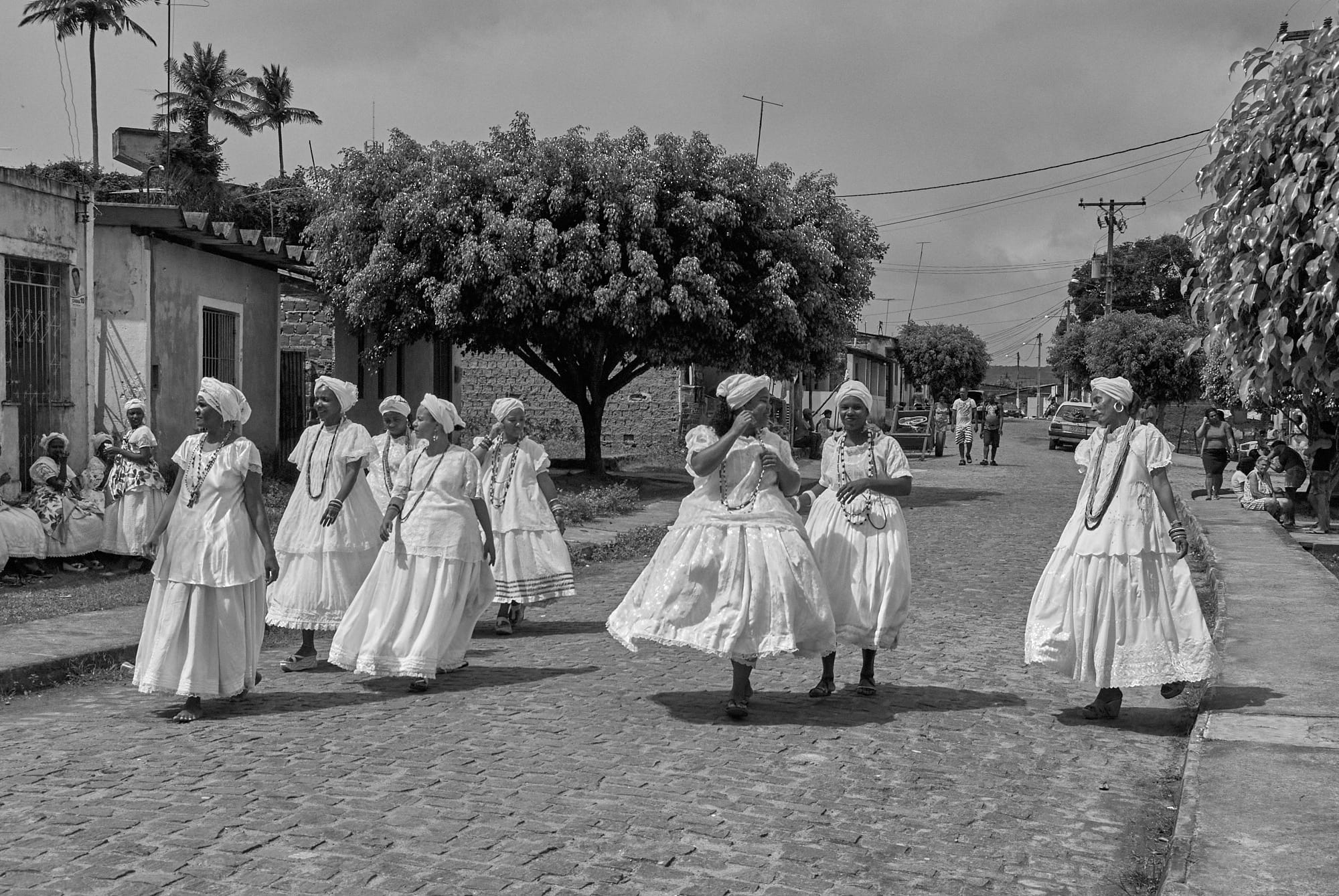
Women inherited responsibilities from other women, who inherited them from women before them; knowledge travelled through bodies, fabrics, prayers, kitchens, ceremonies, obligations and stories.
Some of those women had been enslaved, others were born into a society still defined by slavery’s structures, others entered a Brazil that formally declared them free while continuing to organise power through race, gender and class. The Irmandade remained. Perhaps this is what the photographs finally show.
Not survival as something heroic and abstract, but survival as repetition: someone ties the cloth again, someone prepares the food again, someone remembers a dead sister again, someone carries the image through the same streets again.
Then a bus arrives. The women climb aboard. A child watches through the glass; outside, Cachoeira continues.
There is something profoundly Brazilian in this coexistence of ceremony and improvisation, gravity and laughter, memory and ordinary life. But there is also something larger, something that belongs to communities everywhere: traditions survive not because they remain frozen, but because people continue to find reasons to carry them.
The Irmandade da Boa Morte has been doing this for generations. For those of us who come from elsewhere, perhaps the most respectful response is not to ask how much of its mystery we are permitted to take home.
A better question is simpler: what have these women kept alive, and what does our presence require of us while we are there? That is where travel can become something more than movement. It can become attention.
This is the first story in an A Bag of Stories series about Brazil, told through the people, places, histories, and forms of knowledge that continue to shape the country from within.
Marco Tardio is the founder of Cultour, a Brazil-based travel company built around the same idea of travel explored in these pages: spending time with places and communities, respecting local identities, and approaching culture as a relationship rather than an attraction. Cultour creates journeys across Brazil for travelers who want to experience the country from within.


Member discussion