


The first page is outside
Before a visitor reaches a shelf, Abrehot Library asks to be read. Seven tall columns stand beneath the deep concrete roof, assembled from pale blocks covered with signs. Some are immediately familiar, others are not; scripts change from panel to panel, from one side of a column to another.
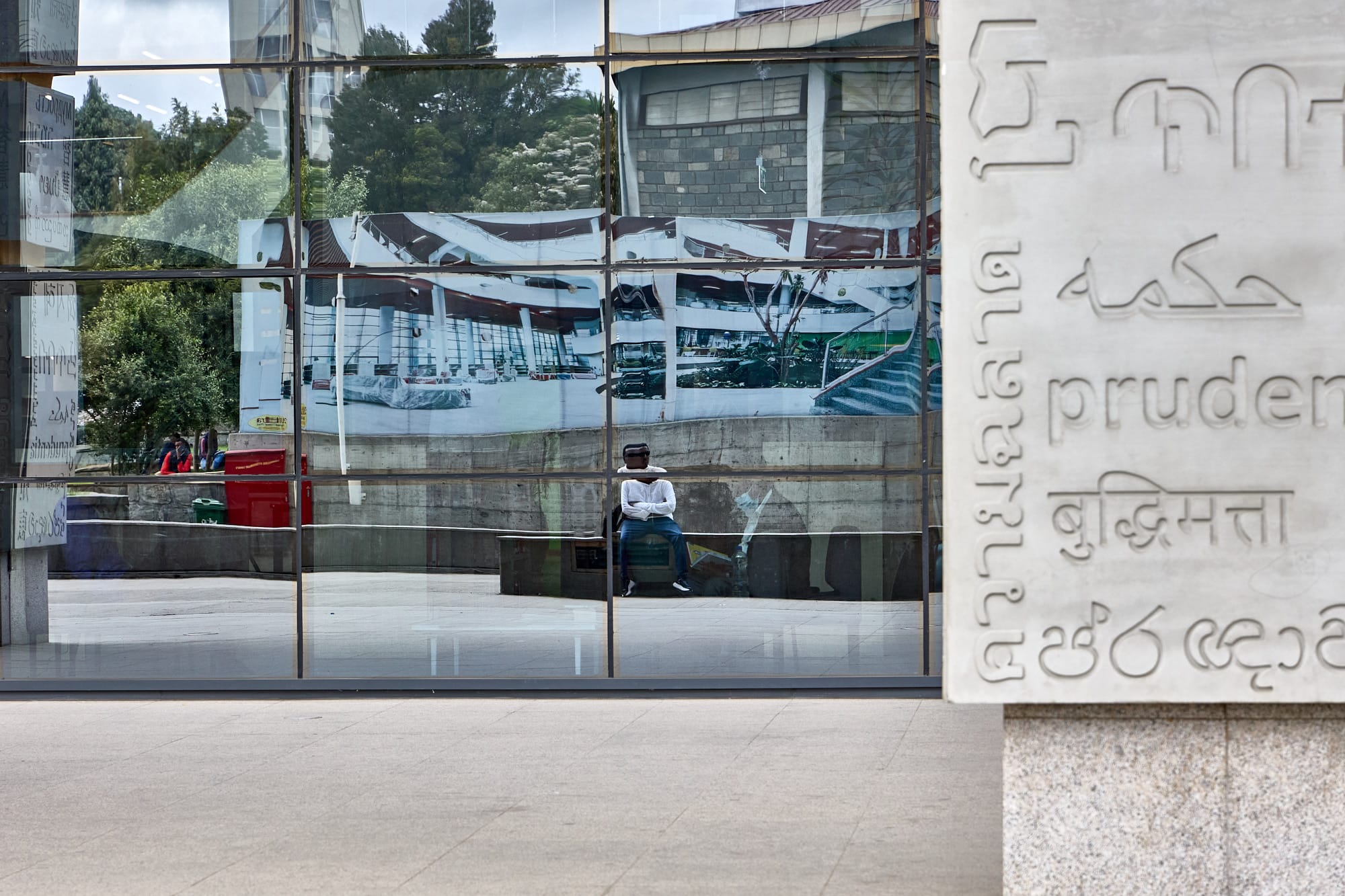
Among them appears prudentia, the Latin word associated with practical wisdom. Elsewhere there is Amharic, Chinese characters, Devanagari, and other systems of writing.
The principle behind them is simple: the façade carries the idea of wisdom in eighteen languages. In Amharic it appears as tibeb — ጥበብ. The library has taken something normally kept inside a book and placed it outside, enlarged to architectural scale, where anyone crossing the plaza can encounter it.
Our photographs remain outside too. Photography is not permitted in the interior, so there are no images of reading rooms, shelves, desks or books in this story. At first this might seem like an absence. Instead, it changes the question. What does a library say before we enter? At Abrehot, quite a lot.
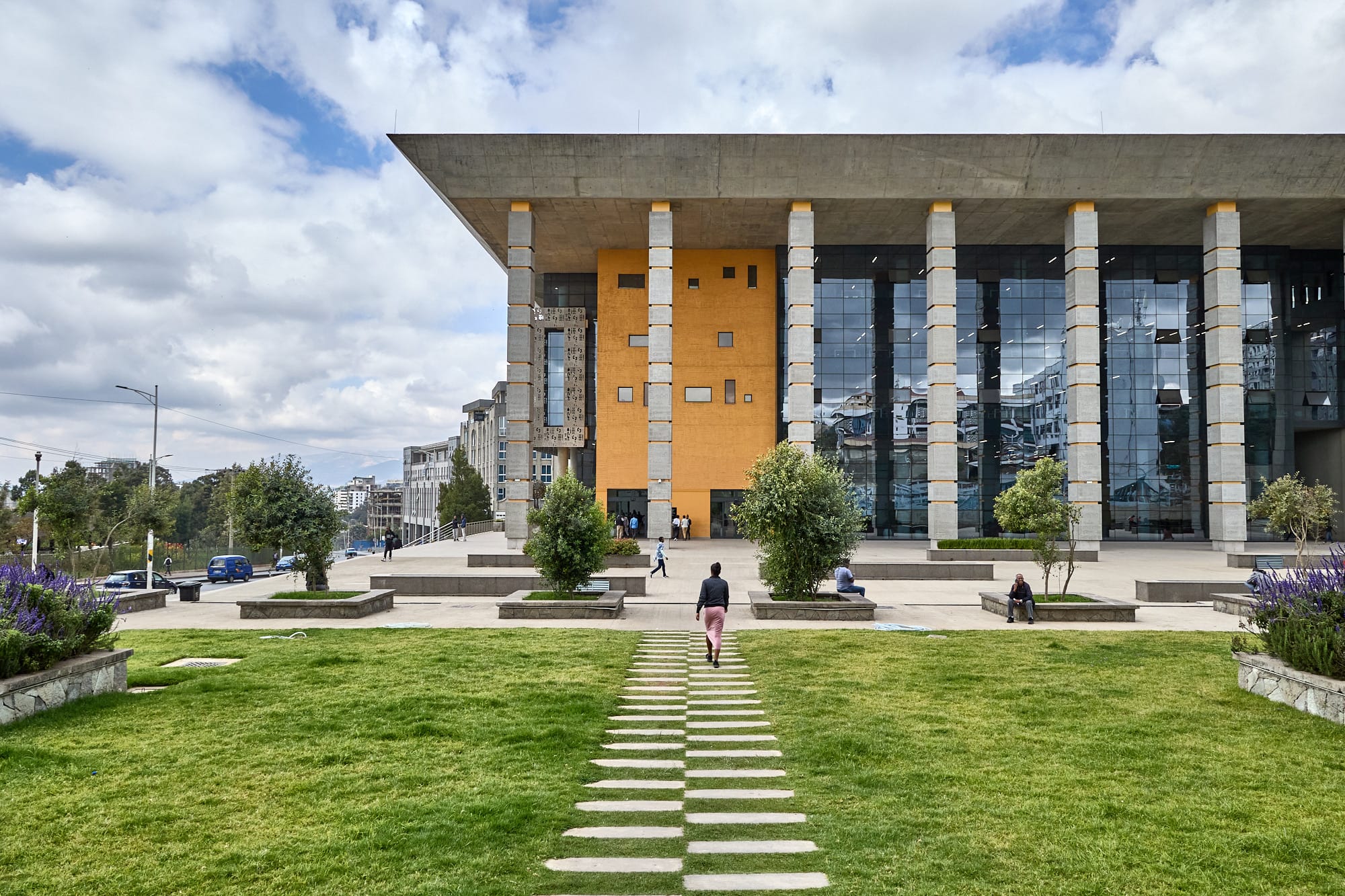
A building that can be read
The building opened in January 2022 in Arat Kilo, opposite the Ethiopian Parliament. It occupies roughly 19,000 square meters over four floors and was designed to accommodate thousands of readers and, eventually, as many as 1.4 million books.
The architectural concept was developed by ABBA Architects, while project credits identify ZIAS Design International as design lead and responsible for detailed architecture, within a broader Ethiopian design team.
Yet numbers explain surprisingly little about the experience of approaching Abrehot. From the plaza, the architecture is built from a few forceful elements: the vast horizontal plane of the concrete roof; the long rhythm of the columns; a wall of ochre-orange; expanses of dark glass. The building is monumental, but its surface is rarely still. The glass keeps receiving Addis Ababa.
Buildings across the street bend across it. Trees appear between structural lines. Clouds pass over windows. A person walking in front of the library can appear twice: once on the pavement and again, less certain, inside the reflection. In some photographs it becomes difficult to say where the building ends and the city begins.
The inscriptions behave differently. They refuse reflection. Cut into the pale surfaces of the columns, they have weight. Language has become construction material.
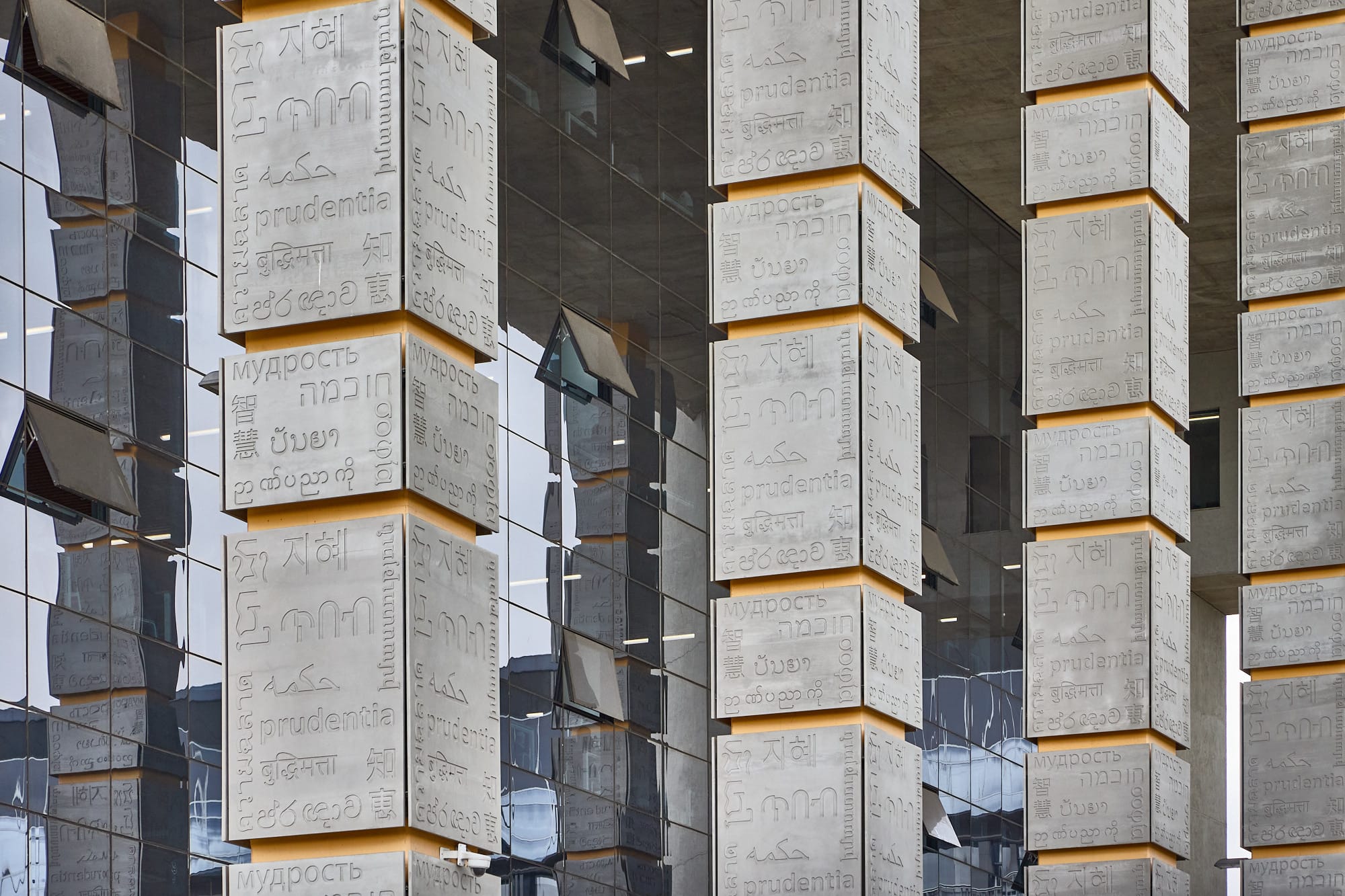
Eighteen ways of writing wisdom
There is something particularly appropriate about placing alphabets on a library: a book begins long before its binding, its shelf, even its author. It begins with the possibility of making a mark and agreeing that the mark carries meaning. A line becomes a letter; letters become words; words allow memory to travel beyond the person who remembers.
Abrehot makes that elementary fact visible. The columns do not present a single script as the natural language of knowledge. They place different writing systems beside one another and allow their shapes to remain different. They do not need to resemble each other to occupy the same structure.
This matters in a country with a long written tradition of its own, but it also gives the façade a wider meaning. A library depends on translation in its broadest sense: between languages, certainly, but also between generations, disciplines, experiences and ways of understanding the world.
Its name carries the same intention. Abrehot means enlightenment in Amharic. The word could easily become rhetoric. The architecture does something more useful with it: it breaks the idea into letters and places those letters where people can touch them, pass beneath them, ignore them, notice them again tomorrow. Knowledge returns to ordinary scale.
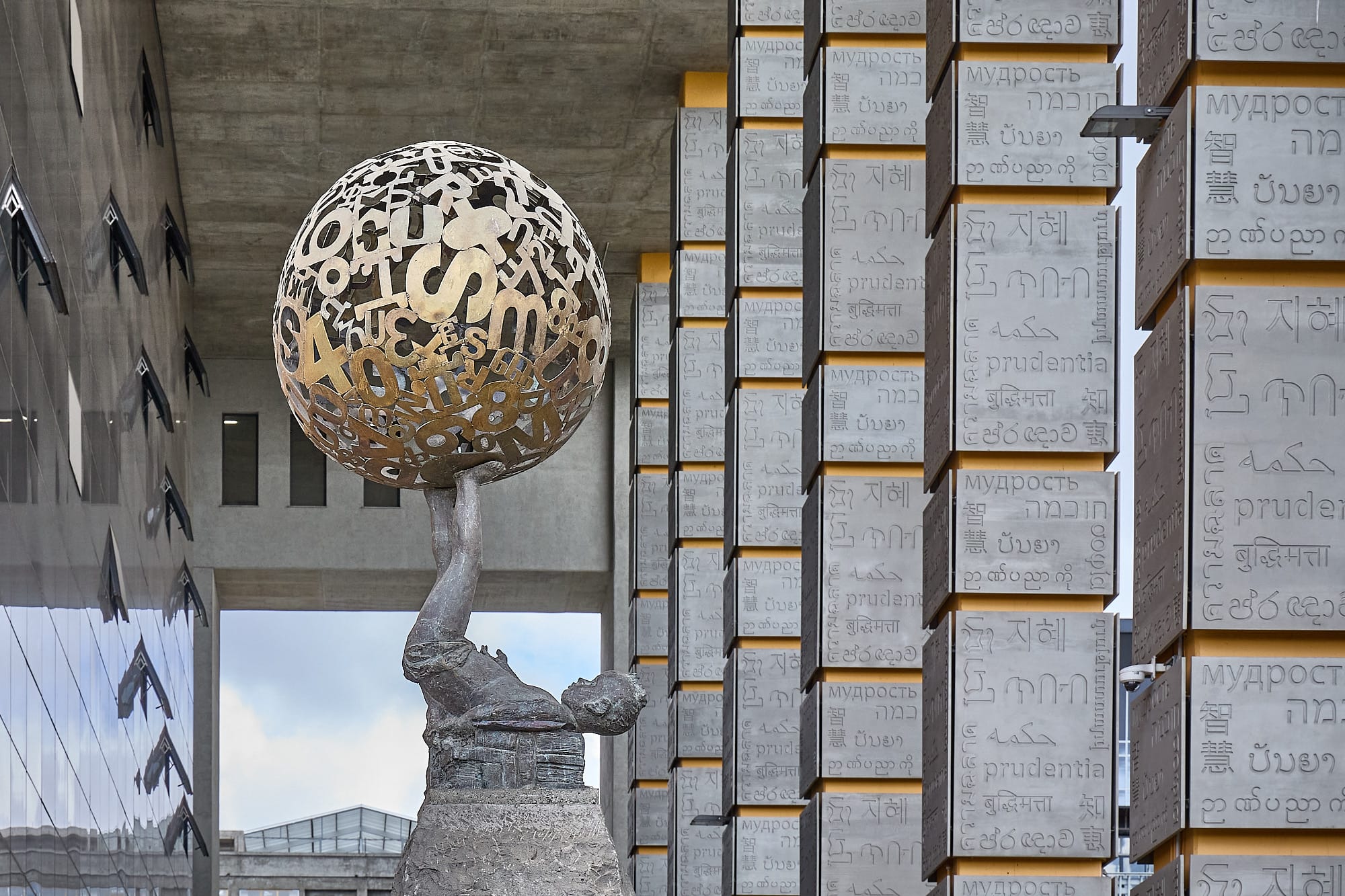
The child beneath the letters
Beside the library stands another image of knowledge. A sculpture by Ethiopian artist Bekele Mekonnen shows a child reclining on books while holding above him a hollow sphere assembled from letters and numbers.
The library's account of the work explains that the child represents curiosity and the freedom to question; the books beneath him stand for existing knowledge, while the sphere suggests a world made legible through signs.
The distinction is subtle and important. The child does not kneel before the book. He rests on it. Knowledge is already there, accumulated by others, but it does not close the world. It gives him somewhere from which to look at it.
Placed among Abrehot's inscribed columns, the sculpture almost becomes a footnote to the architecture: learning is inheritance, but also movement; one generation leaves words behind, another rearranges them. A library needs both.
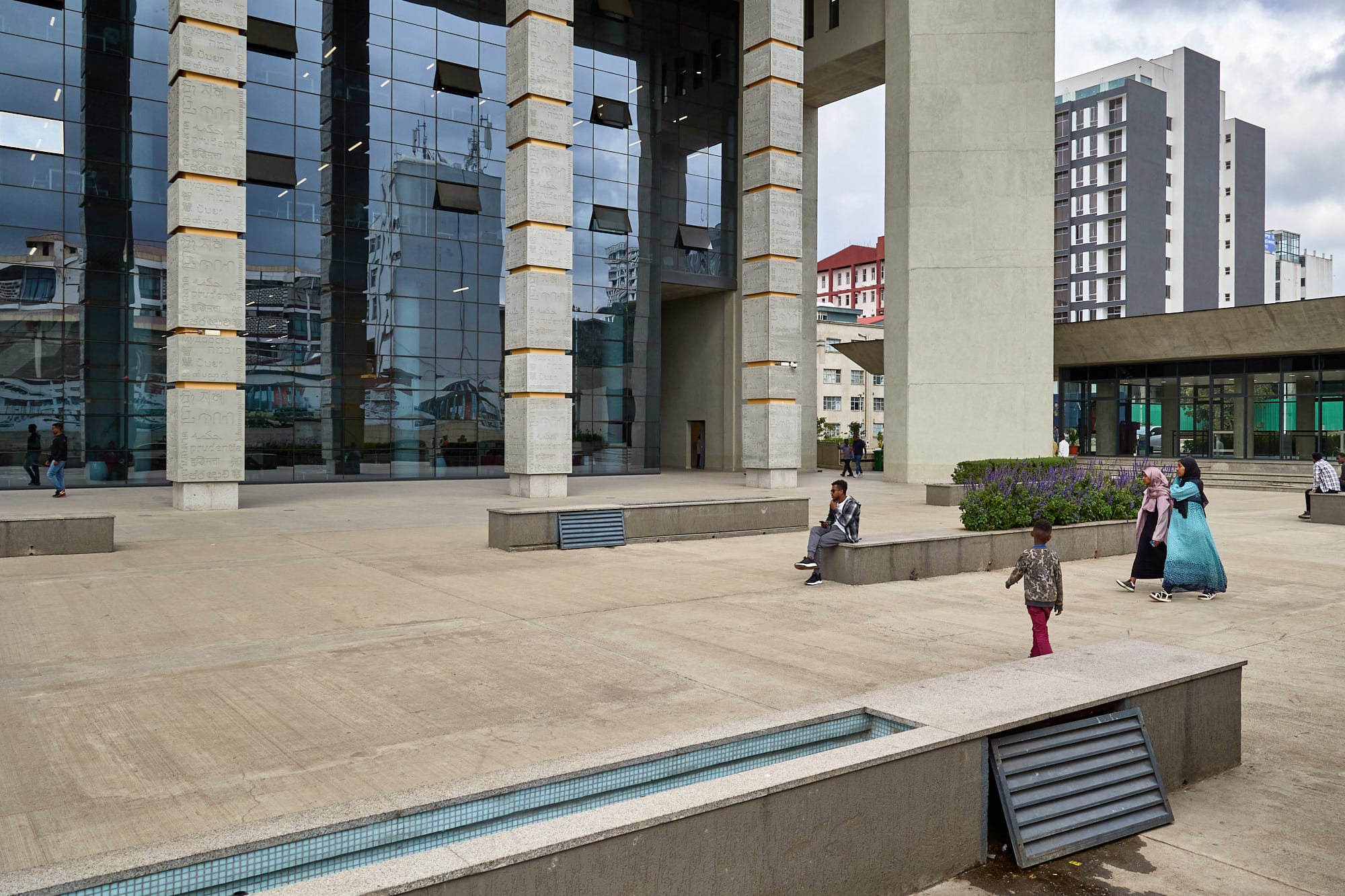
When architecture becomes public
The real measure of a public library is eventually much less spectacular than its architecture. People must be able to use it.
Abrehot's own service information describes open and free access to its physical and electronic collections, along with free Wi-Fi; there are children's facilities, reading and work areas, meeting rooms, audiovisual resources and a Braille hall.
The ground floor includes spaces designed for children and parents, while other floors provide study areas and facilities for different forms of access to information. These facts matter because a public building acquires meaning through ordinary use.
The photographs tell part of that story without entering the library. A man sits alone against the glass. Two women cross the open space in conversation. Someone climbs the broad steps. A security guard walks through the enormous geometry of the plaza. Children pass between adults. Others wait near the entrance.
Nothing extraordinary is happening. That may be the point: libraries are among the places where a society makes room for activities whose results cannot always be measured immediately: reading, studying, asking questions, looking for something without knowing precisely what one will find.
They require time that is not necessarily productive in the commercial sense, and space in which a person can remain without constantly being asked to consume. The architecture of Abrehot gives considerable physical form to that possibility.
The city in the glass
Perhaps the most revealing part of the building is neither the inscription nor the concrete, but the reflection.
Again and again, the windows return Addis Ababa to itself: nearby buildings, vegetation, fragments of sky, pedestrians, structures bent by the uneven surface of glass. The library does not appear separated from the city. Visually, at least, it absorbs it.
Behind that reflection are the books we could not photograph. In front of it are the people who may enter. Between the two stand the columns, carrying the same idea through different alphabets: wisdom.
There is no need to make the word larger than that. A person approaches. A door opens. Someone goes inside. And a public library begins its work.


Member discussion