


Thirteen logs
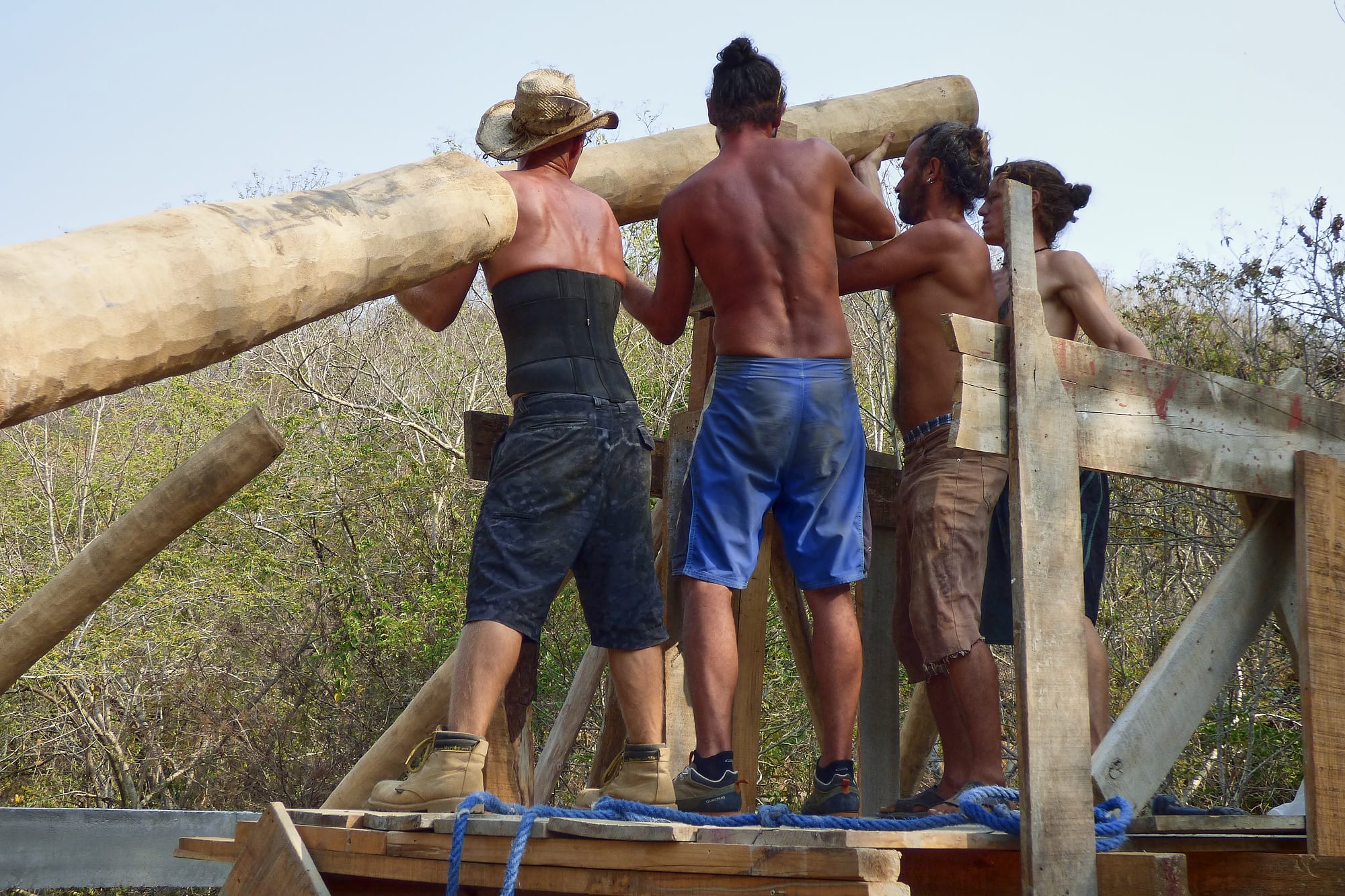
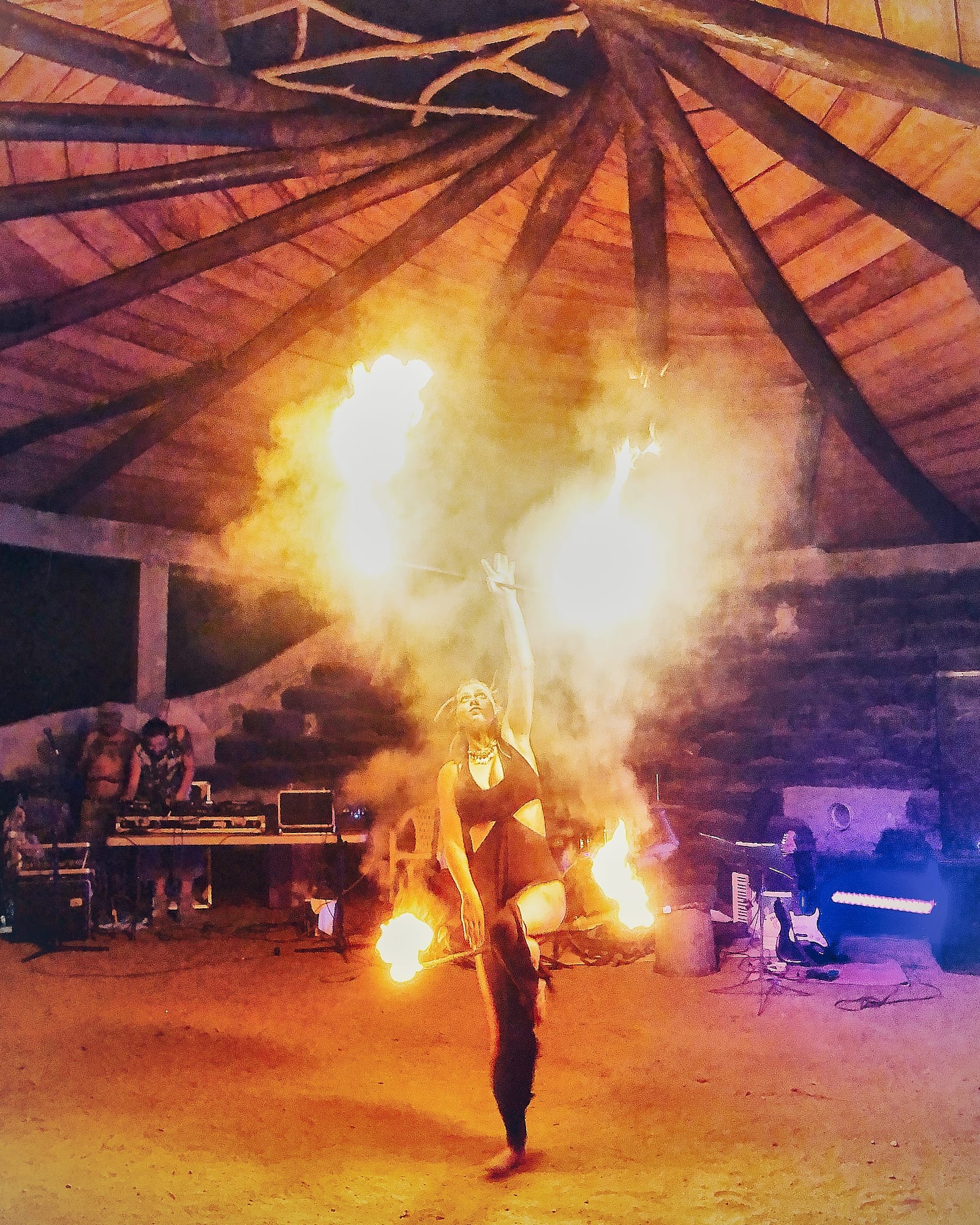
There were about thirteen of them, each weighing more than 550 pounds. We drove for more than three hours to collect the logs and brought them back at night in a bus. They would become the main structure of the roof of our theater in Mazunte, on the Pacific coast of Oaxaca.
Before we could use them, the timber had to be stripped and treated against termites; then came the concrete work, the columns, the supports, the ropes, and finally the problem of lifting those enormous pieces of wood high enough to put them into place.
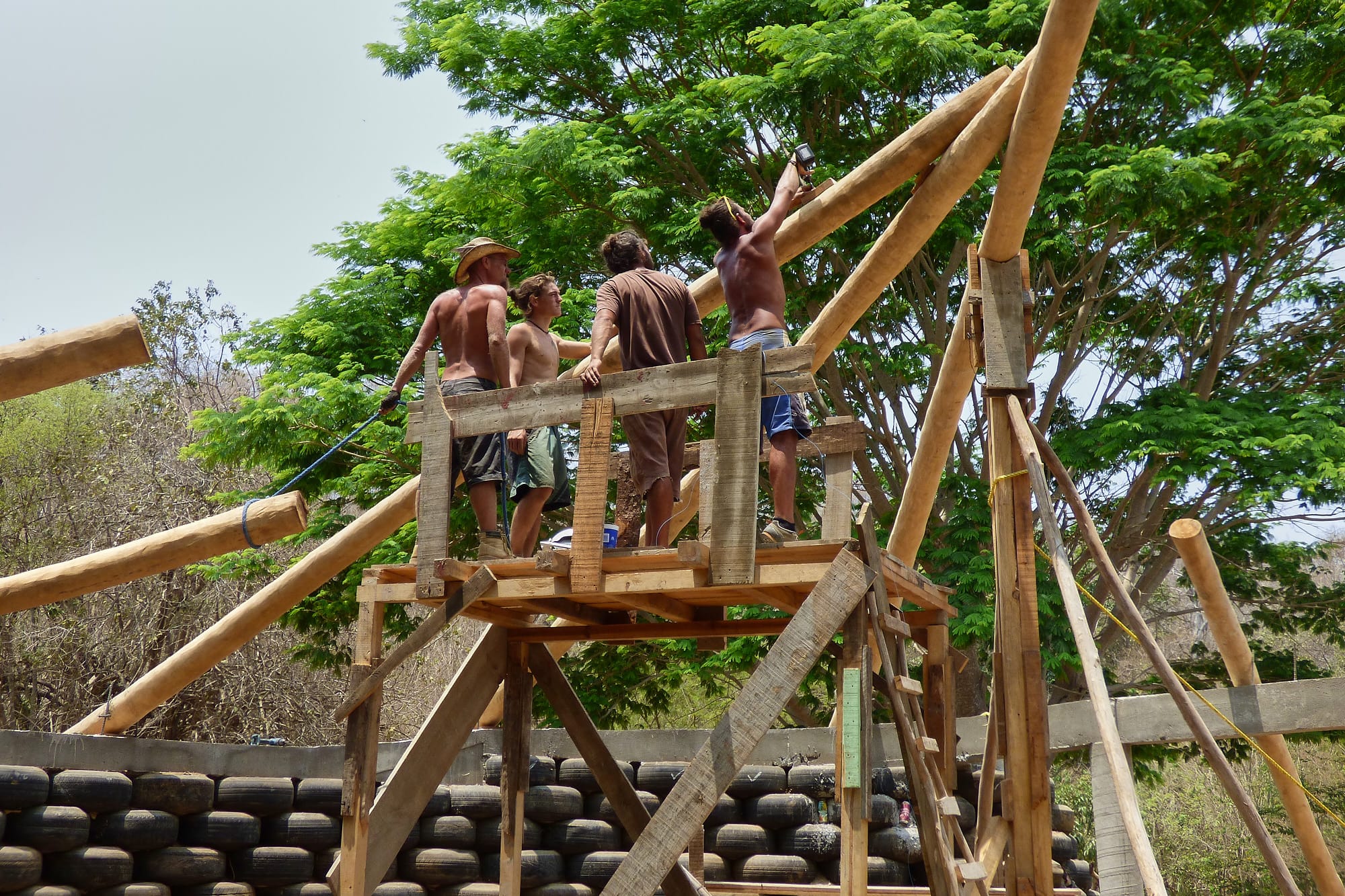
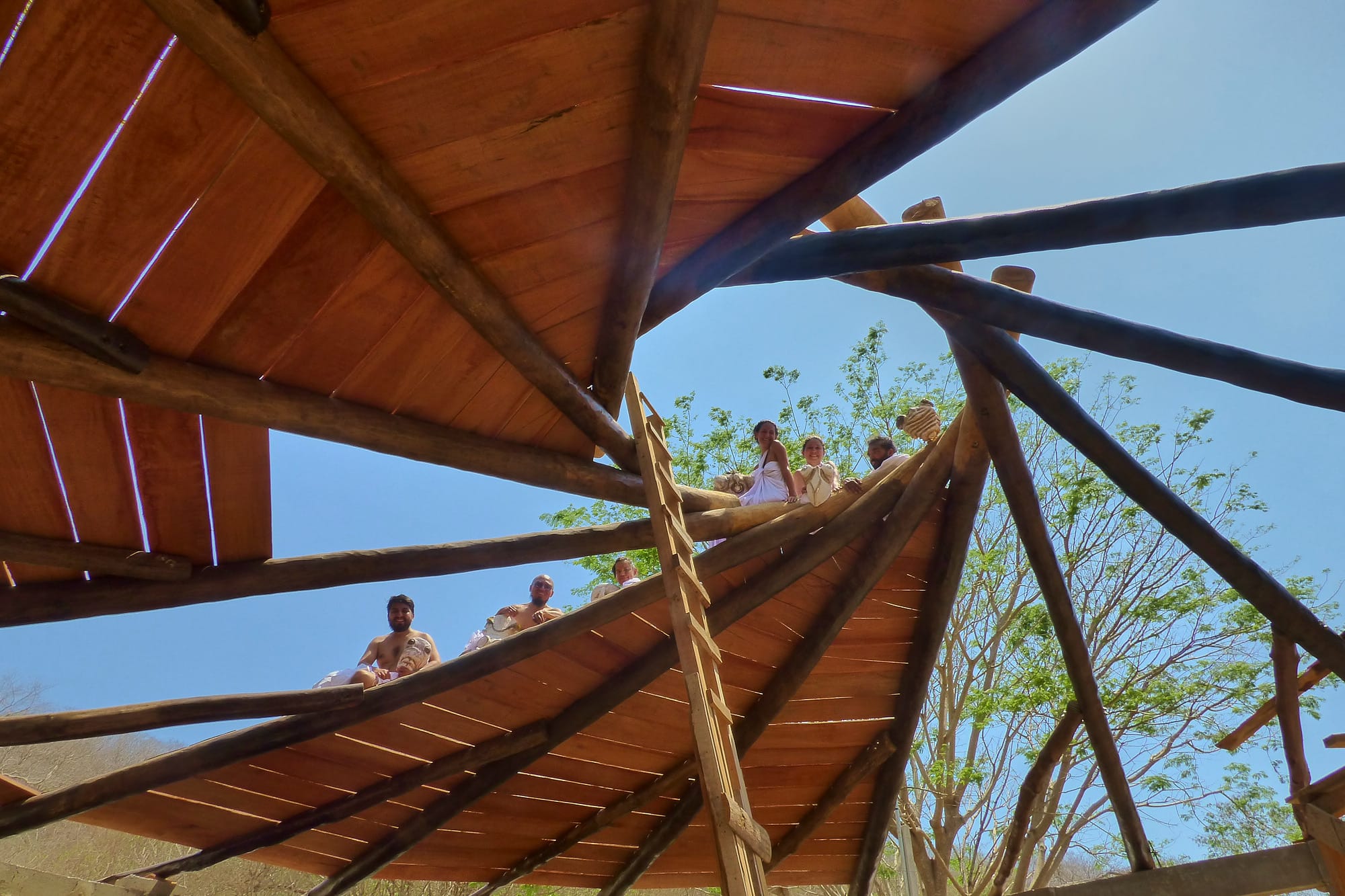
We had chosen a reciprocal roof, a structure in which each beam rests on another until the entire system supports itself. The principle is elegant. Building it with the resources we had was something else.
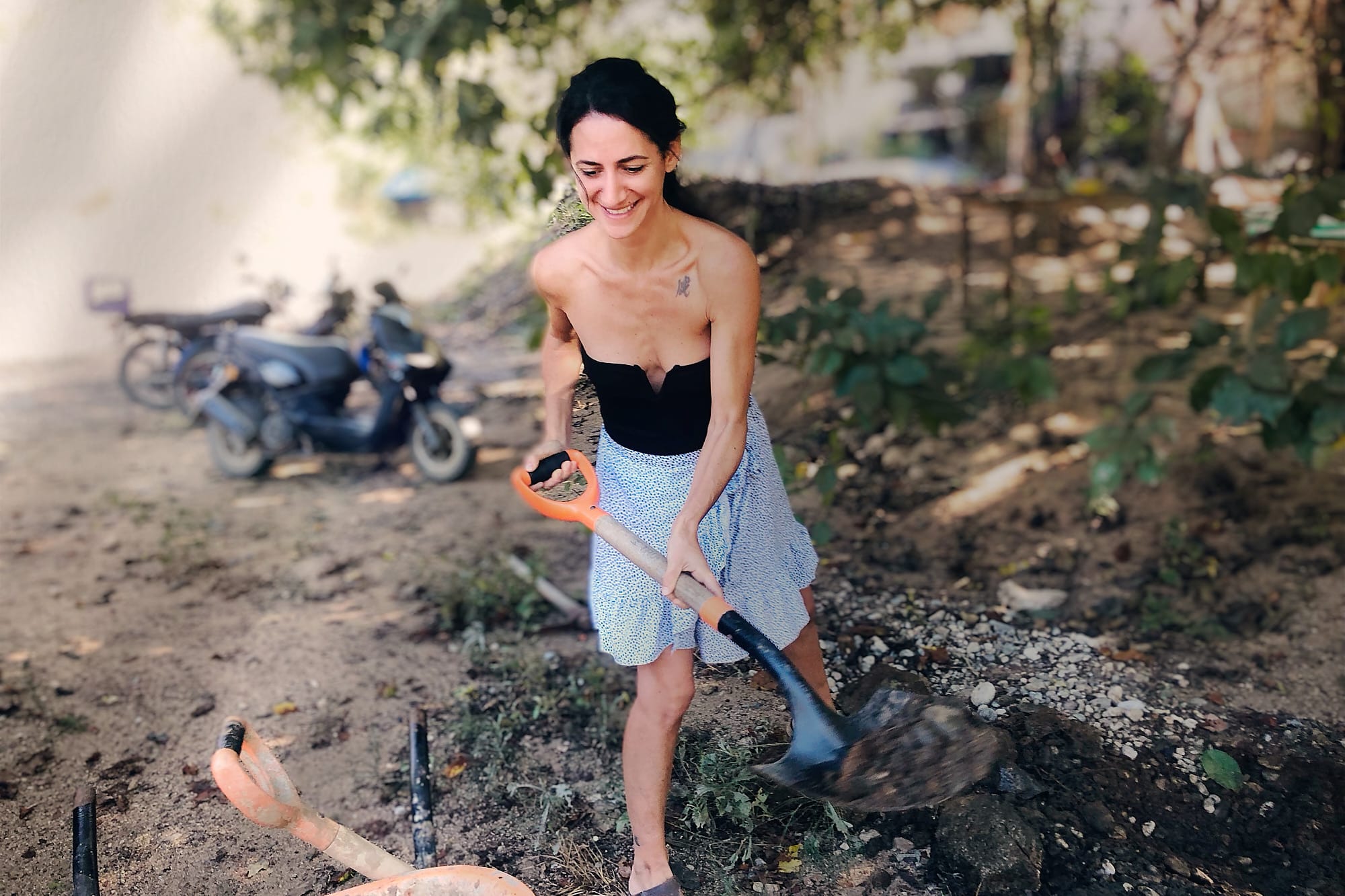
We pulled the beams up with ropes. Once almost all of them were in position, the first one had to be lowered gradually so that the others could settle against it. For this delicate operation we used a car jack. Today, I would not recommend doing it that way.
We calculated as much as we could, checked things again and again, and tried to make the process safe, but there was risk involved. Considerable risk: we were younger, probably more reckless, and completely focused on reaching the next stage of the construction.
Looking back, there are moments when I wonder how we managed it. At the time, however, there was always another problem waiting. And usually not enough money to solve it.
Before there was a theater
I did not arrive in Mexico looking for a place to build a theater. By then, movement had already become part of my life. I had begun studying theater as a teenager in Italy, later training at the Arsenale school in Milan and working with companies and artists from different theatrical traditions, including the Living Theatre, Pontedera Teatro, and performers connected to Odin Teatret.
Over the years, my work took me through Europe, Asia and Latin America, teaching, performing and developing a practice that brought together theater, movement, voice and music.
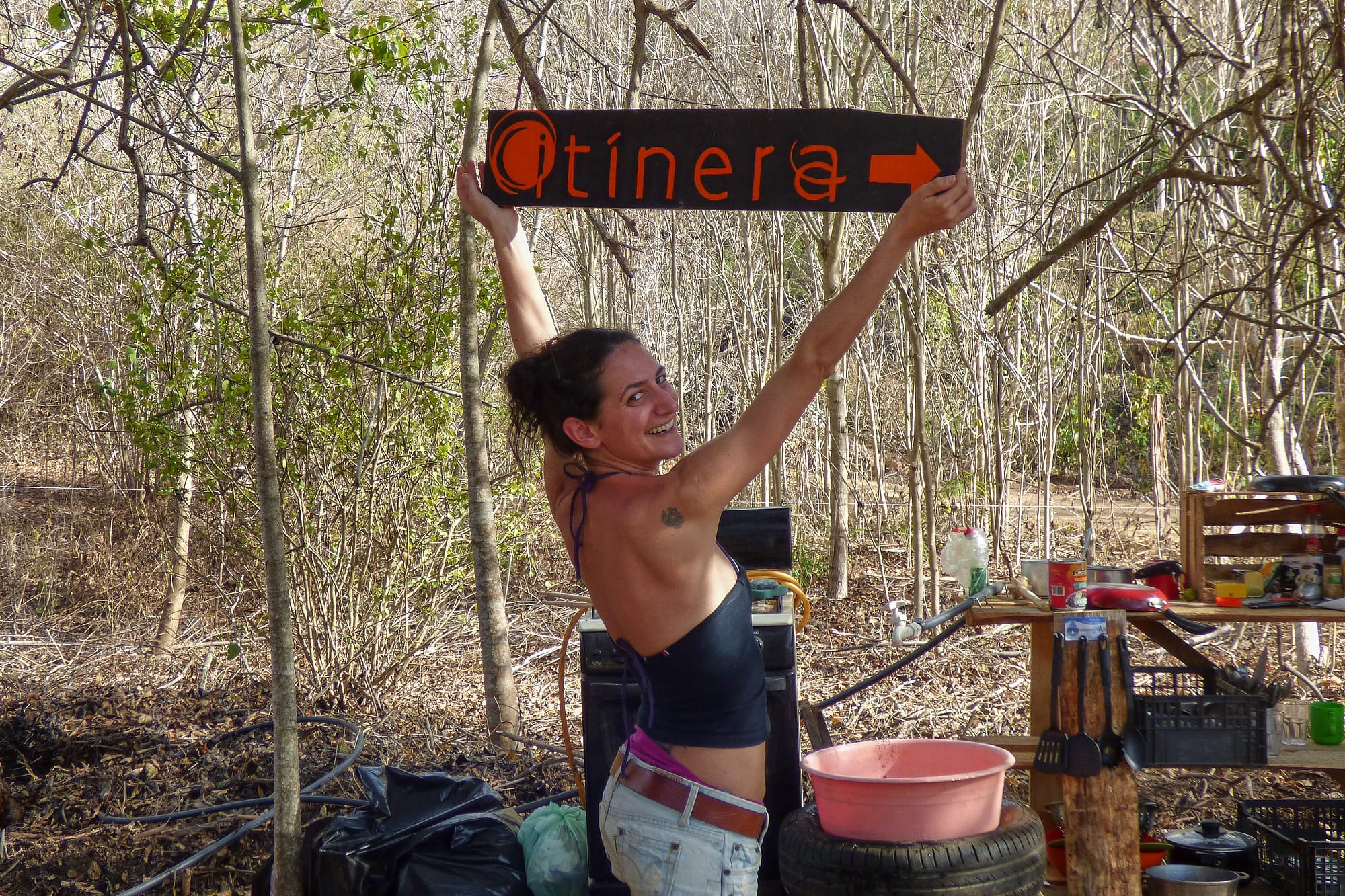
In 2010, together with artists from Colombia and Portugal, I founded Itínera. At that stage, the company existed through movement: projects, workshops, performances, temporary collaborations, places that welcomed us for a few days or a few months. We learned to work by entering other people's spaces, adapting to them, and then leaving again.
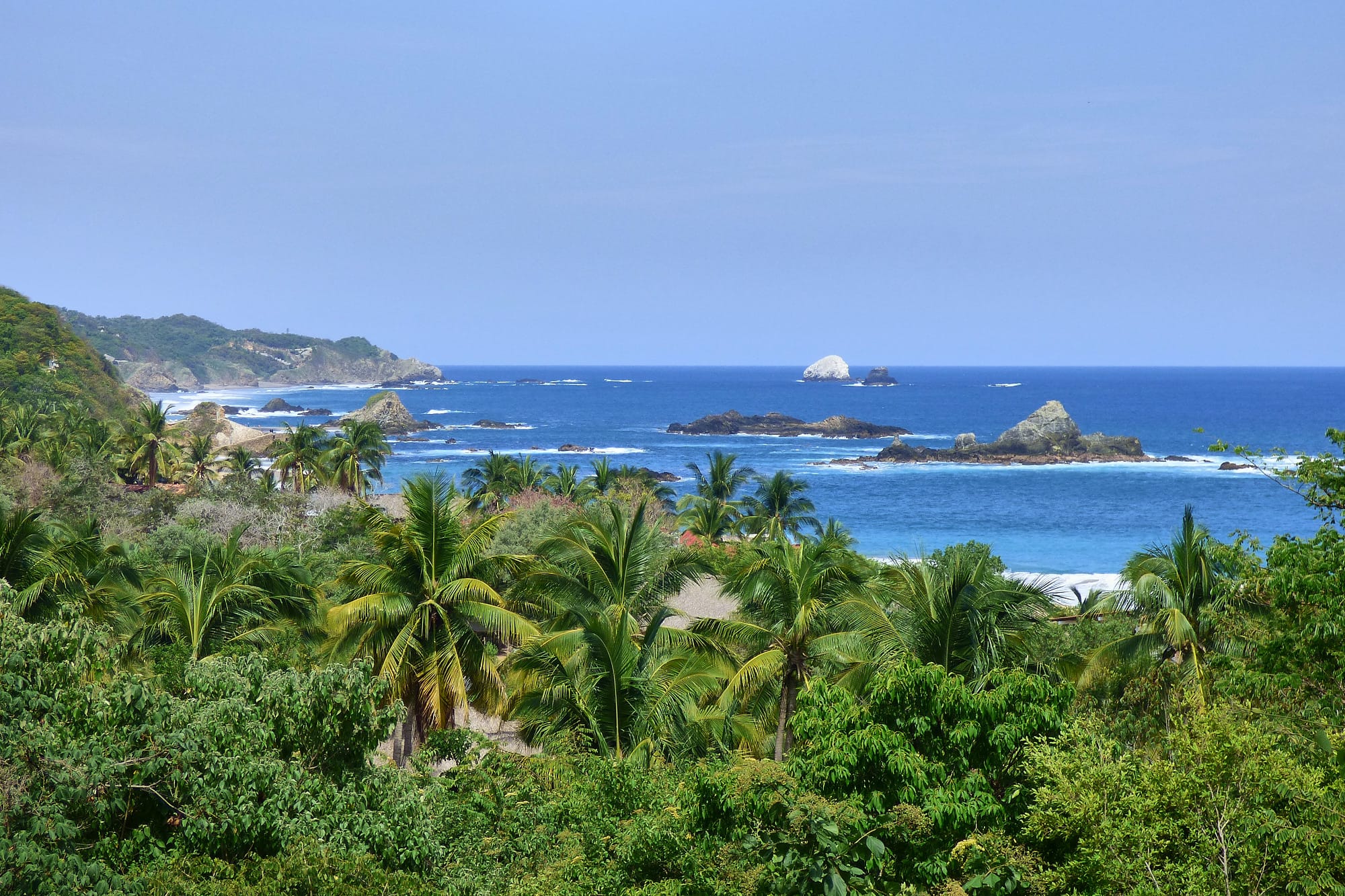
Mexico entered that journey in 2012. It was there that I met Stephane Ferreira, a Frenchman of Portuguese origin who had been studying ecological construction and permaculture.
He later went to the United States to train at the Earthship Biotecture Academy, where he deepened his knowledge of a form of construction based on reuse, thermal autonomy and adaptation to the surrounding environment.
At the time, none of this looked like the beginning of Itínera as it exists today. I was still traveling constantly. I was working, teaching, performing, moving from one project to another. Yet, almost against my own habits, another desire had begun to appear: I wanted to remain somewhere.
After years of being hosted by theaters, cultural centers and people in different parts of the world, I began to imagine a place that could offer the same hospitality to others.
Somewhere we could rehearse and create; somewhere artists from different countries could stay and work; somewhere relationships could continue beyond the duration of a performance or a workshop. For someone accustomed to movement, wanting to stay felt almost suspicious.
For several years, the idea remained mostly in conversation. Stephane's experience with ecological construction gradually became part of it, as did my work with Manuel Ramos and the wider Itínera group. We began imagining a theater that would not simply be a building, but a place where artistic work, daily life and the surrounding environment could coexist.
Then conversation became a search for land. We looked in several countries before concentrating on Mexico, and eventually on Oaxaca. In August 2015, Manuel, Stephane and I went to Mazunte.
We had only a short time and a rather improbable objective: find a piece of land close enough to the town to have a real relationship with the people living there, large enough for what we imagined, and inexpensive enough for people who did not have much money.
In twenty days, we visited more than twenty properties. There was always something wrong. Too remote. Too expensive. Too small. A seller we did not trust. Then something happened that changed the way I understood the project.
We met with local representatives and explained what we wanted to build. Eventually the idea was presented to members of the community. We spoke about theater, cultural exchange, artistic work.
Their response was direct. “Why would we need a theater? We already have the main forum. Aren’t there other priorities?” It was painful to hear, but they were right.
We had arrived with an idea that made complete sense to us and assumed that its value would be equally evident to everyone else. Suddenly the question was no longer simply how to build a theater. The question was whether we understood enough about the place where we wanted to build it.
We were foreigners. The desire to contribute did not automatically give us the right to decide what was useful. That lesson stayed.
Buying land without having the money
By the final days of the trip, we were beginning to accept that we had failed. There were only a couple of properties left to see, so we divided up. Late that afternoon Stephane returned to our meeting place smiling. “I found the only flat piece of land in Mazunte.”
That evening we were already talking to the owner. We had almost no time and very little money. I had recently decided to buy another, smaller plot nearby for a future artists’ house, so whatever reserves I had were already committed.
For the deposit on the Itínera land, I put down roughly $500: money I had earned performing at a theater festival in Bogotá.
We arranged the rest in installments. In practical terms, we bought land before we had the money to buy it. The agreement depended on each of us working during the following months, earning what we could and finding our share of the next payment. It was reckless, perhaps. But it also forced the project out of the realm of plans.
Itínera finally had somewhere to exist. Then we had to build it. The first major stage involved the tires.
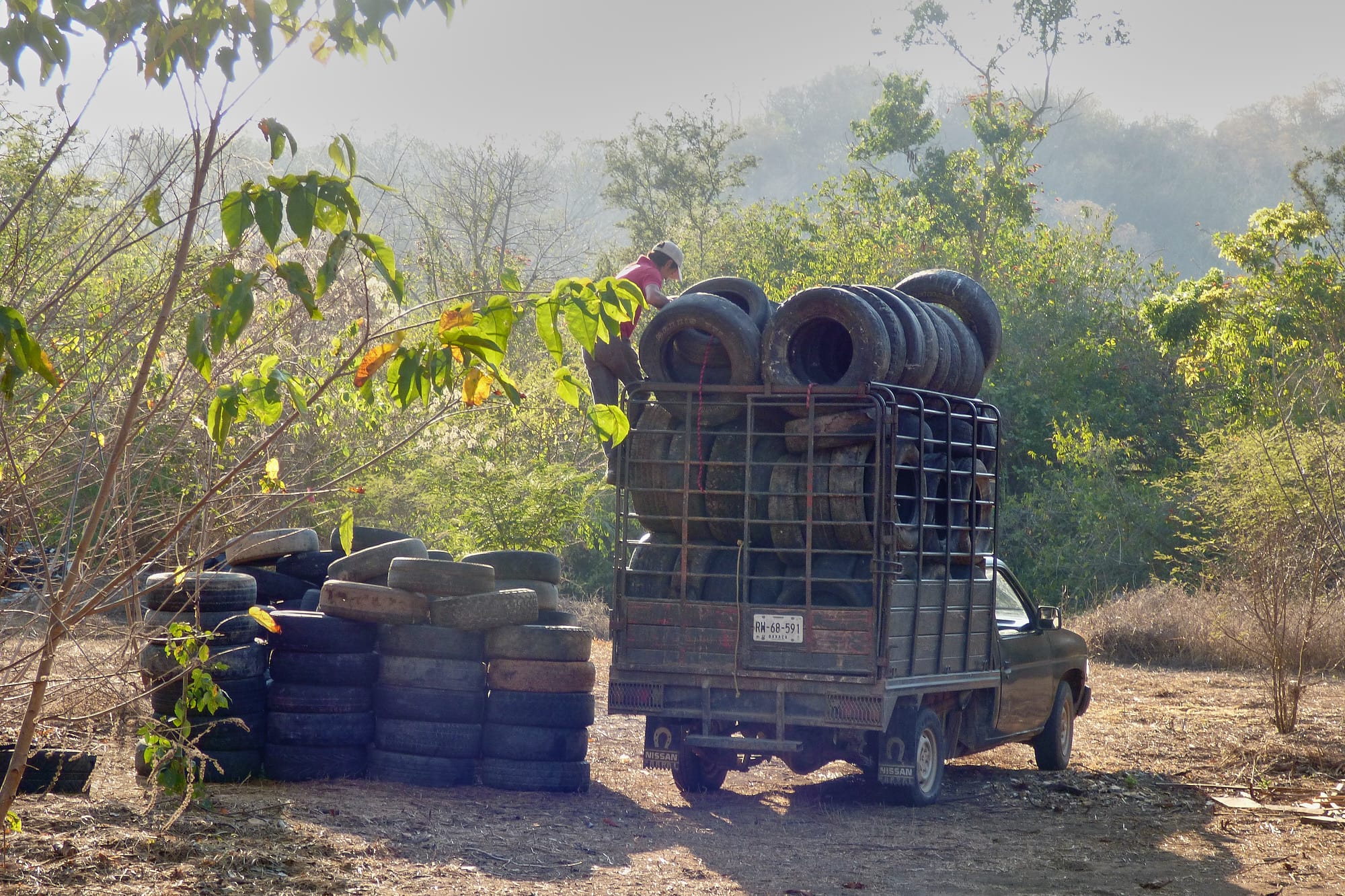
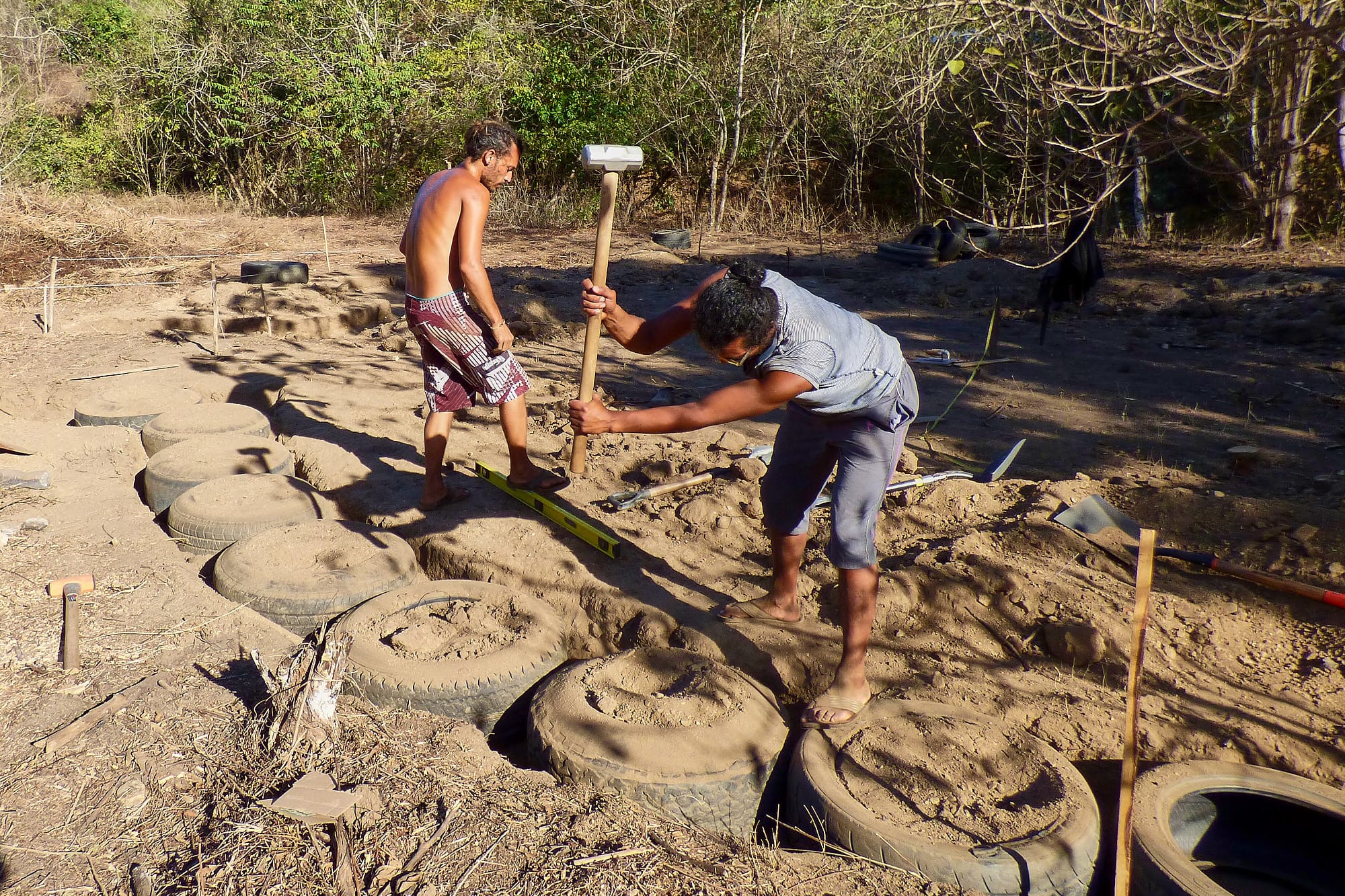
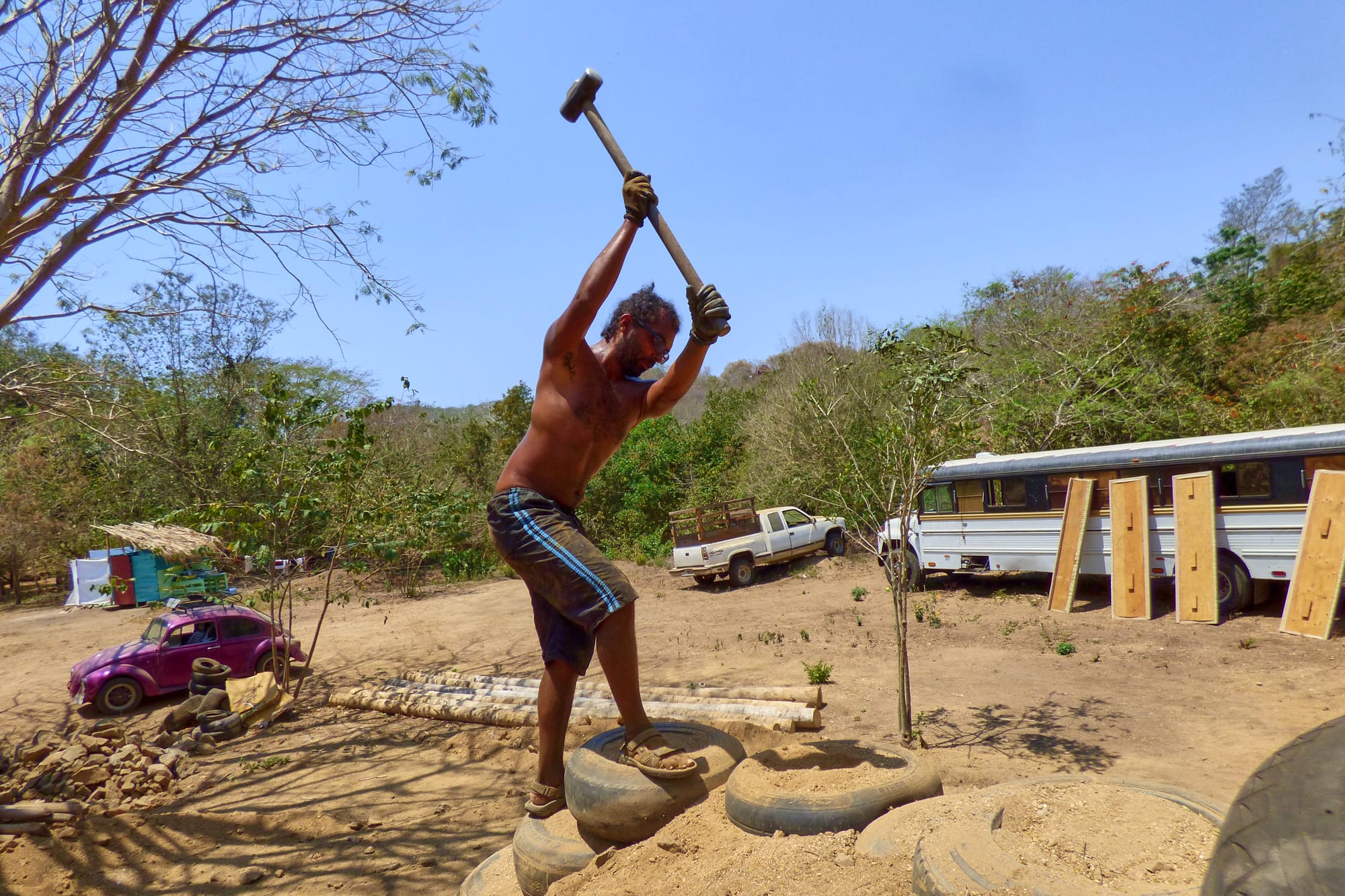
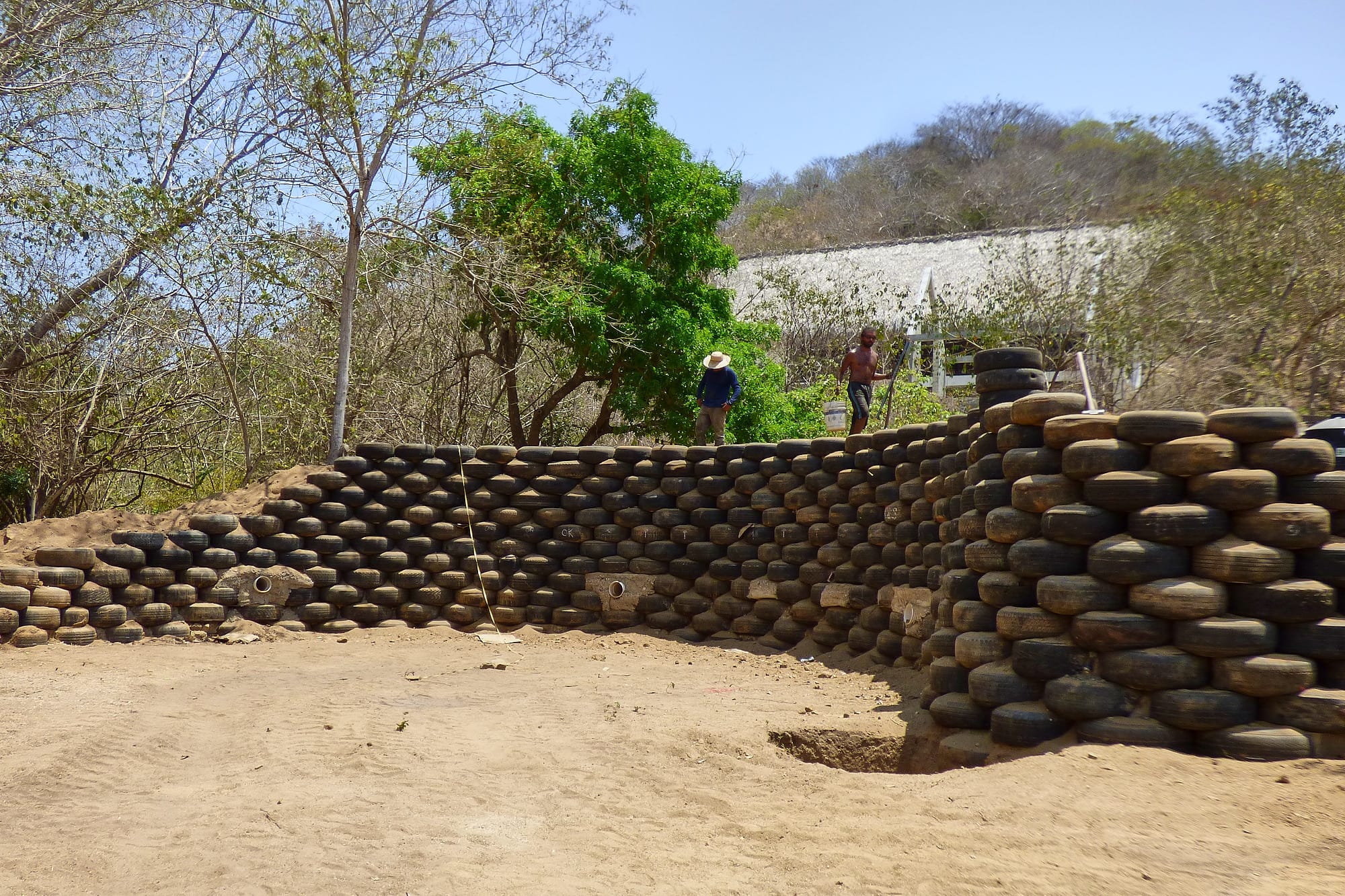
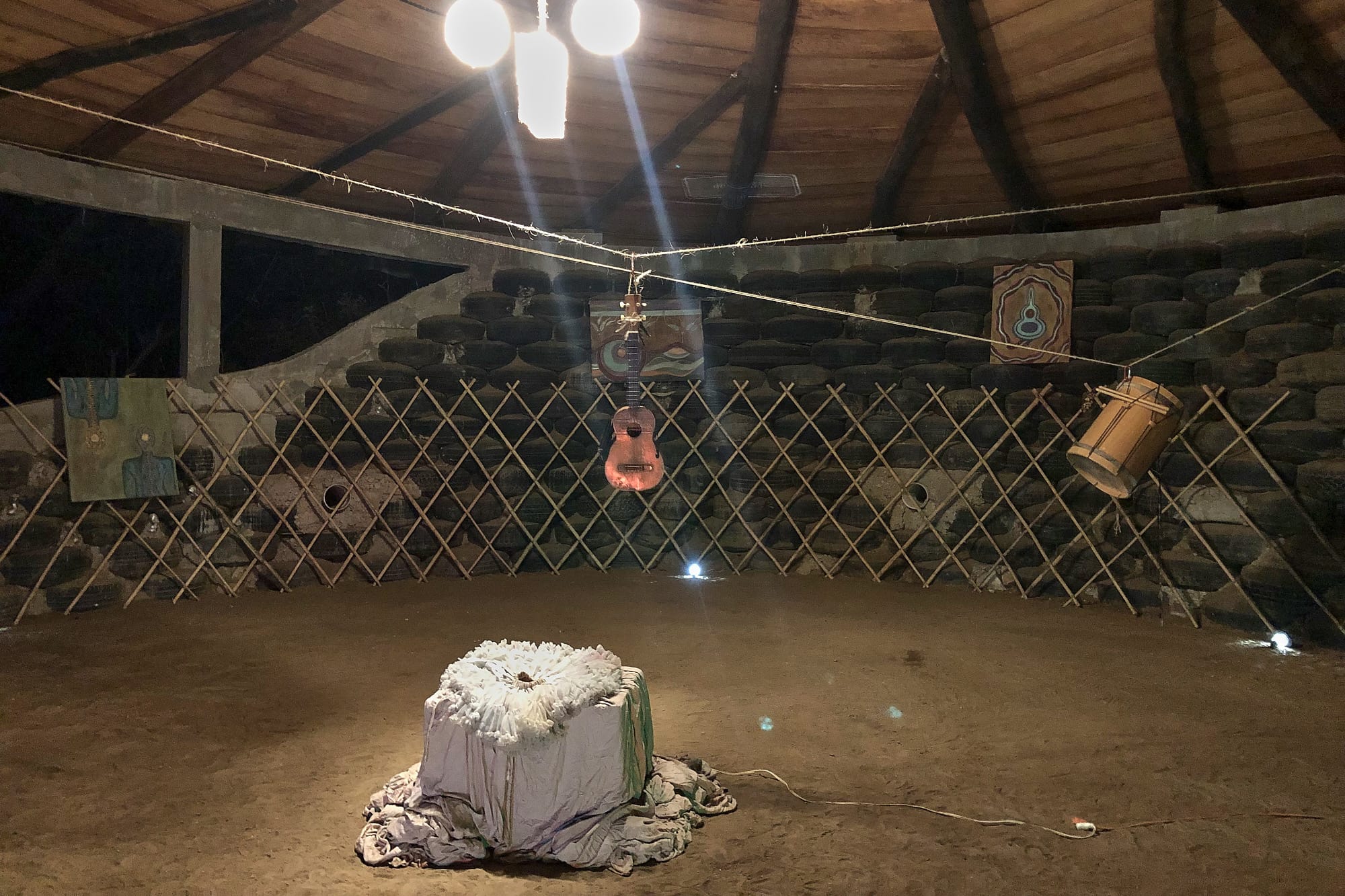
Using techniques derived from Earthship construction, discarded tires were filled with earth and compacted repeatedly with heavy sledgehammers. Tire after tire, layer after layer, they became massive walls. Behind parts of those walls we packed additional earth, creating thermal mass and helping regulate the temperature of the space.
It was slow physical work. For long periods our rhythm became very simple: we would go back to Europe, work through the summer, save as much as possible, return to Mexico, and build again.
Money became walls. A performance became a deposit on land. A summer of work became timber. A crowdfunding campaign helped us finish another section of the roof. The project grew according to what we could afford to do next.
Learning to arrive
Building the structure turned out to be easier, in certain ways, than building a relationship with Mazunte.
At first, we tried to introduce ourselves through our work. We proposed a free theater workshop at the local school. One class had been without a regular teacher, and we imagined that offering an arts program would obviously be welcomed. It wasn't.
We sat in a classroom with the parents, many of them mothers, squeezed into the children's chairs in the midday heat. We explained our program.
One woman finally said what several people were clearly thinking: she had expected the meeting to be about getting their children a teacher.
Instead, strangers had arrived proposing theater. Again, we had misread the situation. A free project is not automatically a needed project. Good intentions do not remove priorities that already exist.
We went away, talked about what had happened, reconsidered our approach and eventually asked to present the program to another class.
This time we explained more clearly who we were, what experience we had, what the workshop would involve and why we believed it could be useful.
After an uncomfortable silence, one mother said quietly that she agreed. Others followed. It was a very small beginning, but perhaps the right kind of beginning. We also began learning about forms of collective organization that already existed there.
Assemblies, committees and tequio — collective work carried out for the community — were not theories. They were part of everyday civic life. Decisions could be contested loudly and publicly. People contributed labor to common tasks. Participation carried responsibilities.
At Arroyo Cruz, where I had bought the smaller property, I discovered my name on the list for a tequio to mark the boundaries of the cemetery. They did not know my surname, so someone had written me down as “Julia La Boquilla,” Julia from the beach. I signed.
On the appointed day, Stephane and I went to help set a concrete post into the ground. People shared tools, carried materials, worked beside their children and neighbors. We were later told that we had been the first foreigners to take part in a tequio there.
For me, that mattered more than arriving with another cultural proposal. For once, instead of asking the community to participate in something we had imagined, we were participating in something that already belonged to them.
A theater without bathrooms
Eventually, the walls rose and the roof existed. And then, for a while, I found myself largely alone with the project.
Some of my colleagues needed to step away. We had already worked with many volunteers over the years — artists, musicians, craftspeople, people traveling through Mexico, people staying for months — but suddenly I had to confront a fairly obvious problem.
We had built a theater. We had not built everything needed for people to use one. There were no proper bathrooms. No real kitchen. No comfortable accommodation. What existed had been sufficient for us and for volunteers working on the construction, but it was not yet a place that could receive a public.
I am a performer and cultural organizer. I am not an ecological builder. So I began working from what I knew.
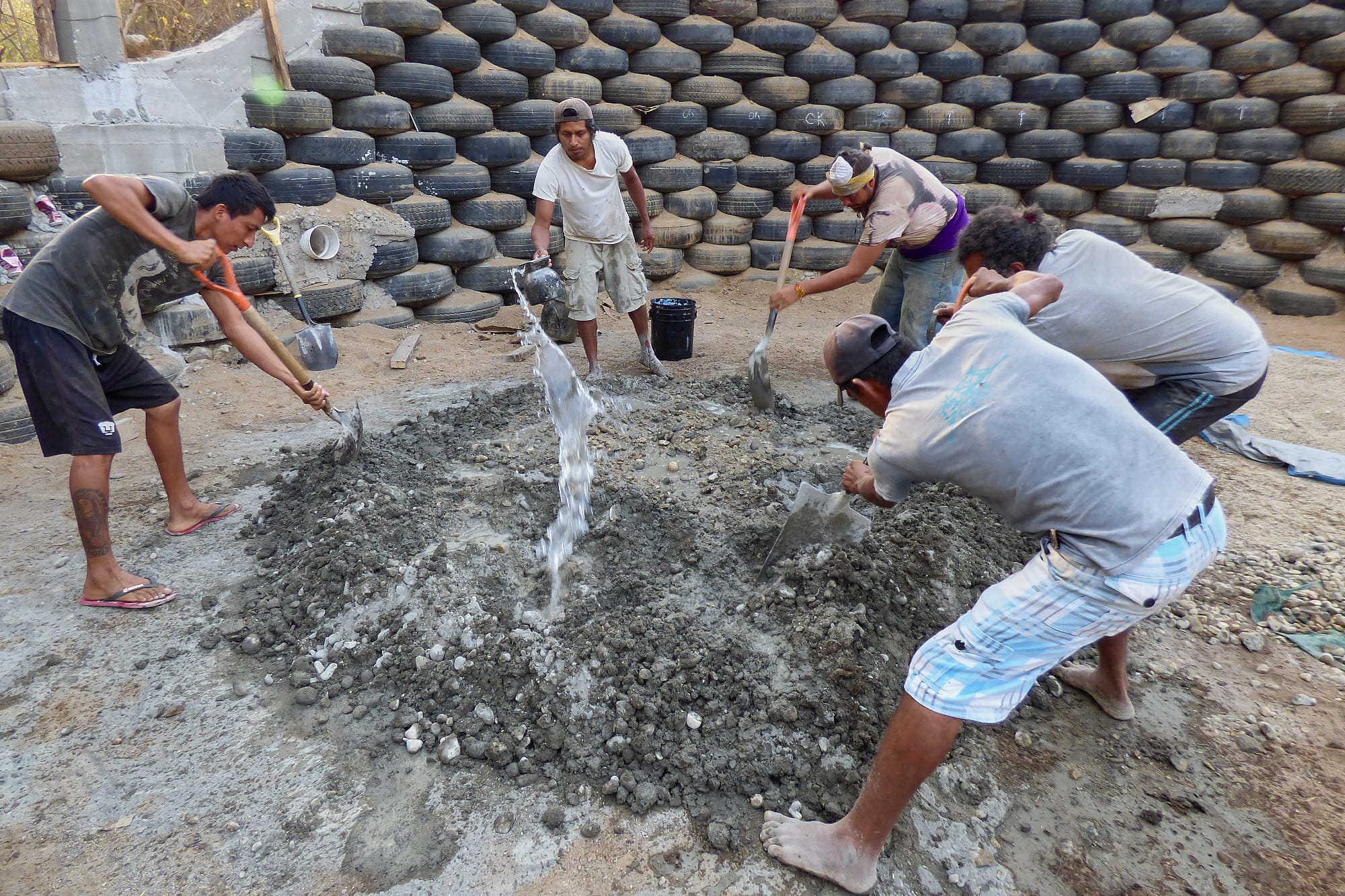
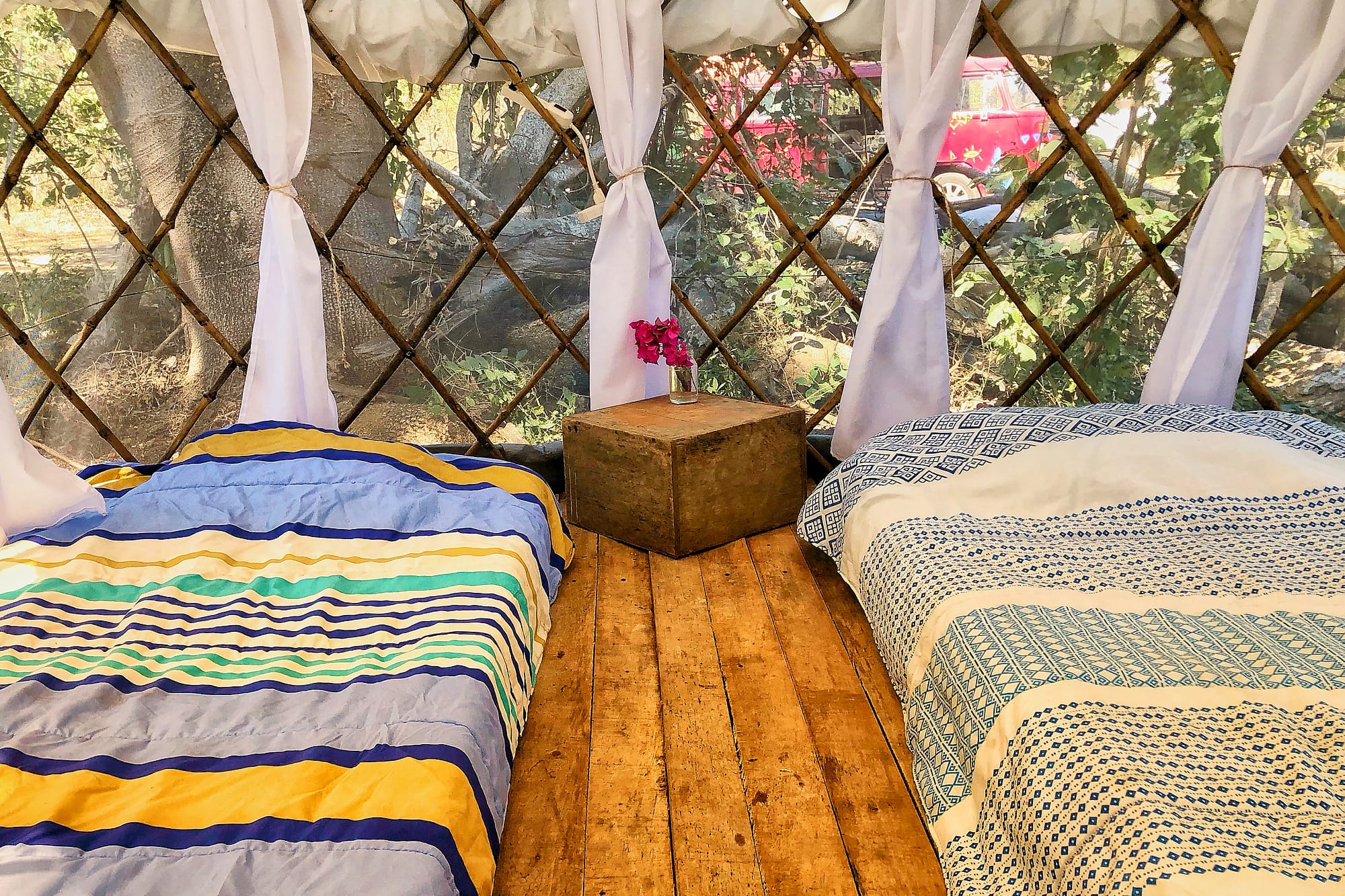
With volunteers, we made a kitchen. We repaired bathrooms and added another near the theater. We created a small open-air cinema. Through workshops we began constructing simple yurts where people could stay.
At first there were two. Then three, then four. Today there are six. They became part of the economic survival of Itínera. We rent them inexpensively, particularly to artists and people who stay for residencies or exchange time and work for accommodation.
Over the years they have become more comfortable: floors, fans, mosquito nets, better facilities. Nothing arrived fully formed. The same was true of the theater. I decided we would use it before it was finished.
If the floor was dirt, then the dirt could become part of a performance. If there were yurts, the yurts could become part of the space. We held performances, concerts, workshops, small events. Artists came and stayed. Work was presented.
Instead of waiting for the perfect theater, we began making theater with what was there. That decision probably saved the project.
Still unfinished
The strange thing is that Itínera is still unfinished. After all these years, there are floors we are completing, spaces we still want to build, and better working conditions we would like to provide for the artists who come here. For much of the year, while coordinating the project, I still live in one of the yurts.
We have moved slowly because we are independent. We have no permanent institutional funding behind us; much of what exists has been built with money we earned elsewhere, income generated by the space itself, crowdfunding at particular moments, and the work of people who chose to stay and help.
My own salary remains very small. I don't say this to romanticize sacrifice. There is nothing particularly poetic about worrying about the next expense, postponing construction, or calculating how much of what you earn can go back into a roof, a bathroom, a floor.
I hope that, as the place improves, the conditions of the people who keep it running will improve too.
But slowness has taught me something. For years, people in Mazunte must have looked at us and wondered what exactly these foreigners were doing. We worked a great deal and yet seemed to advance very little. Ten years later, the theater is still not completely finished.
At the same time, something less visible has changed. I play in two musical groups that are closely connected to projects in the village. People know us now. They recognize what happens at Itínera, come to performances and concerts, recommend the place to others, participate in workshops, sometimes support what we are doing.
The relationship we hoped to create at the beginning did not arrive because we described our intentions well enough. It developed through time, repetition, mistakes, work, and presence.
That distinction matters to me. When we first came to Mazunte, we were thinking about what we wanted to build. Today I think much more about what can be shared.
Art is still at the center of the project, but after these years I find it difficult to separate artistic work from collective life.
A performance exists because other people are there to see it. A cultural space exists because people cross its threshold. A project such as this has very little meaning if there is nobody with whom to share it.
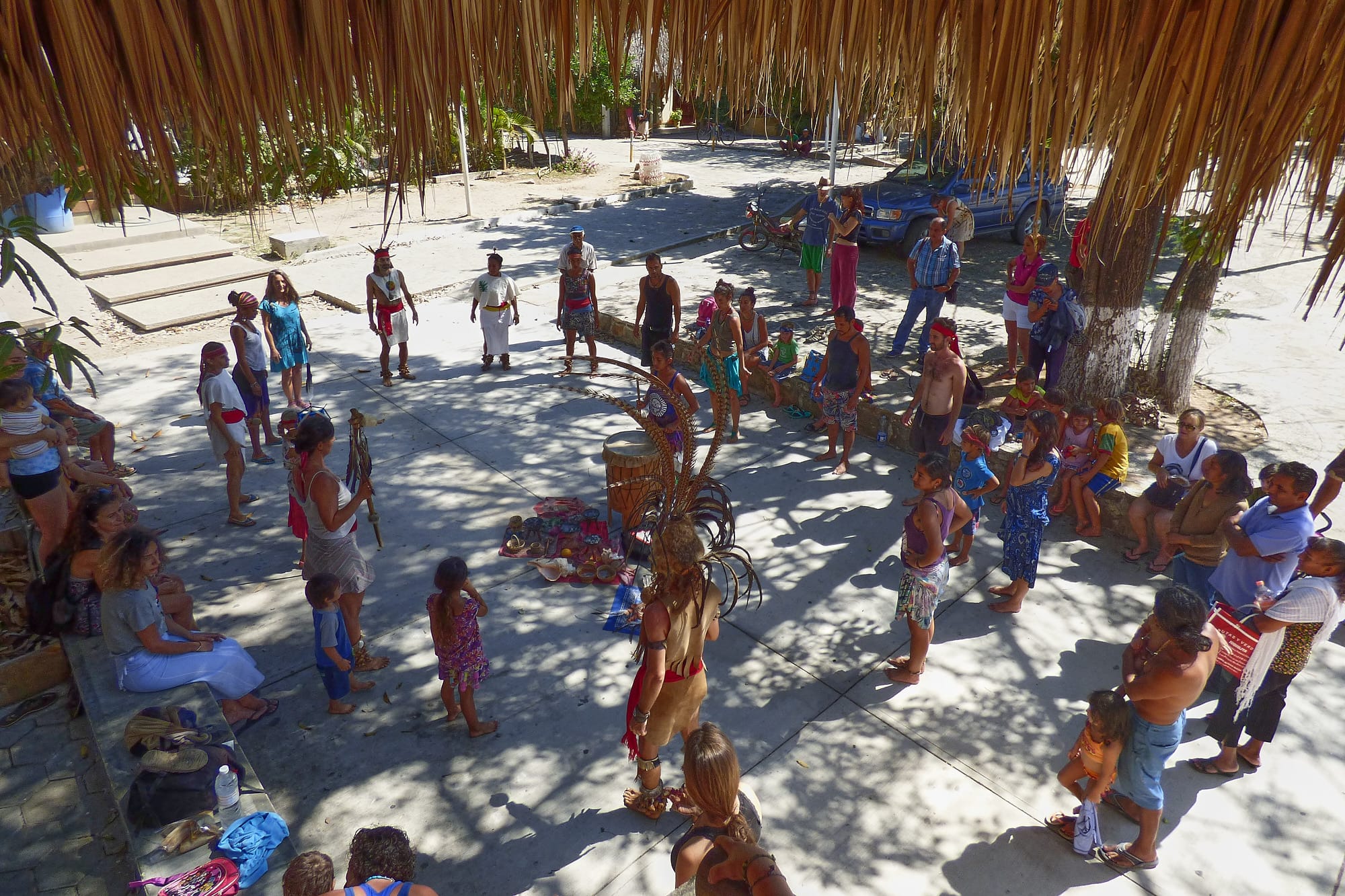
Perhaps this is also why Itínera has never become the place we originally drew on paper: it has become a constellation of smaller things: a theater, yurts, workshops, concerts, residencies, an outdoor cinema, collaborations, friendships, unfinished rooms, projects we still cannot afford, people arriving and leaving, and relationships with a village that continue to change.
There is still a great deal we would like to do. We still need resources. We still improvise more often than I would like.
But independence has also forced us to understand the real dimensions of what we are building. Every addition has a cost. Every project needs people. Every idea eventually has to become wood, cement, a payment, a working day, a conversation with a neighbor.
In the beginning, I thought our task was to build a theater. Now I think the theater was only the visible part. The harder work was learning how to remain somewhere long enough for a place to become shared. And that work is still unfinished.


Member discussion