


The Day of the Diplomas
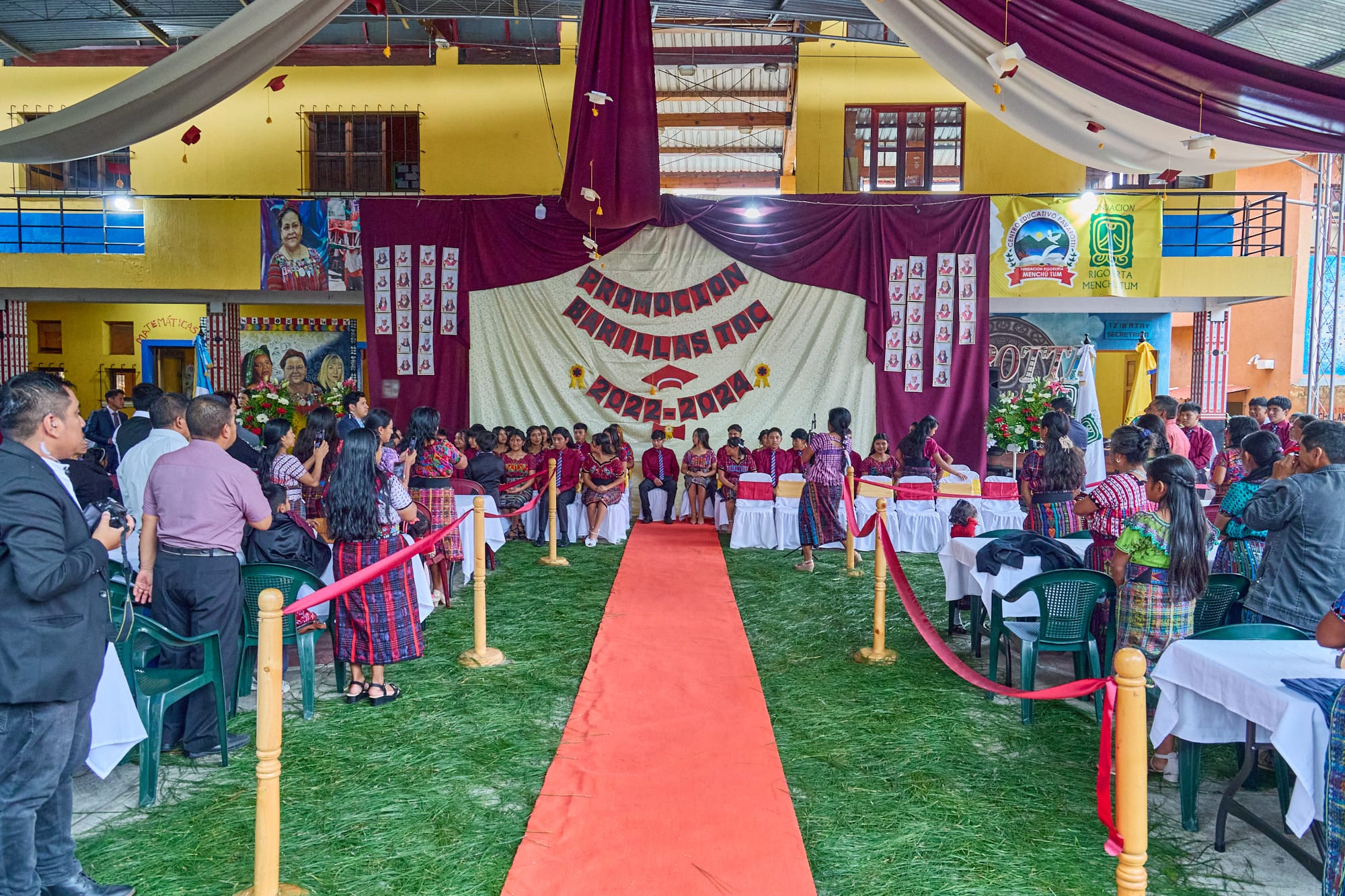
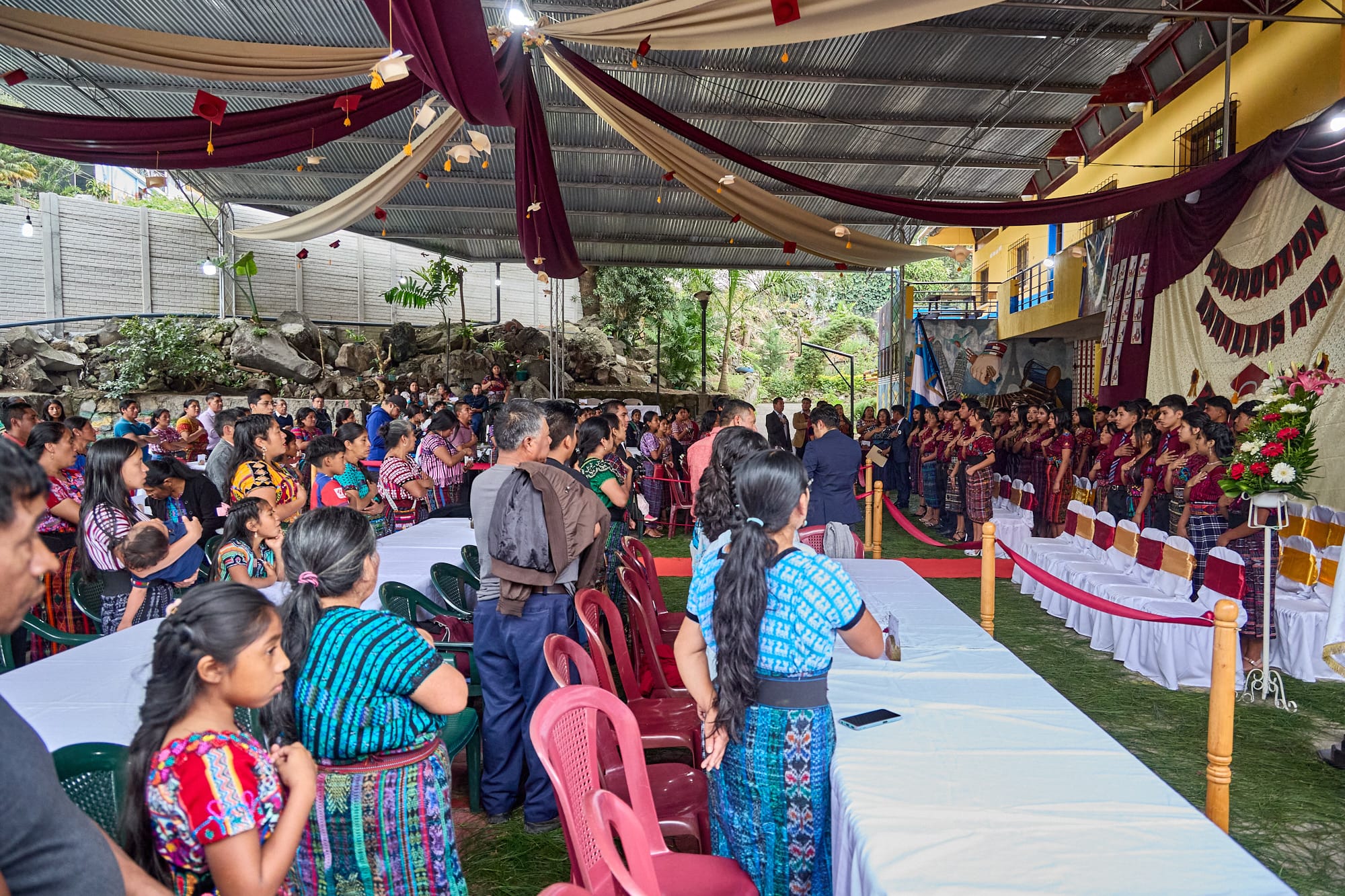
There is a red carpet running across the courtyard, between rows of chairs covered in white fabric. Burgundy and cream-colored drapes hang beneath the metal roof, and the walls of the school, painted yellow and blue, have been decorated with flowers, portraits, and the names of the graduating students. At the far end, a banner announces the completion of the 2022–2024 school cycle.
It is graduation day at the Centro Educativo Pavarotti, in San Lucas Tolimán, a town on the southern shore of Lake Atitlán, Guatemala.
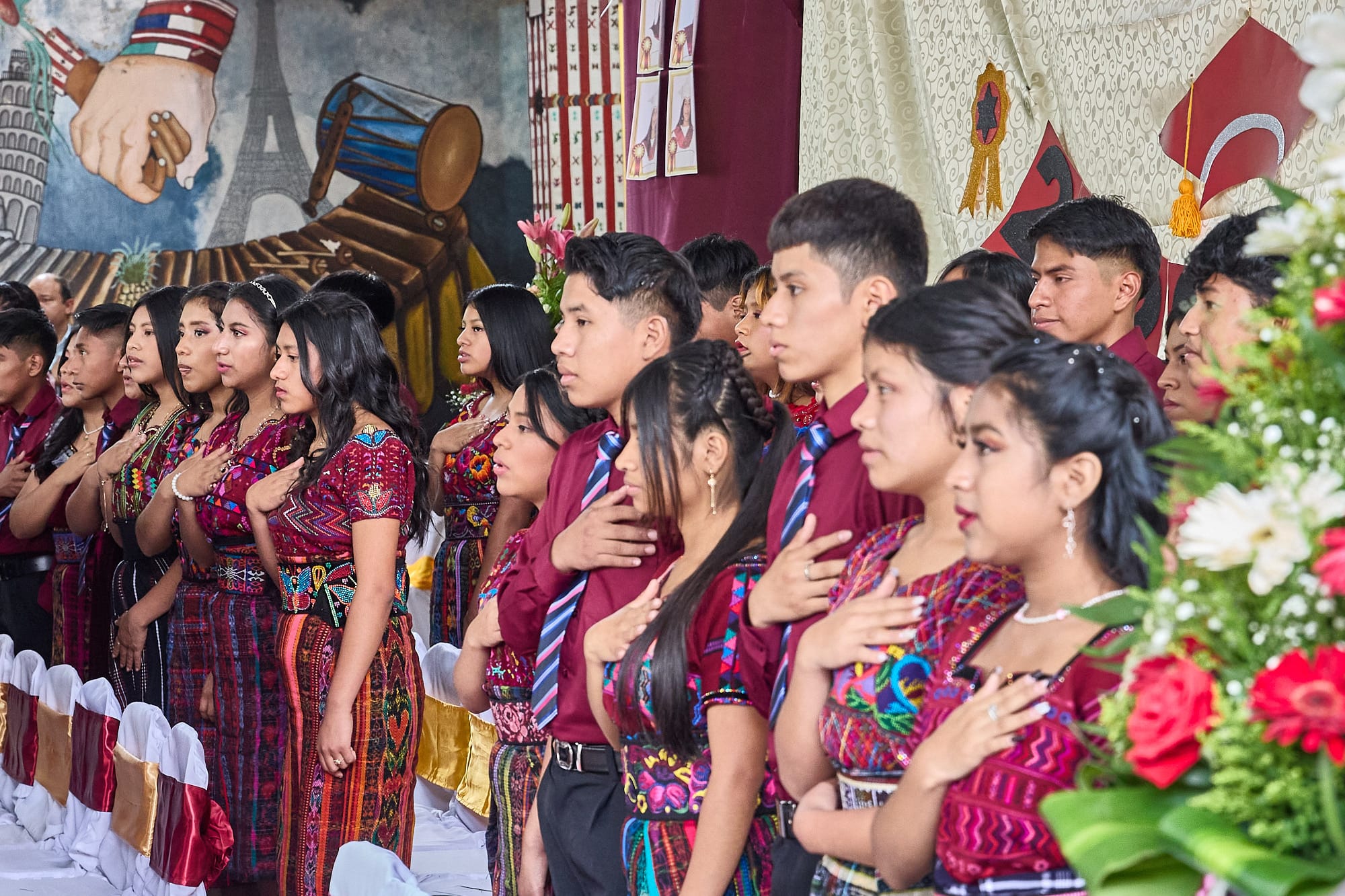
The students have dressed for the occasion. Many of the boys wear burgundy shirts and striped ties; many of the girls wear intricately woven huipiles, the traditional blouses whose colors, patterns, and techniques belong to the living textile cultures of the Maya peoples.
Families have gathered around the courtyard. Some people photograph the ceremony with their phones; others stand beside the tables, watching the students take their places.
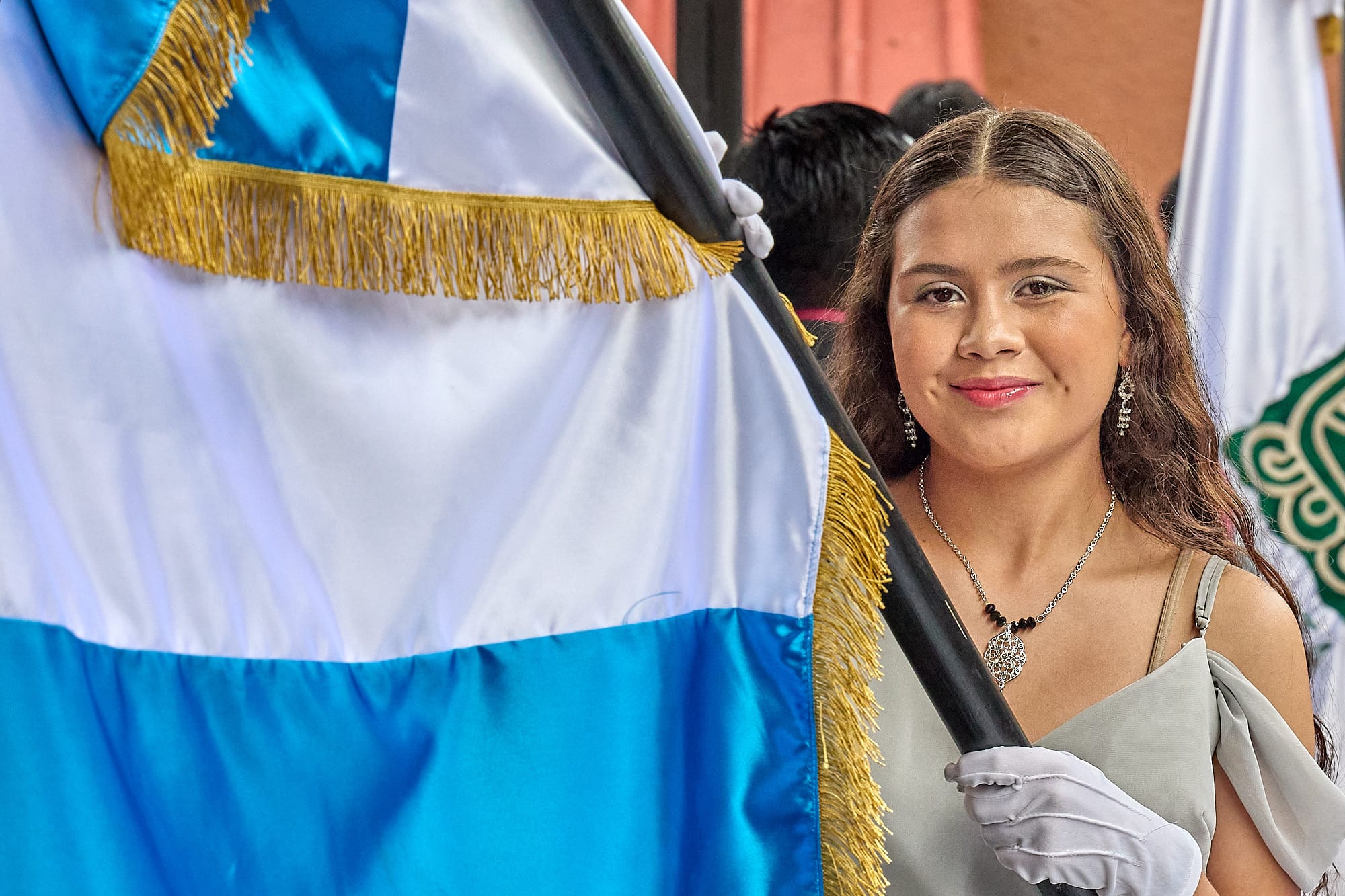
A young woman carries the Guatemalan flag. The blue and white fabric fills much of the photograph, its gold fringe crossing the frame, while the flag bearer looks toward the camera.
There is something particularly appropriate about this image in a school whose educational philosophy gives such importance to cultural identity: here, students are encouraged to recognize themselves within their own communities while taking their place in the wider life of their country.
Among those attending the ceremony is Rigoberta Menchú Tum, the K'iche' Maya activist who received the Nobel Peace Prize in 1992 and whose foundation has guided the school for more than two decades.
Her presence belongs to the history of this institution, which was created through an unlikely collaboration between a Guatemalan Indigenous rights advocate and Luciano Pavarotti, the Italian tenor whose name appears above the entrance.
Yet the attention of the day belongs to the young people receiving their diplomas. For each of them, the certificate marks the completion of a stage of secondary education.
For the school, it represents another class having passed through a program developed around a demanding idea: Indigenous students should have access to excellent academic education, with their languages, cultural knowledge, and communities treated as essential parts of the learning process.
The implications extend well beyond a graduation ceremony. They concern the kind of society a school helps make possible.
A School That Takes Knowledge Seriously
The Centro Educativo Pavarotti serves young people from Maya communities around Lake Atitlán and the surrounding countryside. Its educational program is known as Utzilal Tijonikel, commonly translated as "Teaching Goodness."
The name suggests an ethical purpose, but understanding the school requires looking carefully at what happens in its classrooms.
Students follow the Guatemalan national curriculum for the lower-secondary cycle. Their education includes mathematics, sciences, Spanish, English, Maya languages, entrepreneurship, and the arts.
The institution's pedagogical framework also emphasizes critical thinking, dialogue, social responsibility, and the ability to resolve conflicts.
Academic achievement and cultural knowledge are intended to develop together. The school describes its approach as intercultural and bilingual, grounded in the principles of human dignity, diversity, and peace.
These principles have practical consequences for the way education is understood: students are encouraged to recognize the value of knowledge acquired within their families and communities while developing the skills necessary to participate in contemporary society.
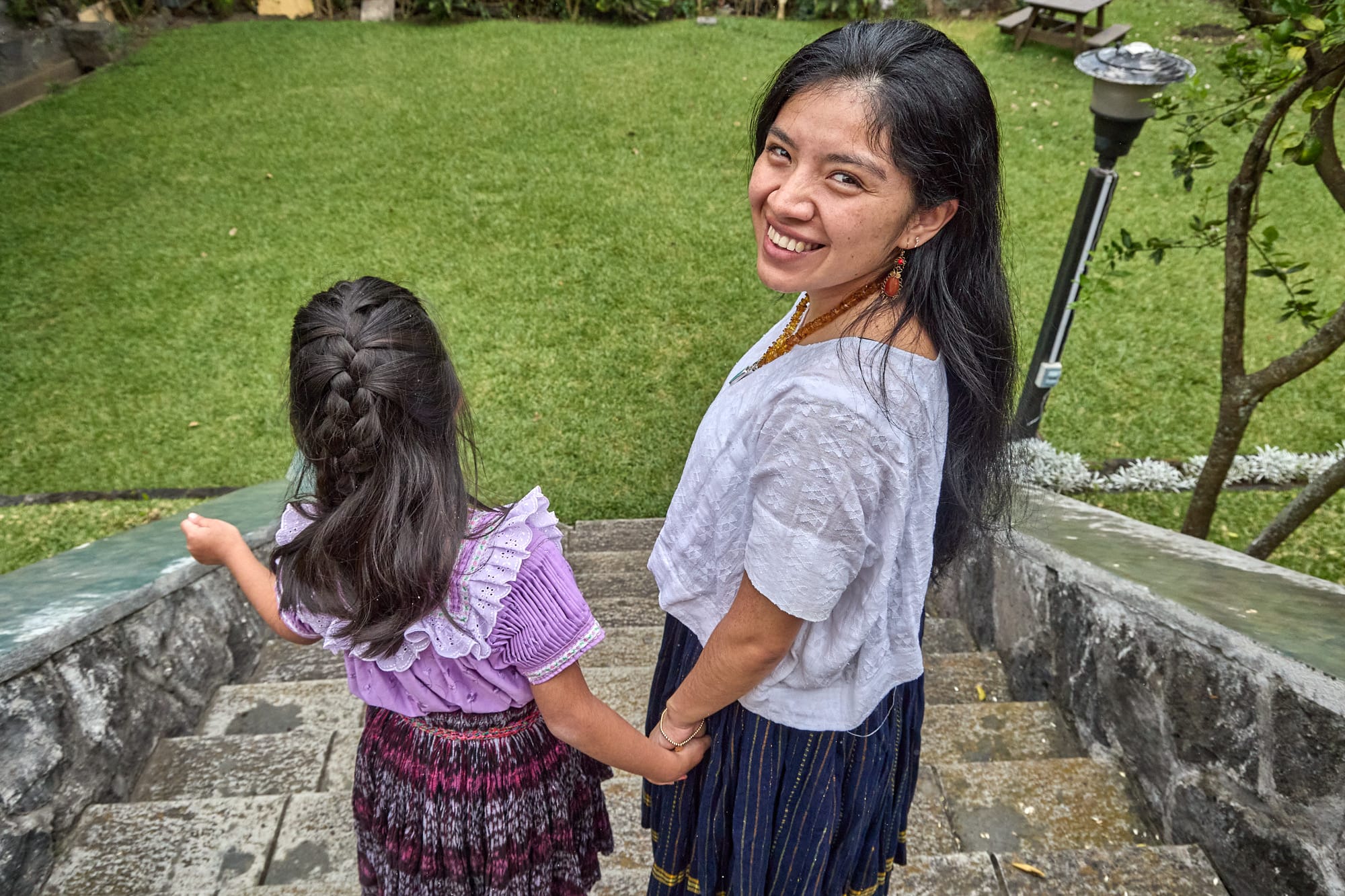
Outside the classrooms, the ordinary life of the institution continues. In one photograph, the school's director descends a flight of stone steps holding a young girl's hand.
The girl faces away from the camera; the director turns toward it and smiles. The photograph says little about the educational curriculum, but it gives the institution a human scale.
Inside, a group of students sits on the classroom floor, working with colored paper and notebooks. Others gather around desks. On the yellow wall hangs a linguistic map of Guatemala, showing the distribution of the country's languages. It is a small detail, easily overlooked, but particularly relevant to the educational project.
Guatemala is a multilingual country in which Spanish exists alongside numerous Maya languages, as well as Xinka and Garífuna. For generations, however, Indigenous children have frequently encountered educational systems in which their mother tongues were marginalized or regarded as obstacles to advancement. The consequences of this inequality have been profound.
In 2020, UNICEF reported that, according to Guatemala's 2018 census, fewer than half of bilingual teachers could speak the relevant Indigenous language fluently. The difference between the legal recognition of linguistic rights and their practical implementation remains an important challenge for the country's educational system.
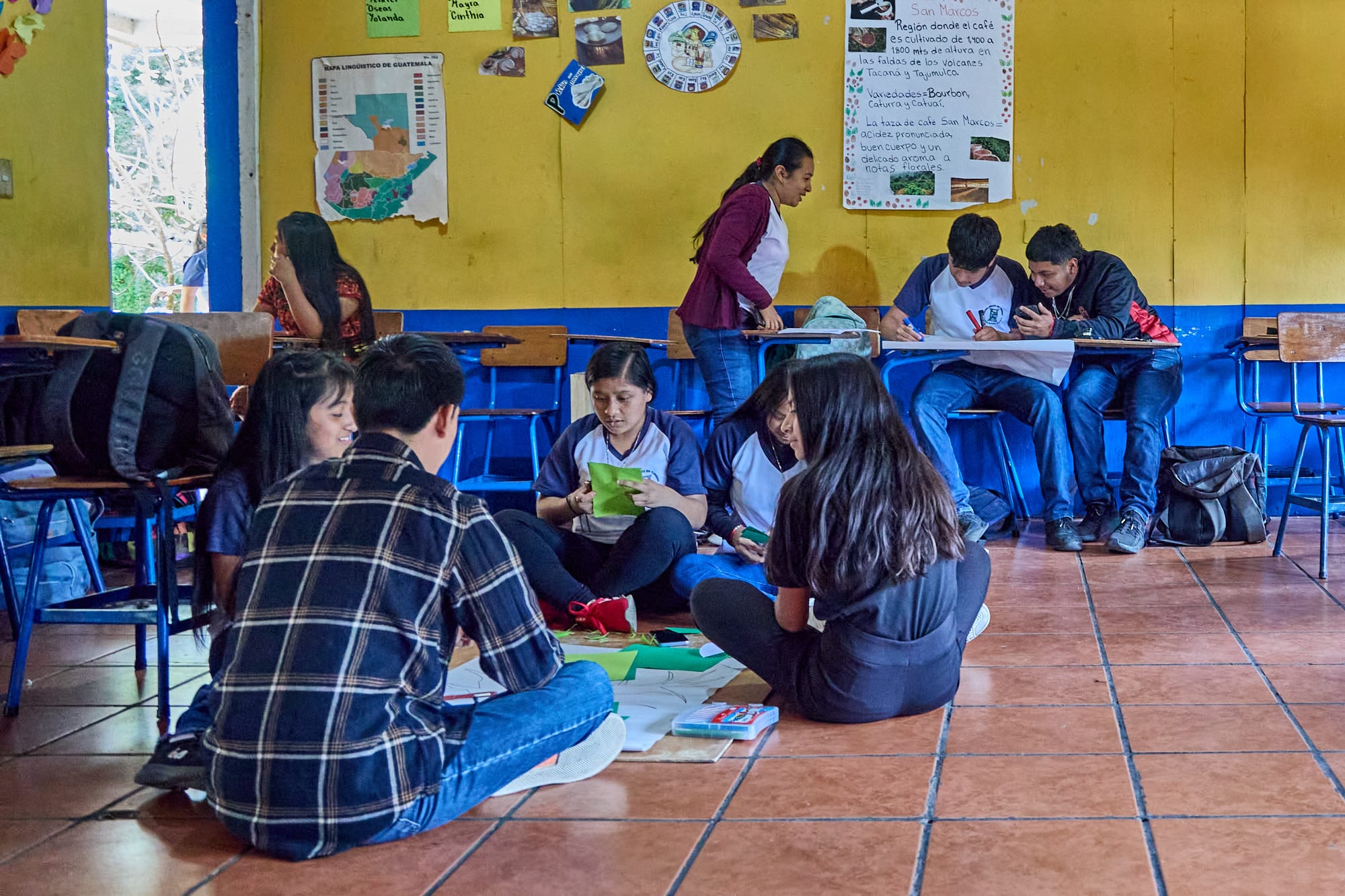
At San Lucas Tolimán, the right to speak a Maya language is explicitly included in the school's educational philosophy, alongside the study of sciences, mathematics, and other academic subjects.
These commitments matter because the purpose of a good education cannot be reduced to preparing young people for employment. It must also give them the intellectual resources to understand the world around them, question established arrangements, participate in public life, and make decisions about their own future.
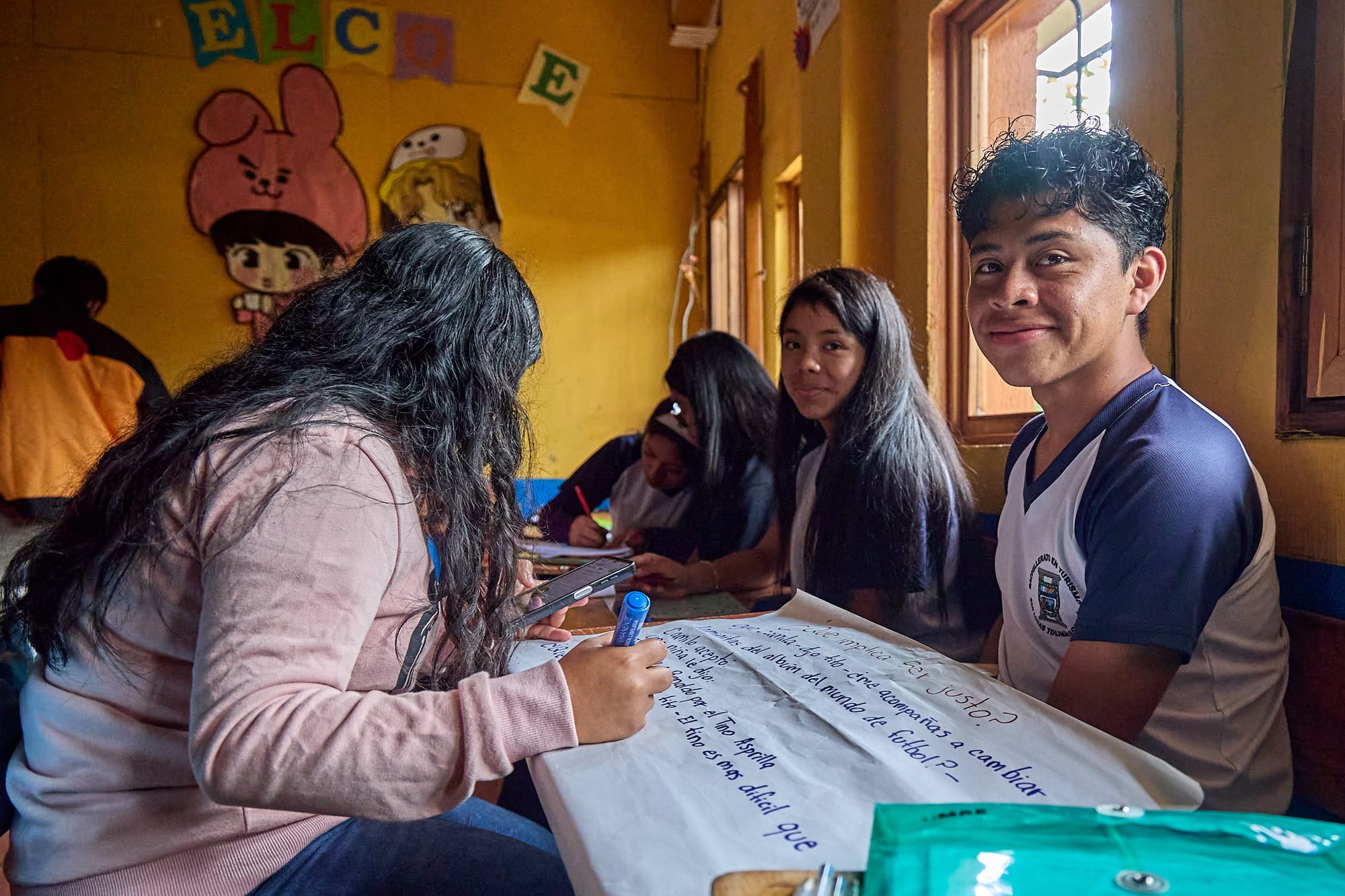
In another classroom photograph, several young people work around a sheet of paper covered with handwritten questions. One student looks toward the photographer; the others remain occupied with the exercise.
The setting is ordinary: desks, school uniforms, notebooks, a window admitting daylight. There is nothing ceremonial here. The importance of the photograph lies precisely in that ordinariness, in the possibility of seeing students engaged in the daily work of learning.
The Right to Remain, the Freedom to Leave
For Indigenous communities, education has often been associated with a difficult choice: learning the dominant language and entering national institutions can provide access to opportunities that were previously unavailable.
But when schooling treats Indigenous knowledge as inferior, education can also become a mechanism through which younger generations are encouraged to distance themselves from their own communities. The Centro Educativo Pavarotti was created around a different understanding of that relationship.
Its curriculum recognizes the cultural knowledge of the Maya peoples, including traditional agricultural practices, the Maya calendar, textile arts, music, and respect for the natural world.
The school also promotes the right to wear Maya clothing and speak Maya languages within the educational environment. These practices belong alongside the academic curriculum rather than outside it.
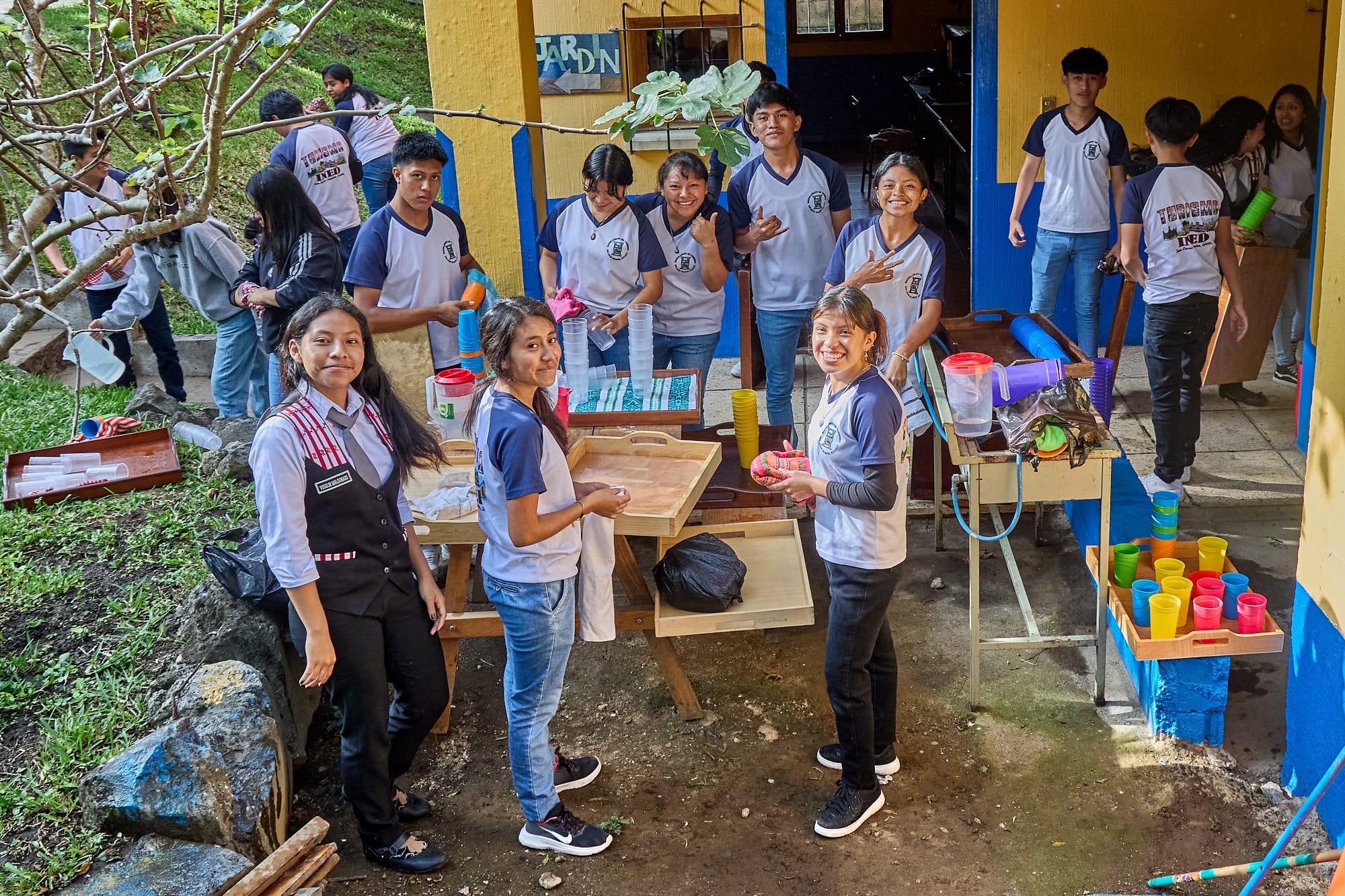
The surrounding communities are themselves diverse. The Fundación Rigoberta Menchú Tum identifies Kaqchikel, Tz'utujil, K'iche', and mestizo populations among those served by the institution.
Their languages, histories, and cultural practices cannot be reduced to a single, undifferentiated Maya identity. Understanding that diversity is part of understanding what intercultural education ought to mean.
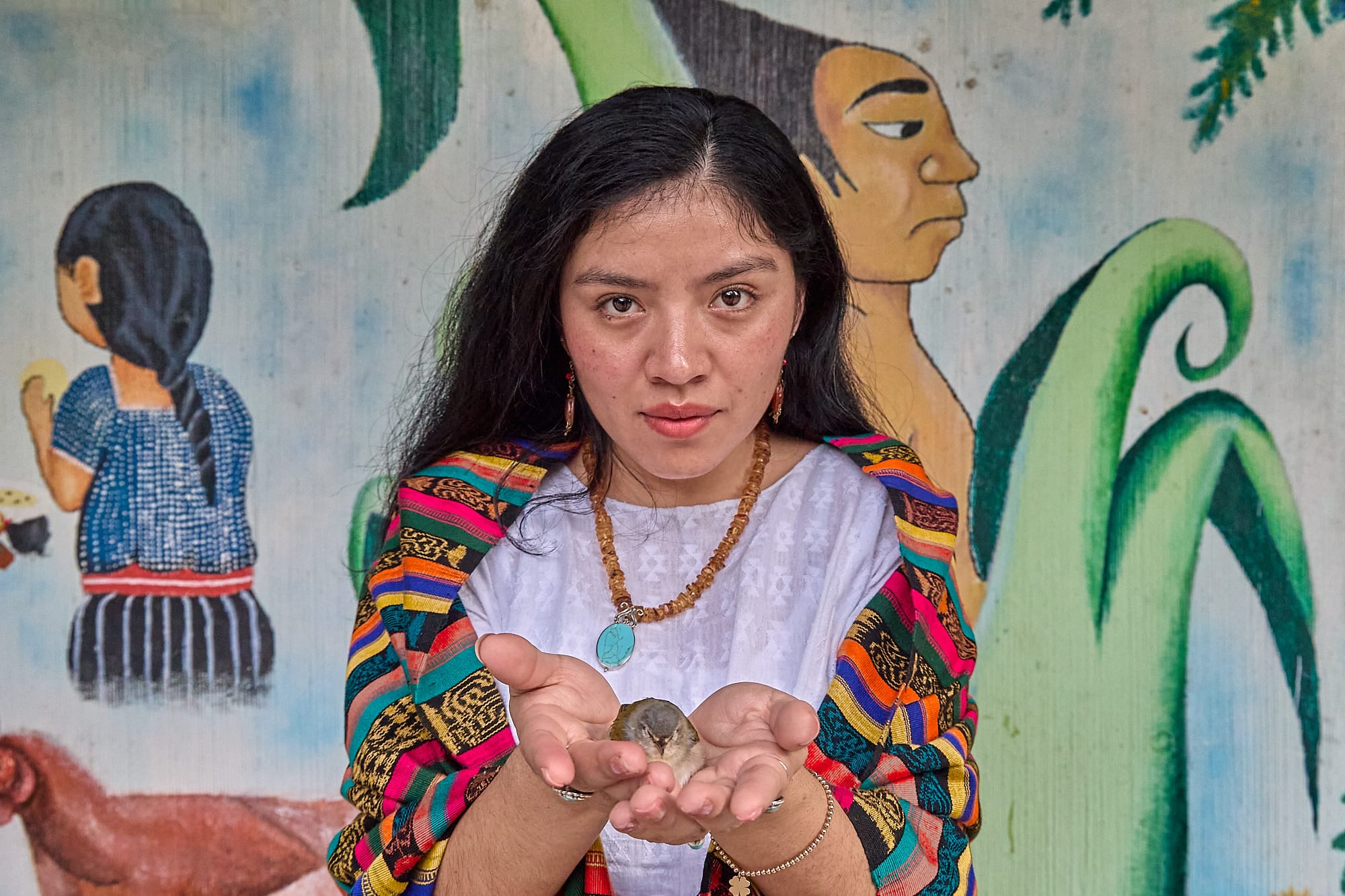
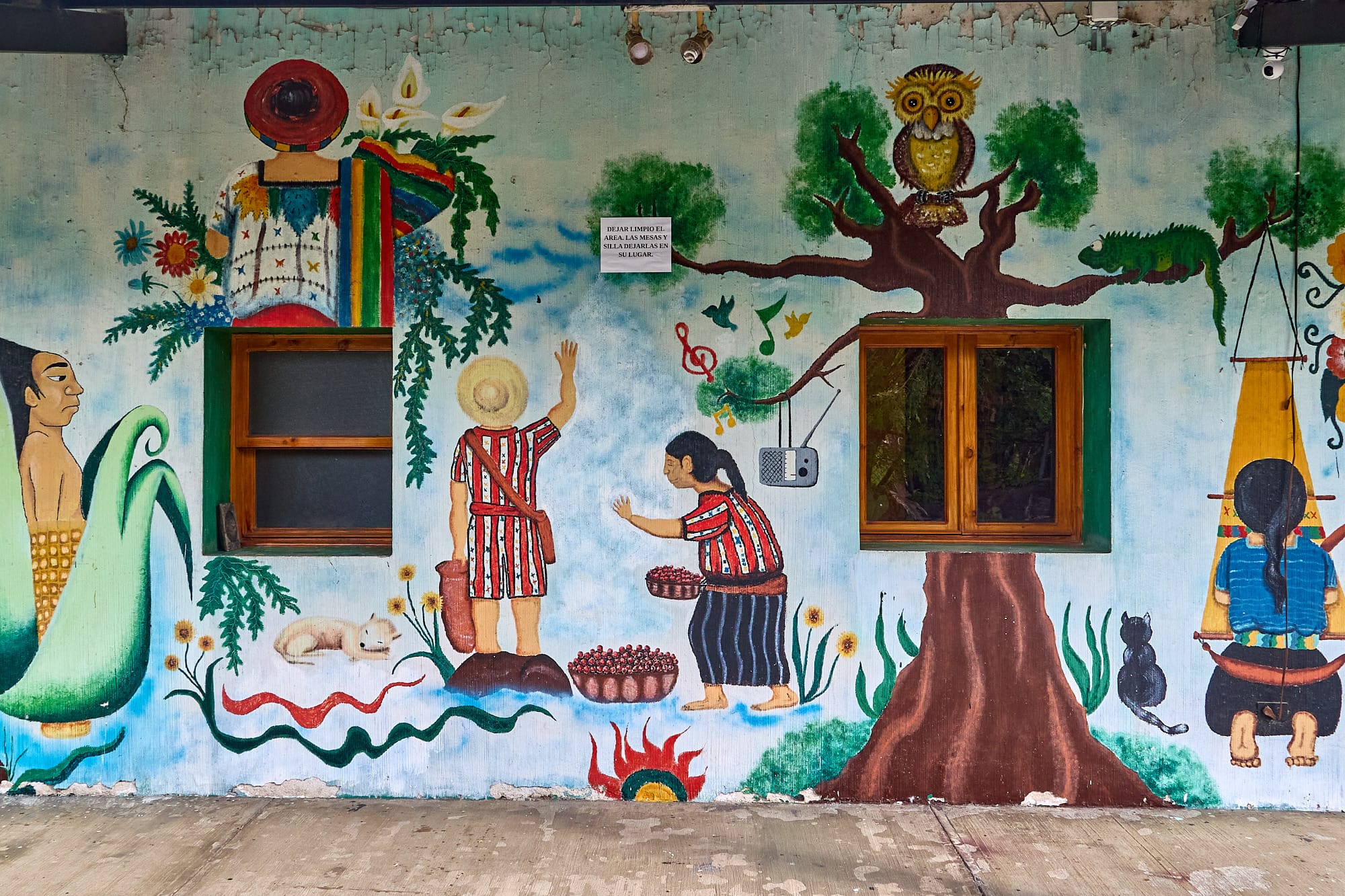
The school director appears in another photograph holding a small bird in her open hands. Behind her is a wall painted with animals, trees, and people. The bird rests between her palms while she looks toward the camera.
Without knowing the circumstances of the encounter, the photograph should not be turned into an illustration of Maya spirituality or an imagined lesson about nature. It remains an intimate, unexpected moment in the life of the school.
Cultural identity is often reduced, especially in accounts written for foreign audiences, to the most visually recognizable elements of a community: clothing, rituals, handicrafts, or traditional beliefs.
These elements deserve attention and respect. But a young Maya person is also a contemporary citizen, whose ambitions and interests may extend in many directions.
A school committed to cultural dignity must leave room for those possibilities: it should allow a student to become a teacher, scientist, entrepreneur, artist, farmer, or professional of another kind, according to personal inclination and opportunity.
Some graduates may choose to remain in their communities; others may study or work elsewhere. Neither decision should require them to deny their origins. The freedom to choose is central to the meaning of education.
The Work Behind the Classroom
A school has a curriculum, teachers, students, and a building. It also has operating costs, administrative responsibilities, maintenance needs, and the daily work required to keep its doors open.
At the Centro Educativo Pavarotti, this practical dimension has been part of the institution's history from the beginning: when the Fundación Rigoberta Menchú Tum assumed responsibility for the school, it faced the challenge of developing a financially sustainable model.
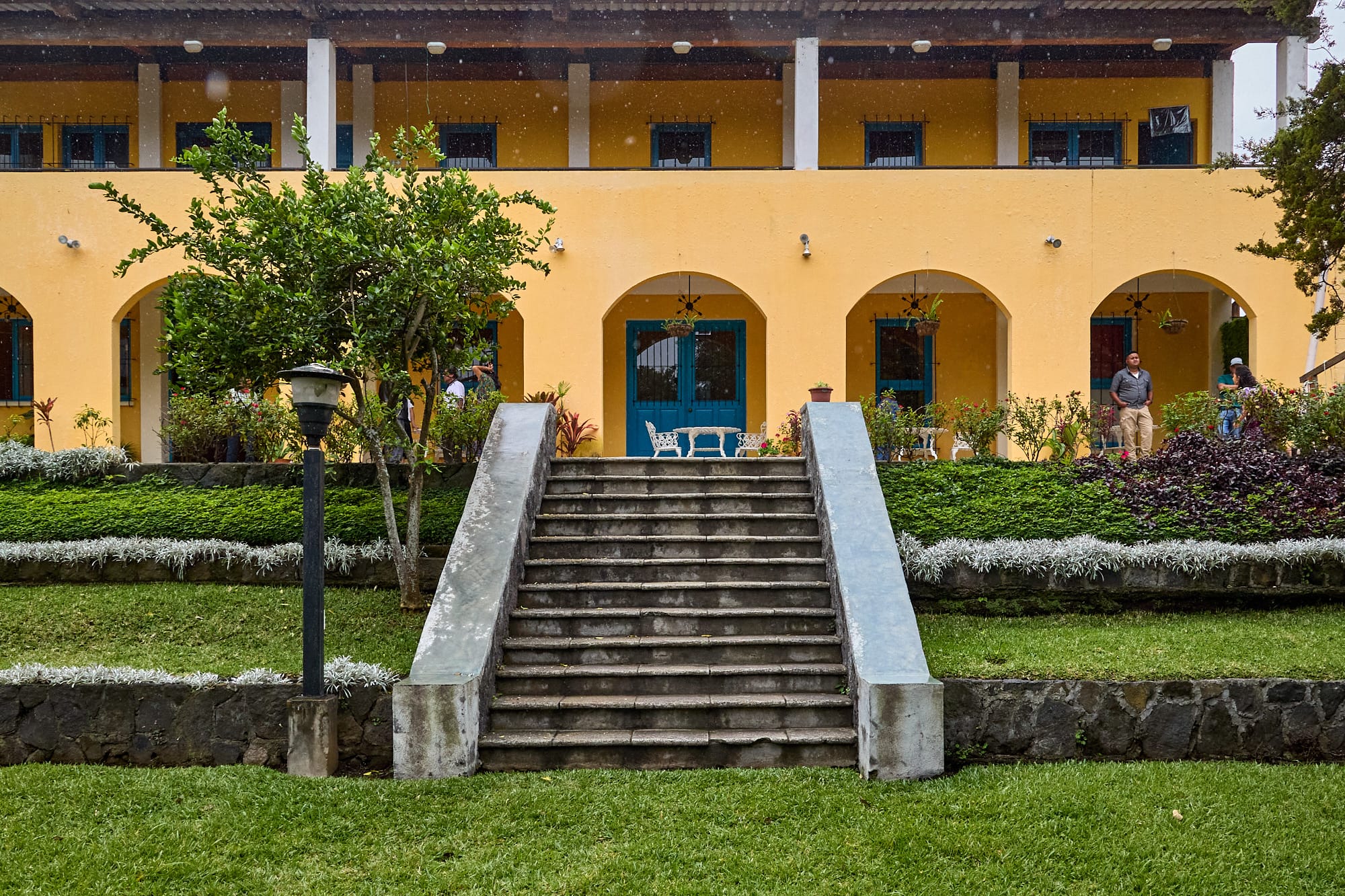
Alongside its educational activities, the center established services for visitors, including a restaurant and guesthouse, intended to generate income that could help support the school.
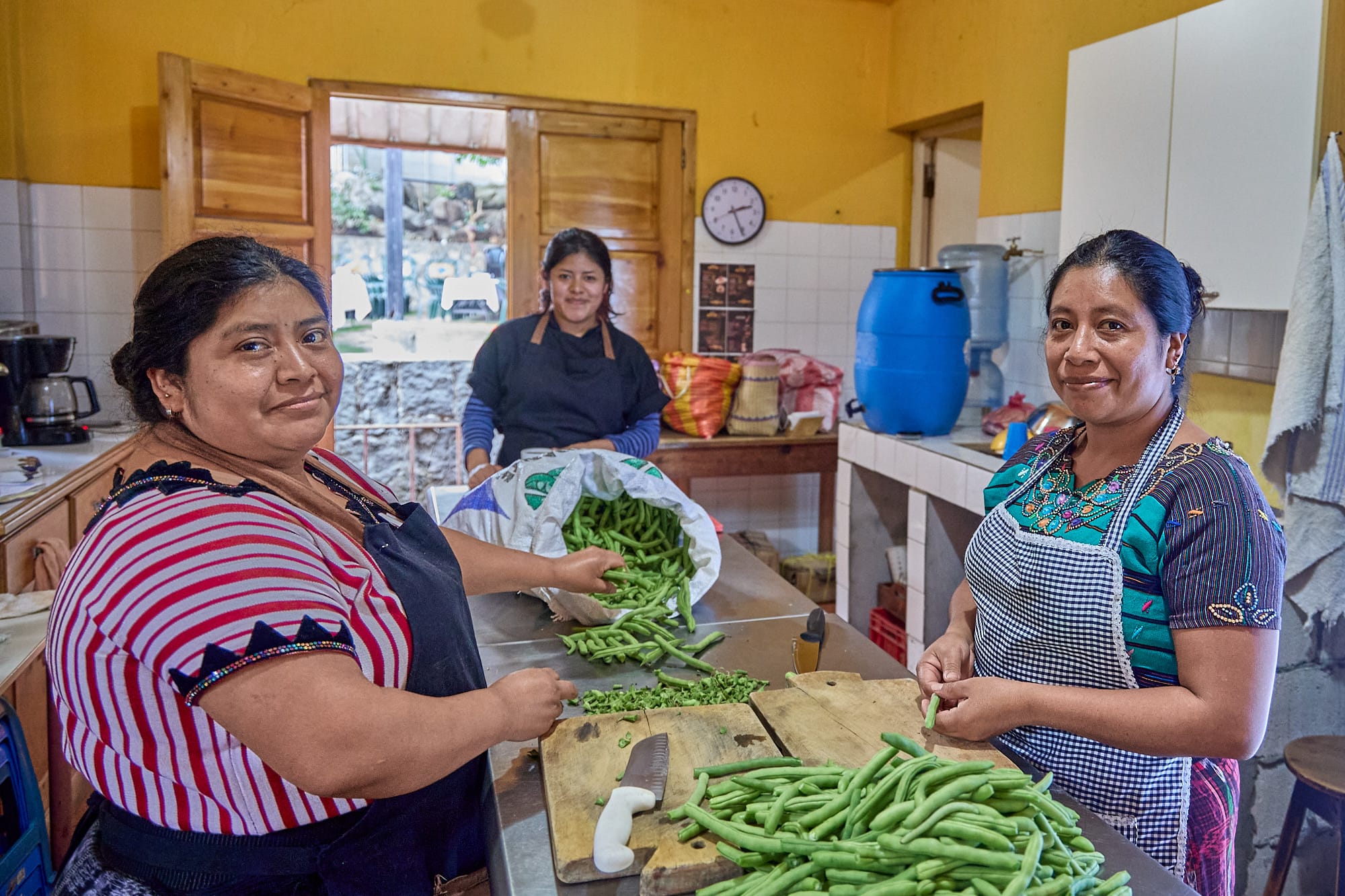
In the kitchen, three women stand around a worktable preparing green beans. One has a knife in her hand; another looks toward the camera, holding a vegetable between her fingers. Behind them are shelves, cooking equipment, containers, and an open doorway leading toward the courtyard.
The photograph introduces another dimension of the educational project: the work of adults whose contribution takes place outside the classroom.
Cooking, cleaning, maintaining buildings, welcoming visitors, and managing resources are activities that rarely receive much attention in accounts of educational achievement. Yet institutions depend on them, and their economic value deserves recognition.
The restaurant and guesthouse connect the school to visitors and provide a source of revenue for its programs. Historically, the institution also developed forms of intercultural tourism in which visitors could encounter aspects of local Maya culture.
These activities require care. Cultural exchange can create income and relationships, but Indigenous knowledge should never be treated as a spectacle organized for outsiders. The value of such encounters depends on the ability of communities to determine how they are represented and how the benefits are shared.
The experience of the Centro Educativo Pavarotti raises a broader question about educational financing. Quality education should be a public responsibility and an enforceable right.
Community initiatives can develop imaginative ways of meeting local needs, but their achievements do not absolve public institutions of the obligation to provide equitable access to schooling.
The school's history illustrates both the capacity for local initiative and the continuing effort required to sustain an educational institution over time.
Rigoberta, Luciano, and the Origins of a School
The Centro Educativo Pavarotti emerged from a particular moment in Guatemala's history: the country's internal armed conflict ended with the signing of the peace accords in December 1996. The war had lasted for decades, devastating communities and leaving profound social and political divisions.
The United Nations-backed Commission for Historical Clarification later documented extensive atrocities, including acts of genocide committed against Maya populations. Its findings identified the majority of the victims as Indigenous and examined the institutional responsibilities behind the violence.
For Maya communities, the peace accords opened a new political period, but ending the war did not eliminate discrimination, land conflicts, economic inequality, or the barriers that limited access to education and public services.
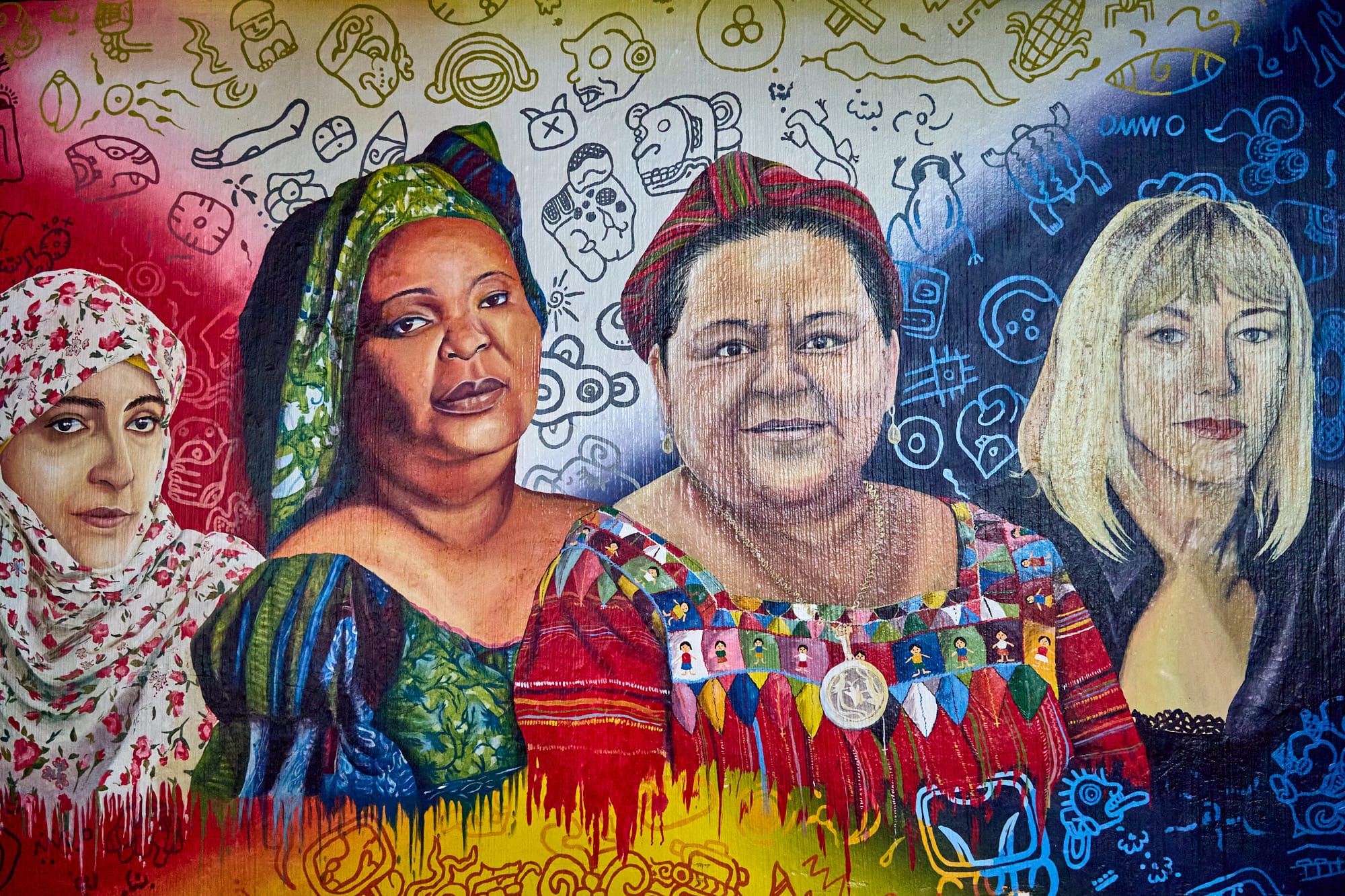
Rigoberta Menchú Tum had spent years bringing the experiences and demands of Indigenous peoples into national and international debate. Her work connected the defense of human rights with the recognition of cultural identity, historical memory, and collective participation.
Her friendship with Luciano Pavarotti helped bring an educational initiative to San Lucas Tolimán. Following the fundraising activities associated with Pavarotti's benefit concerts in 1999, a project took shape to provide education and support for Indigenous children affected by Guatemala's recent history.
The Fundación Rigoberta Menchú Tum developed the educational program, while the local association Arte y Artesanía participated in coordinating construction, which began in 2000.
On March 27, 2001, Pavarotti visited San Lucas Tolimán for the formal handover of the center. The educational program began operating in 2003, with authorization from Guatemala's Ministry of Education.
Pavarotti's contribution helped make the physical institution possible. The foundation's educational work, the involvement of local organizations, and the continuing commitment of teachers and other community members gave the project its daily substance.
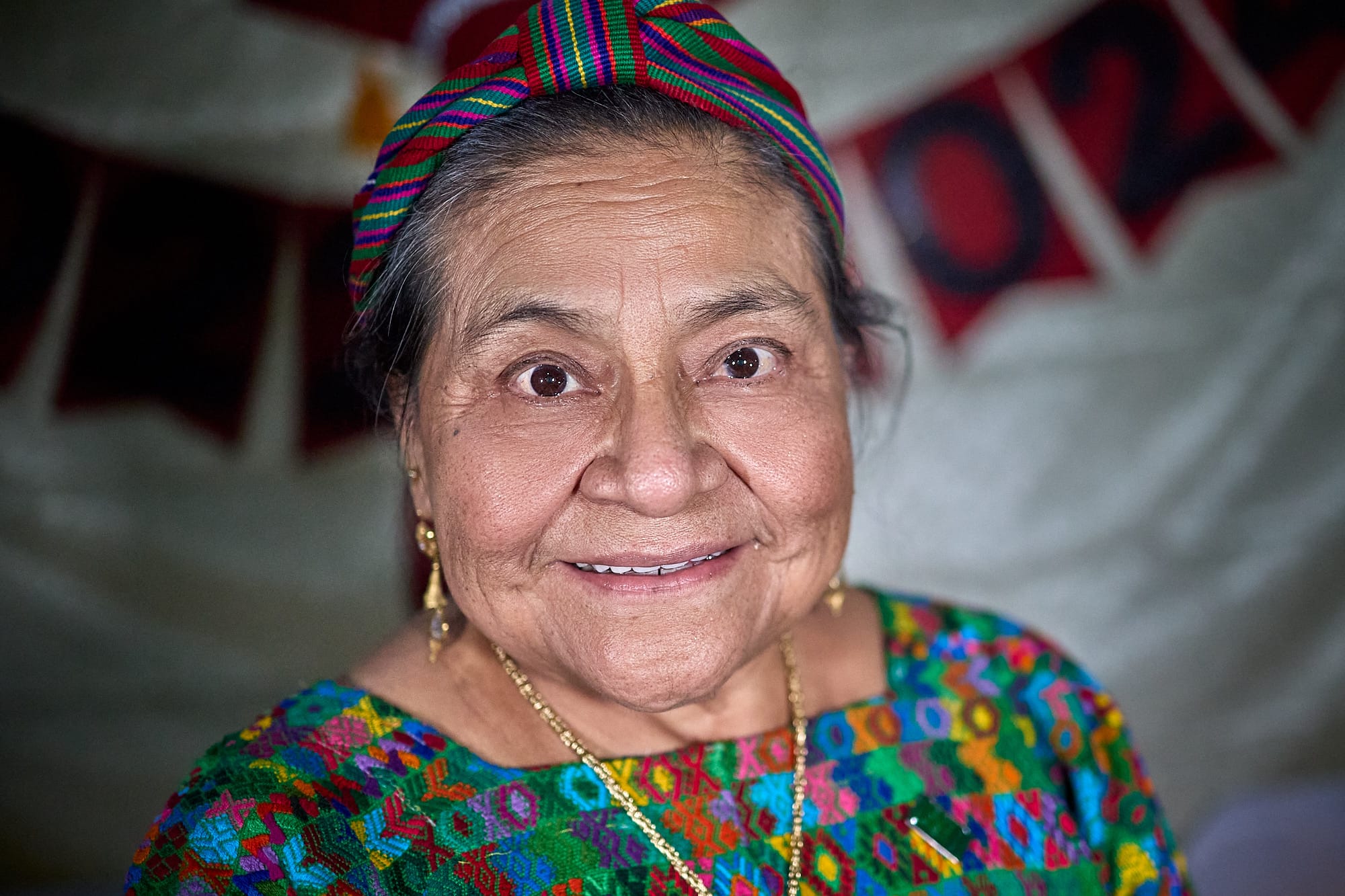
More than two decades later, Rigoberta Menchú was present for the 2024 graduation. Her portrait from that day shows her in a colorful woven blouse and headband, standing before the decorations prepared for the ceremony. It is a direct photograph, without the distance generally associated with official representations of public figures.
The school carries the name of an internationally celebrated musician. Its educational philosophy remains closely connected to the ideas and work of a Maya woman who has dedicated much of her life to Indigenous rights.
But its continuity depends on people whose names are less widely known: educators, administrators, workers, families, and community members, as well as the generations of students who pass through its classrooms. Their contribution is what allows the institution to continue fulfilling its purpose.
Somos: The Responsibility of Being There
For Ayzoh!, the visit to the Centro Educativo Pavarotti took place within Somos / Pueblo Ancestral Viviente, a documentary project developed in collaboration with Maya communities in Guatemala, with support from AFAR.
Somos addresses questions of identity, cultural memory, land, rights, and contemporary life, working through photography and other forms of documentary storytelling.
The project grew from relationships with communities whose histories have too often been described through the interpretations of outsiders. Its central concern is the possibility of developing a form of documentation in which those relationships influence not only what is photographed, but also how the photographs are interpreted and published.
Claudio Maria Lerario – Ayzoh!'s photographer – was introduced to the Centro Educativo Pavarotti by Rigoberta Menchú Tum during the work of Somos/Guatemala.
That introduction made it possible to encounter the school within an existing relationship of dialogue and collaboration, rather than approaching it simply as an unfamiliar institution to be documented.
It also brought a particular responsibility. Photographs can establish what happened before a camera, but they cannot tell us everything about the people represented. A graduation portrait does not reveal a student's ambitions. A traditional garment does not define the totality of someone's cultural identity. A smile does not prove that every difficulty has been overcome.
The photographs made at San Lucas Tolimán are therefore a record of a particular encounter, at a particular moment in the life of the school. They are one small part of the much wider story that Somos seeks to explore.
That distinction is important because the experience of Maya communities cannot be contained within a single school, a ceremony, or even a long-term documentary project. Their political, social, cultural, and economic lives continue independently of the people who come to photograph them.
The task of documentary work is to approach those lives with attention, accountability, and a willingness to recognize what remains beyond the frame.
The Day After Graduation
The ceremony continues. Students stand together in front of the decorated walls, waiting for the next part of the program. Some look toward the camera, others toward their classmates.
There are formal moments in which everyone follows the same instructions, and moments between them when the students are simply enjoying one another's company.
In one photograph, two boys stand side by side in white shirts embroidered along the front. Their hands rest against their chests. Elsewhere, students wearing burgundy shirts and Maya textiles stand in rows beneath the graduation decorations.
The families occupy an important place in this account. A student's education involves decisions and responsibilities that extend beyond the school: the costs of attending, time devoted to study, travel from surrounding communities, and the practical support needed to complete an academic program.
The ceremony offers a public moment in which that collective effort can be recognized. A diploma also represents an institutional achievement. It certifies that a student has completed a defined stage of education, with subjects studied, examinations taken, and requirements fulfilled.
In communities where educational opportunities have historically been distributed unequally, such qualifications can be particularly consequential. They allow students to continue their studies, pursue further training, and make choices that depend on recognized academic preparation.
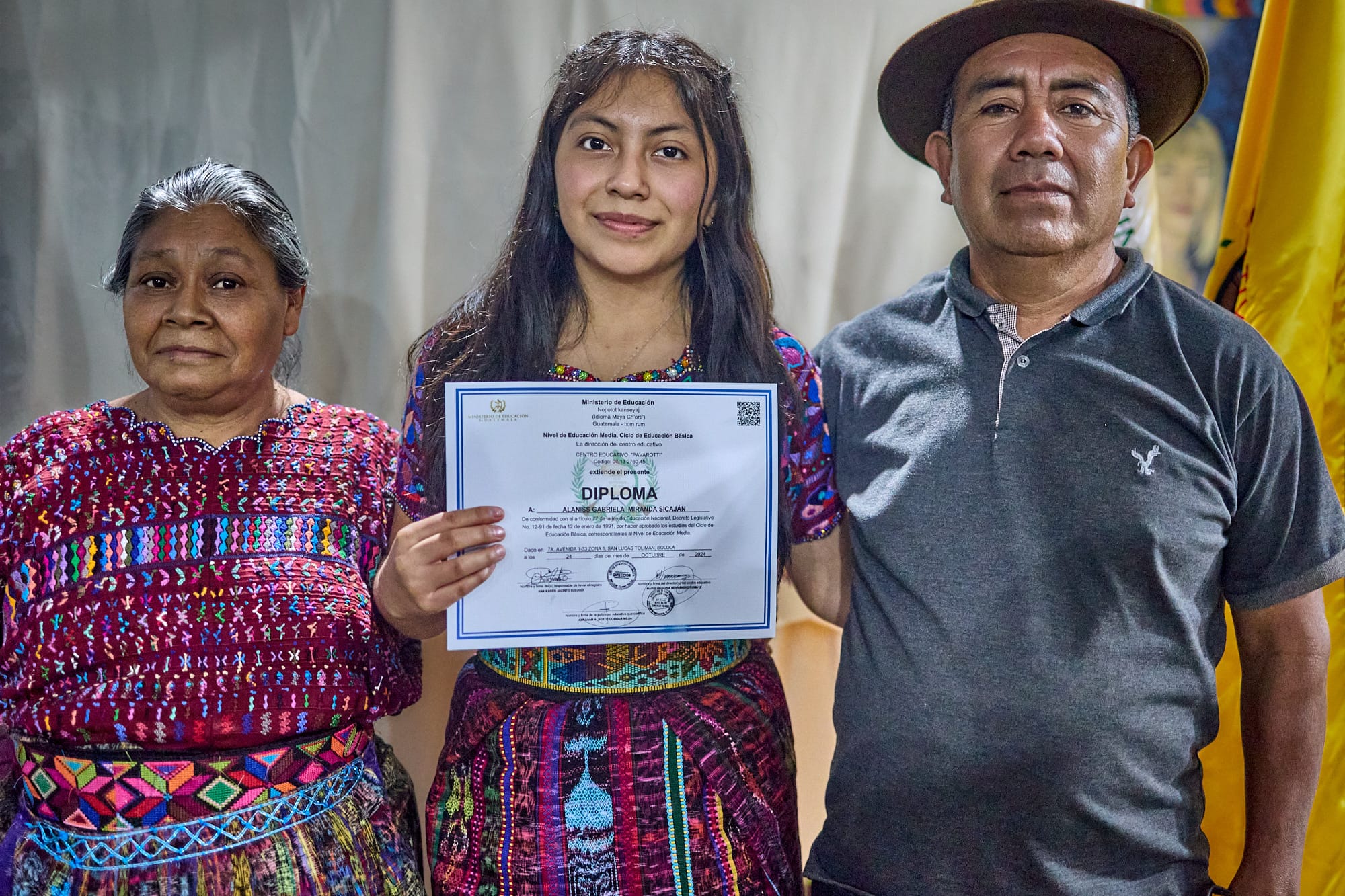
In another photograph, a young woman holds her diploma between two adults. The three face the camera. The certificate is at the center of the picture, but the people surrounding it give the image its meaning as a shared occasion.
There is an understandable temptation, when photographing such an event, to describe the dreams of the graduates or predict the futures awaiting them. But these young people will make their own decisions, in circumstances that the photographs cannot anticipate.
Some may continue studying. Others may begin working. Their paths will be shaped by personal interests, family circumstances, economic opportunities, and conditions in Guatemalan society that remain unequal.
An excellent school cannot eliminate all those obstacles. It can provide knowledge, qualifications, confidence in acquired abilities, and the experience of having one's cultural identity treated with respect. Those are substantial contributions, even when the outcomes cannot be measured immediately.
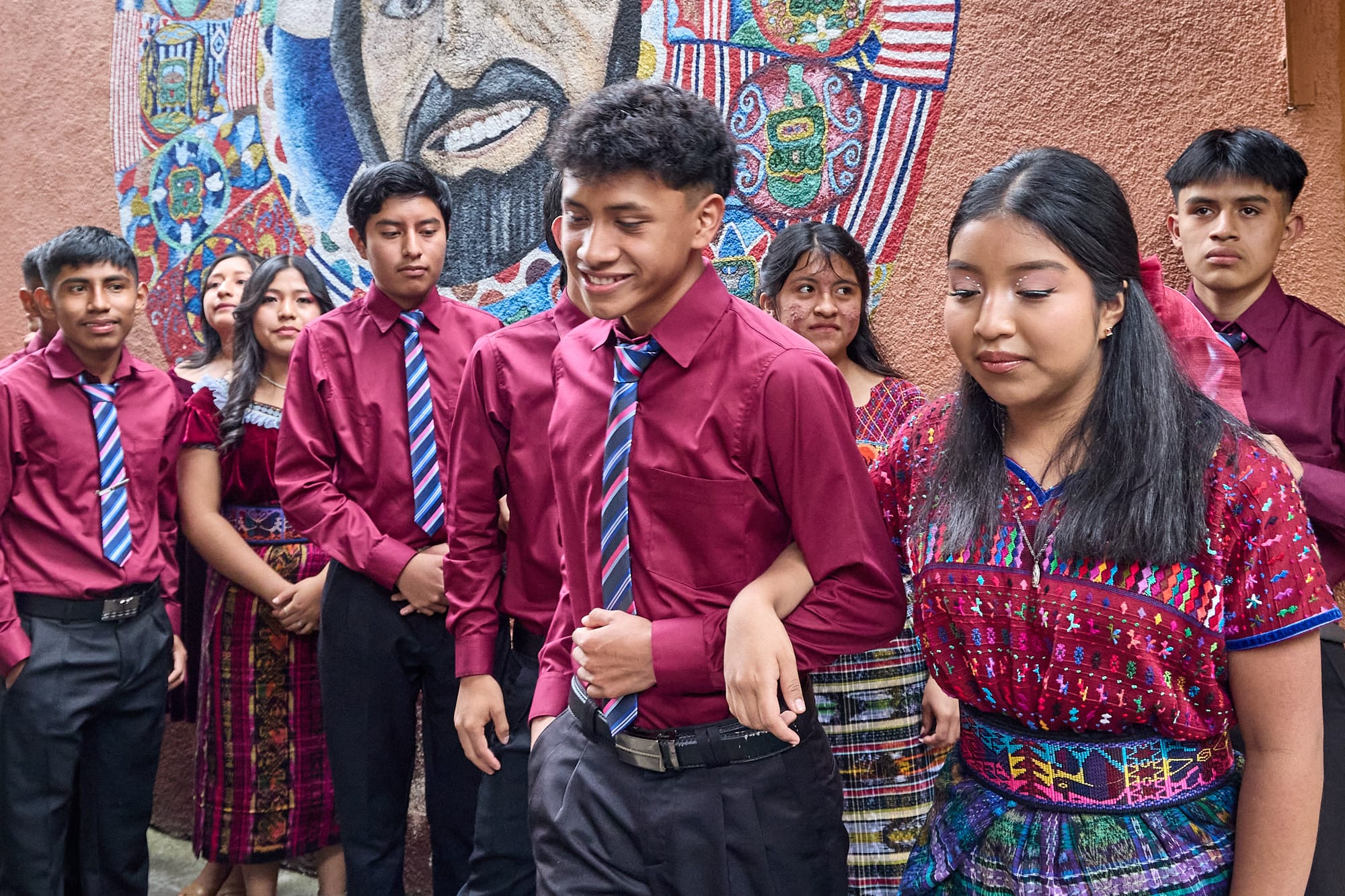
Near the end of the photographic sequence, a young man in a burgundy shirt walks arm in arm with a young woman wearing an embroidered blouse. He looks downward with a restrained smile. Other students gather behind them, against a wall bearing the painted image of Luciano Pavarotti.
The photograph does not tell us what they will do next. It shows them together, in the familiar company of their peers, at the end of a stage of their education.
And perhaps that is the most appropriate place to leave this story: with the graduates, rather than with the people who founded the school, supported it, or came to document it. Their education belongs to them. So does the future they will make from it.
About this story
This reportage is part of Somos / Pueblo Ancestral Viviente, a wider documentary project developed by Ayzoh! in collaboration with Maya communities across Guatemala, with support from AFAR.
The Centro Educativo Pavarotti and its 2024 graduation ceremony represent one chapter in a larger exploration of cultural identity, memory, education, collective rights, and self-determination.
The school's educational work is carried out by the Fundación Rigoberta Menchú Tum, together with its teachers, staff, students, and local communities.
Photography: Claudio Maria Lerario - Ayzoh! / Location: Centro Educativo Pavarotti, San Lucas Tolimán, Sololá, Guatemala.
Acknowledgments
Our sincere thanks to Rigoberta Menchú Tum, Gregorio Canil, and Clemente Peneleu for their generous support, collaboration, and essential contributions to this reportage and to the wider Somos/Guatemala project.
Their involvement has been an important part of the relationships and shared work that made these stories possible.


Member discussion