


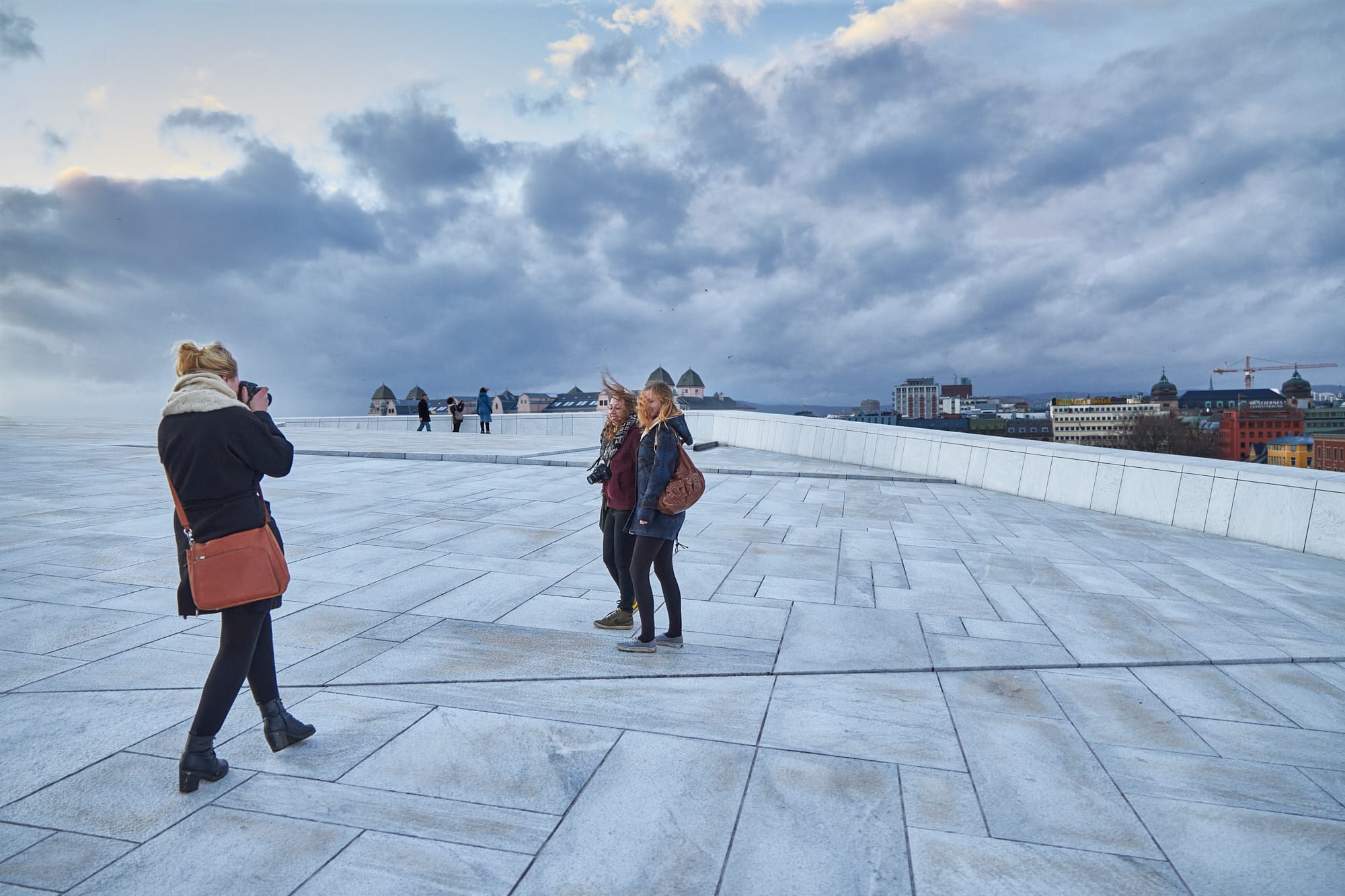
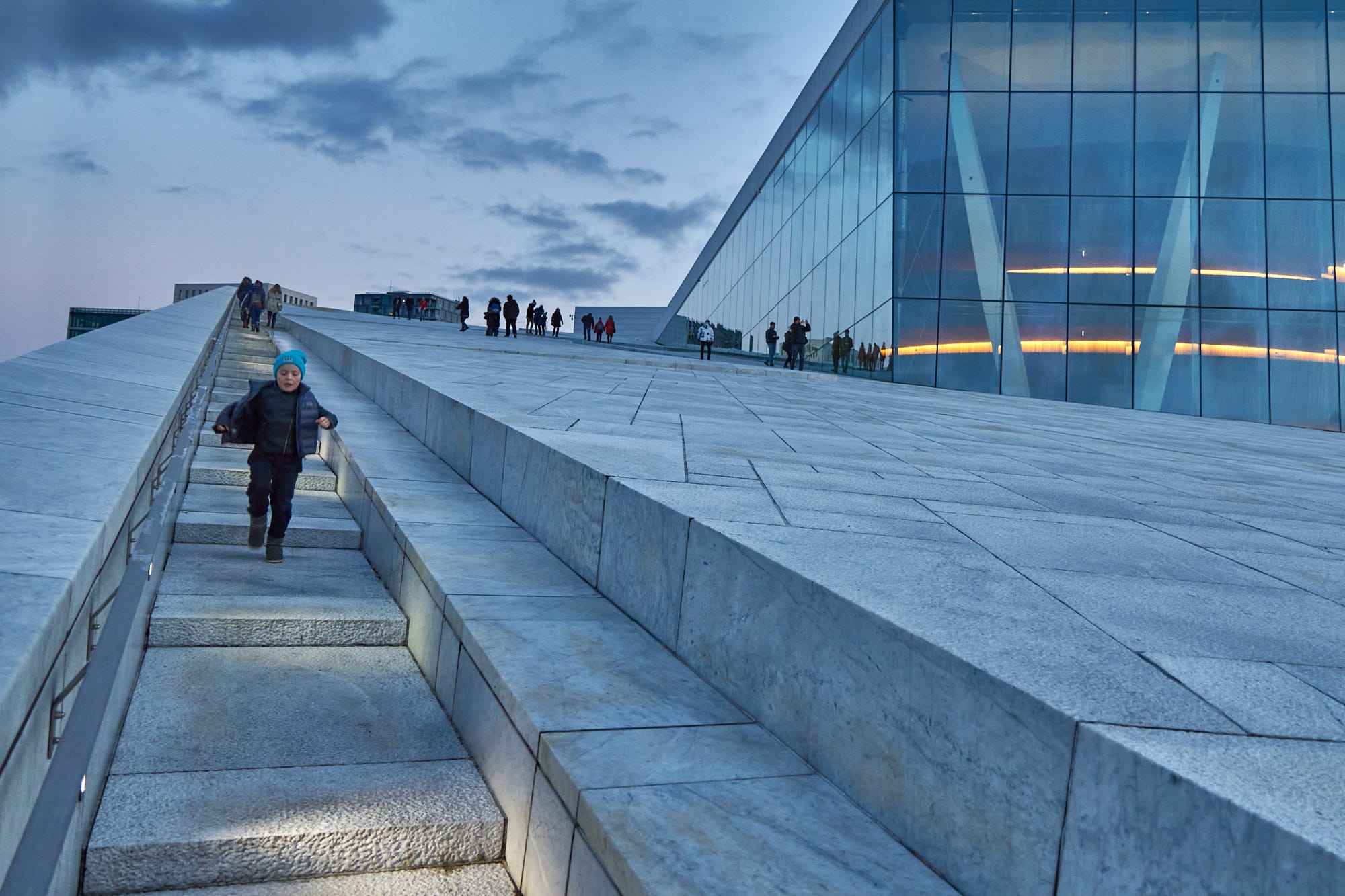
The roof is already the story. Before entering the Oslo Opera House, many people climb onto it. They walk slowly up the broad white surface. Children run ahead. Couples stop near the edge. Someone raises a phone toward the harbor. Someone else photographs a friend.
People sit, talk, look at the weather arriving over the water, then continue upward until the distinction between roof, plaza, and landscape becomes difficult to maintain.
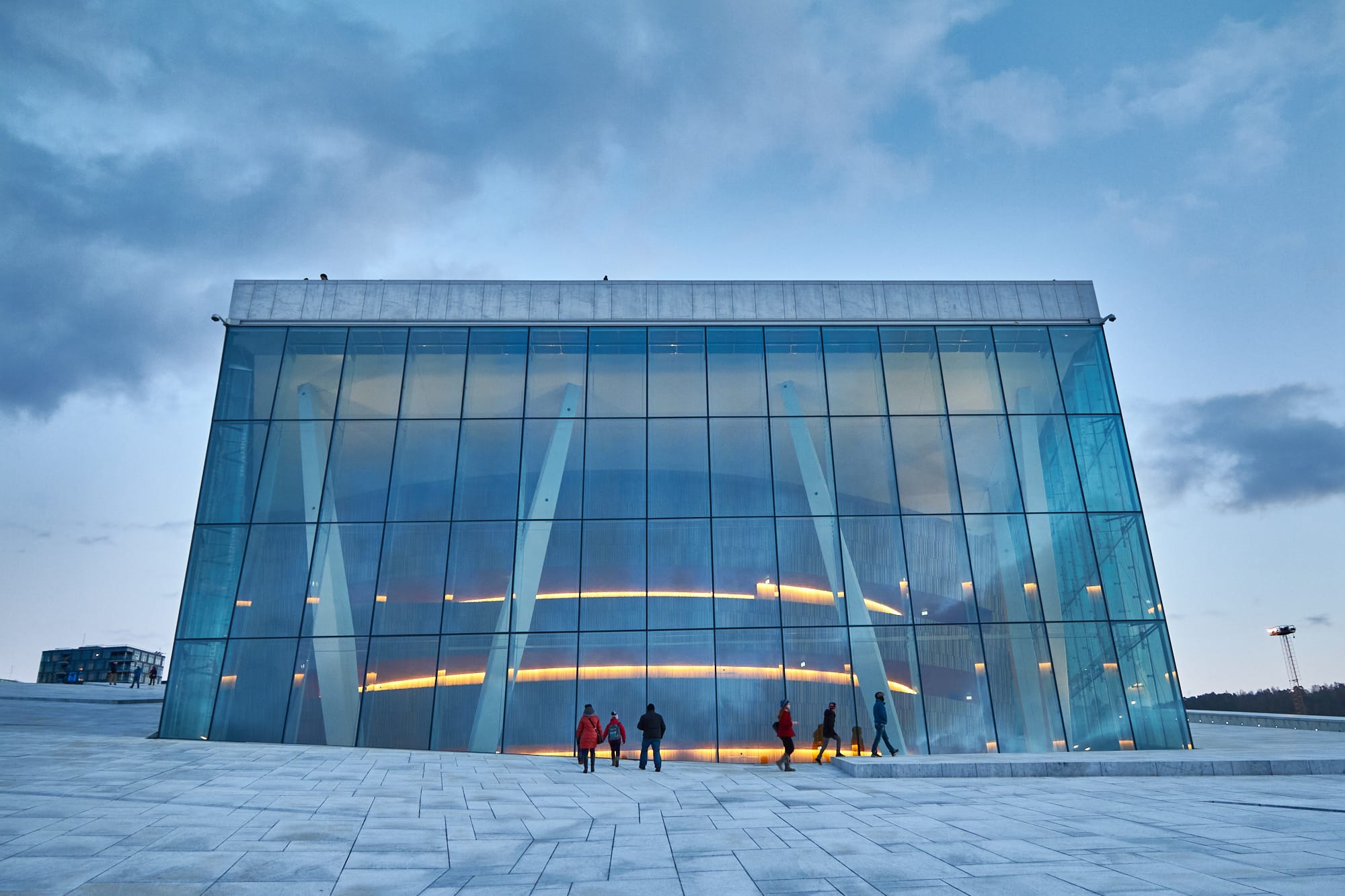
This is not what monumental architecture usually asks of us. Important buildings often establish their importance through distance. Steps, gates, façades, ceremonial entrances: architecture has spent centuries teaching us when to approach carefully, when to lower our voices, when to understand that we are visitors.
Here, the relationship is different. The building does not disappear as a cultural institution, nor does it pretend that opera is ordinary. Instead, it makes another proposition: the value of a place does not have to depend on how effectively it excludes those who have not paid to enter it.
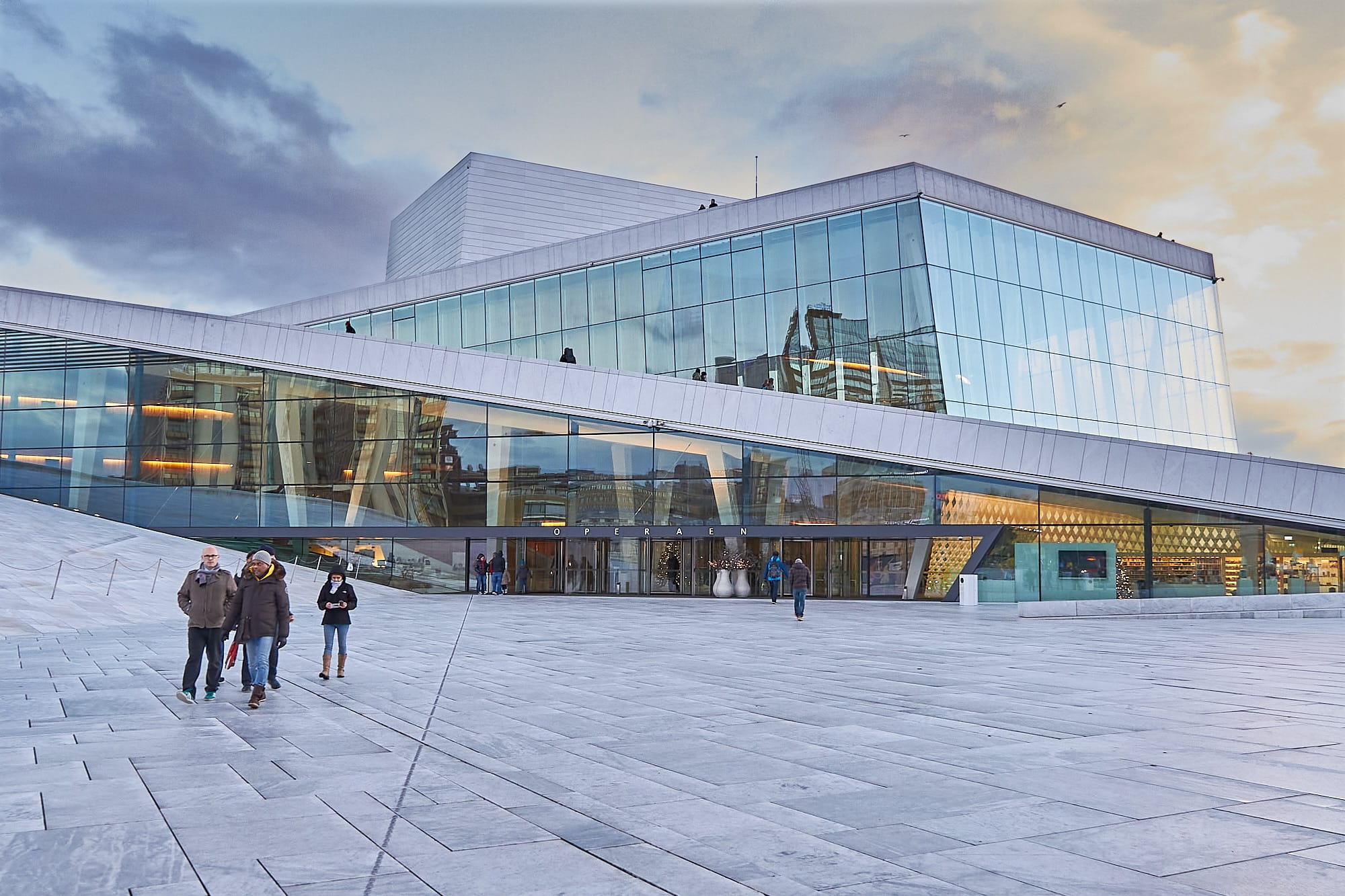
You do not need a ticket to walk on the roof. You do not need to know anything about opera. You do not even need to be interested in architecture. You can simply be there. That distinction matters.
There is a Norwegian word that helps explain what is happening here: allemannsretten — the right to roam. It describes a long-standing principle that gives people broad freedom to move through nature, provided they do so responsibly and with respect for the land.
When Snøhetta designed the Opera House, the architects carried something of that idea into the built environment. The roof and plaza were conceived not merely as surfaces to be admired, but as public ground: places to cross, climb, inhabit, and make one’s own. The gesture is more significant than it first appears.
A principle normally associated with forests, mountains, coastlines, and open countryside enters the architecture of a major cultural institution. The building does not simply offer the public a view. It gives the public territory.
And in doing so, it suggests something larger: that the presence of ordinary people does not diminish a place of cultural importance. It completes it.
Perhaps this is why walking on the roof feels so natural. The architecture is new, but the idea behind it reaches much further back. You are not simply standing on an opera house. You are being invited to move through it.
Beauty as Part of Public Life
Norway is often described from outside through the language of beauty. The fjords are beautiful. The forests are beautiful. The cabins, furniture, cities, snow, light: entire industries have been built around exporting a particular image of Scandinavian refinement.
But beauty becomes more interesting when it stops being an image. What matters is not simply whether a country produces beautiful objects or impressive buildings.
The more revealing question is where beauty is allowed to exist, who is expected to encounter it, and what people are permitted to do once they arrive.
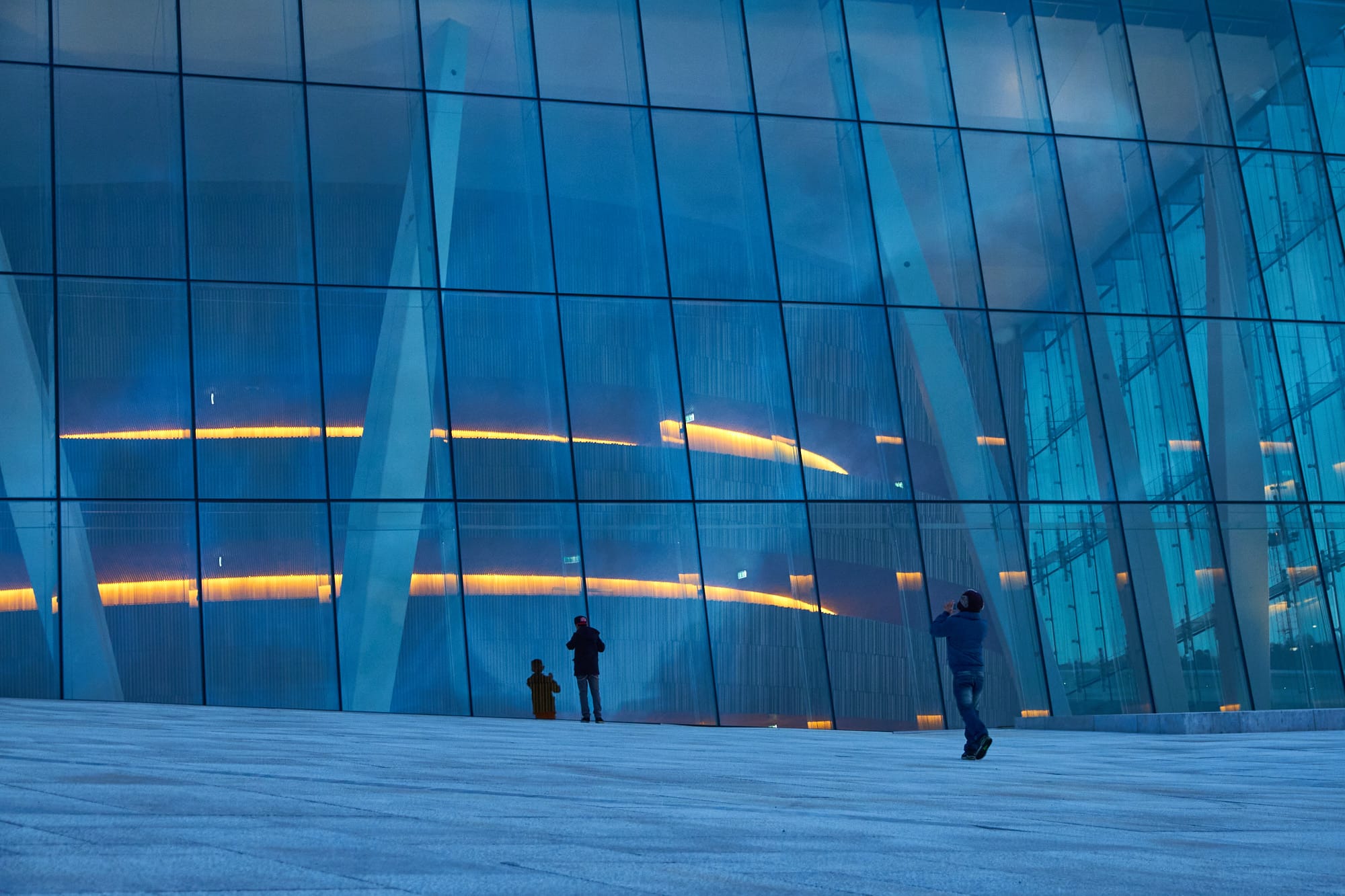
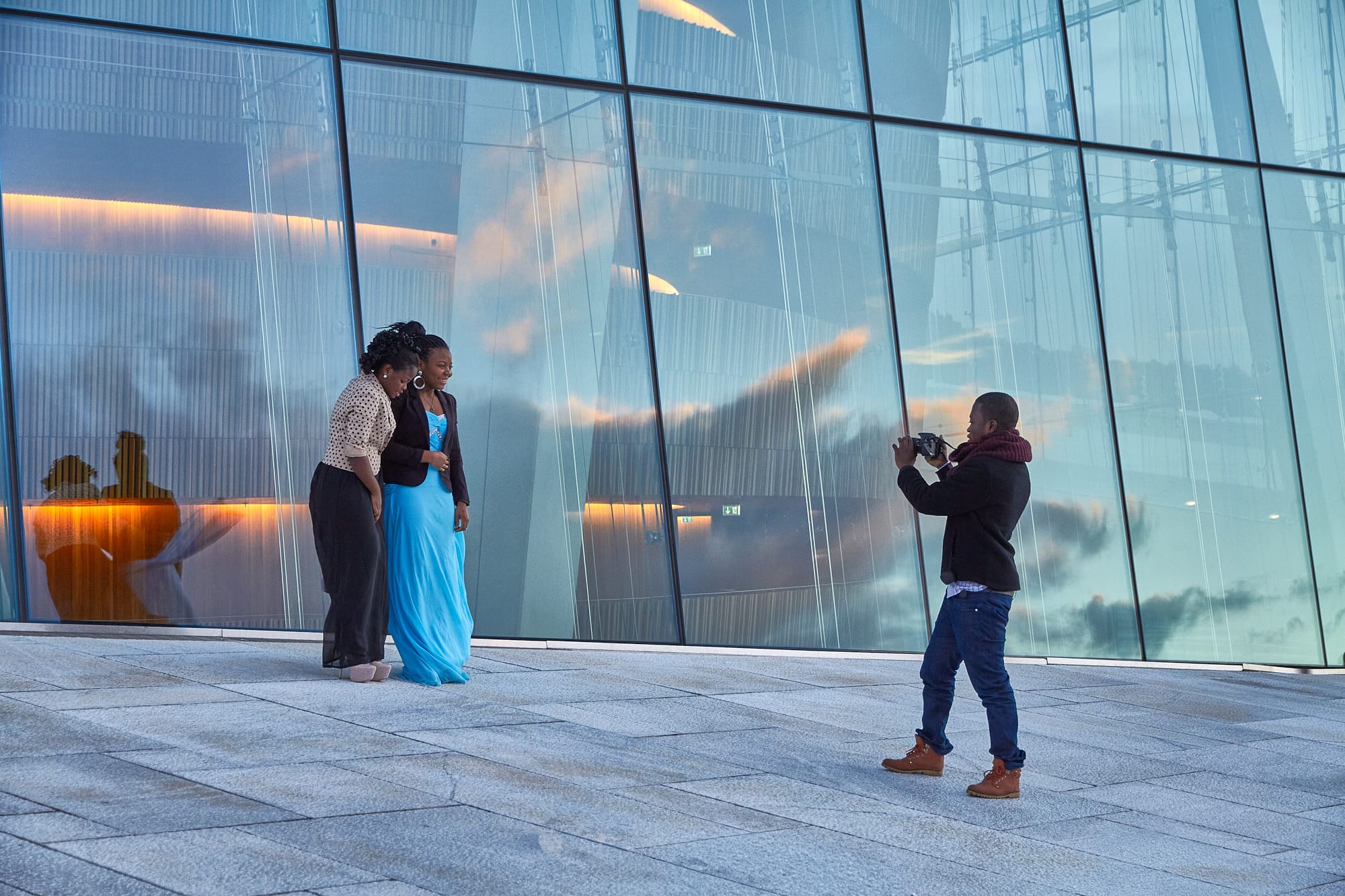
At the Opera House, people do not merely contemplate architecture. They use it. A small child reaches toward a textured wall. A group of friends stands against the enormous scale of the building. Two women pose for a photograph beside the glass.
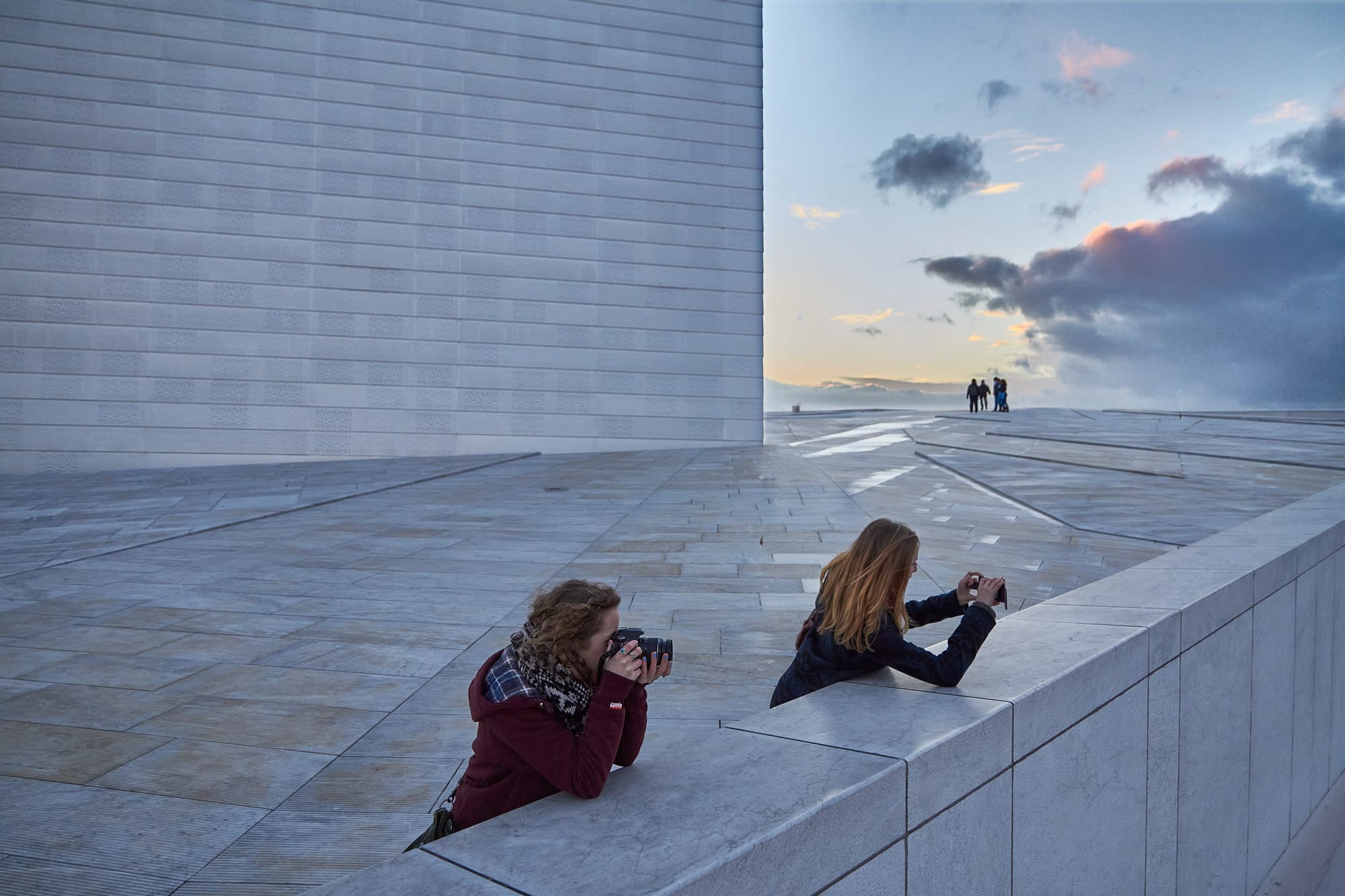
Tourists photograph one another on the roof while other people pass behind them without paying much attention. The building absorbs all of this easily.
There is something democratic in that lack of ceremony. Not because Norway has somehow solved inequality, nor because public architecture can substitute for social policy.
Countries should resist being converted into metaphors, particularly flattering ones. Norway is a real society, with its own tensions and contradictions.
Yet societies reveal priorities through what they choose to make ordinary. And one of the things worth noticing here is the amount of care invested in places that people can simply inhabit.
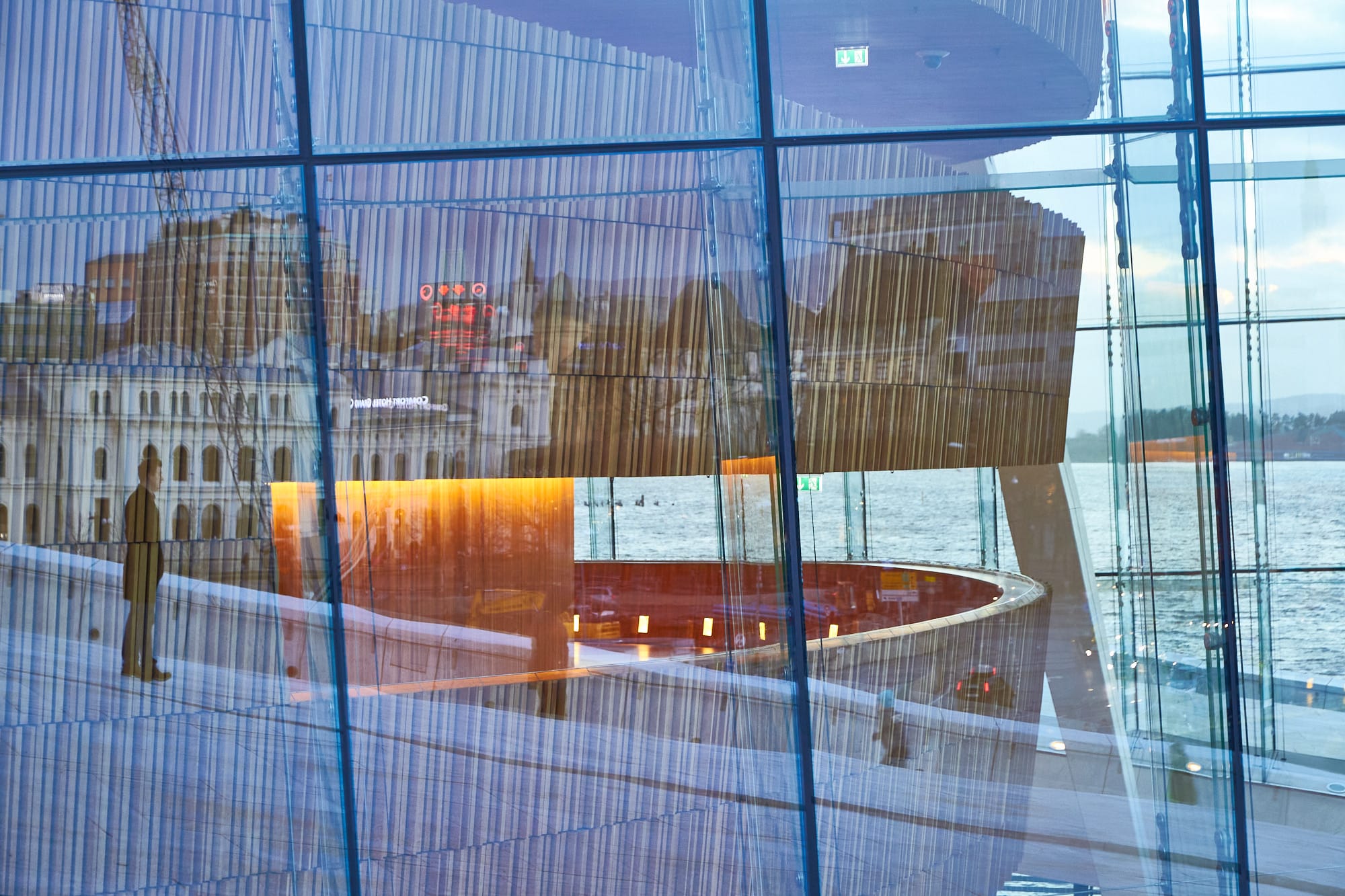
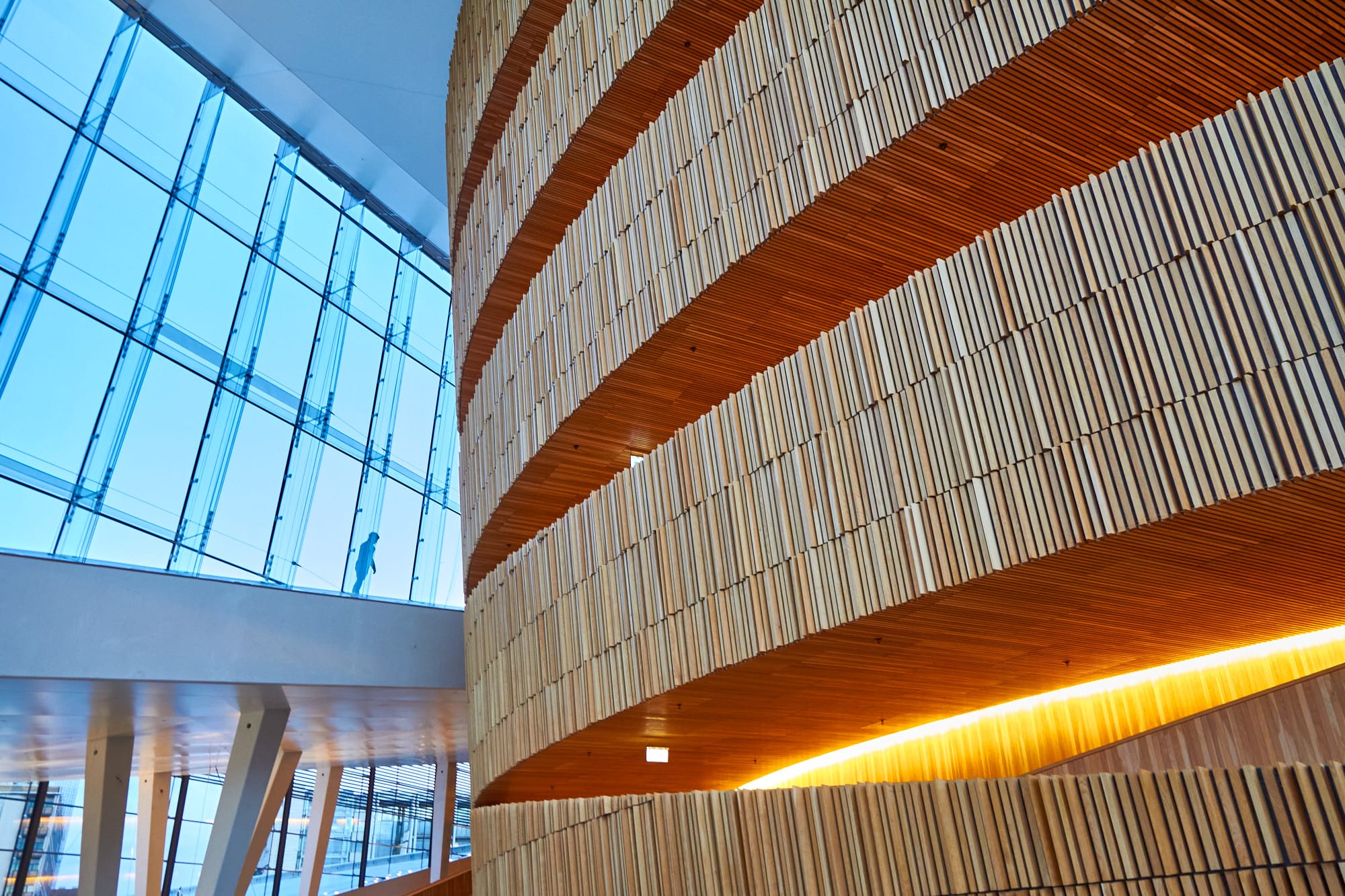
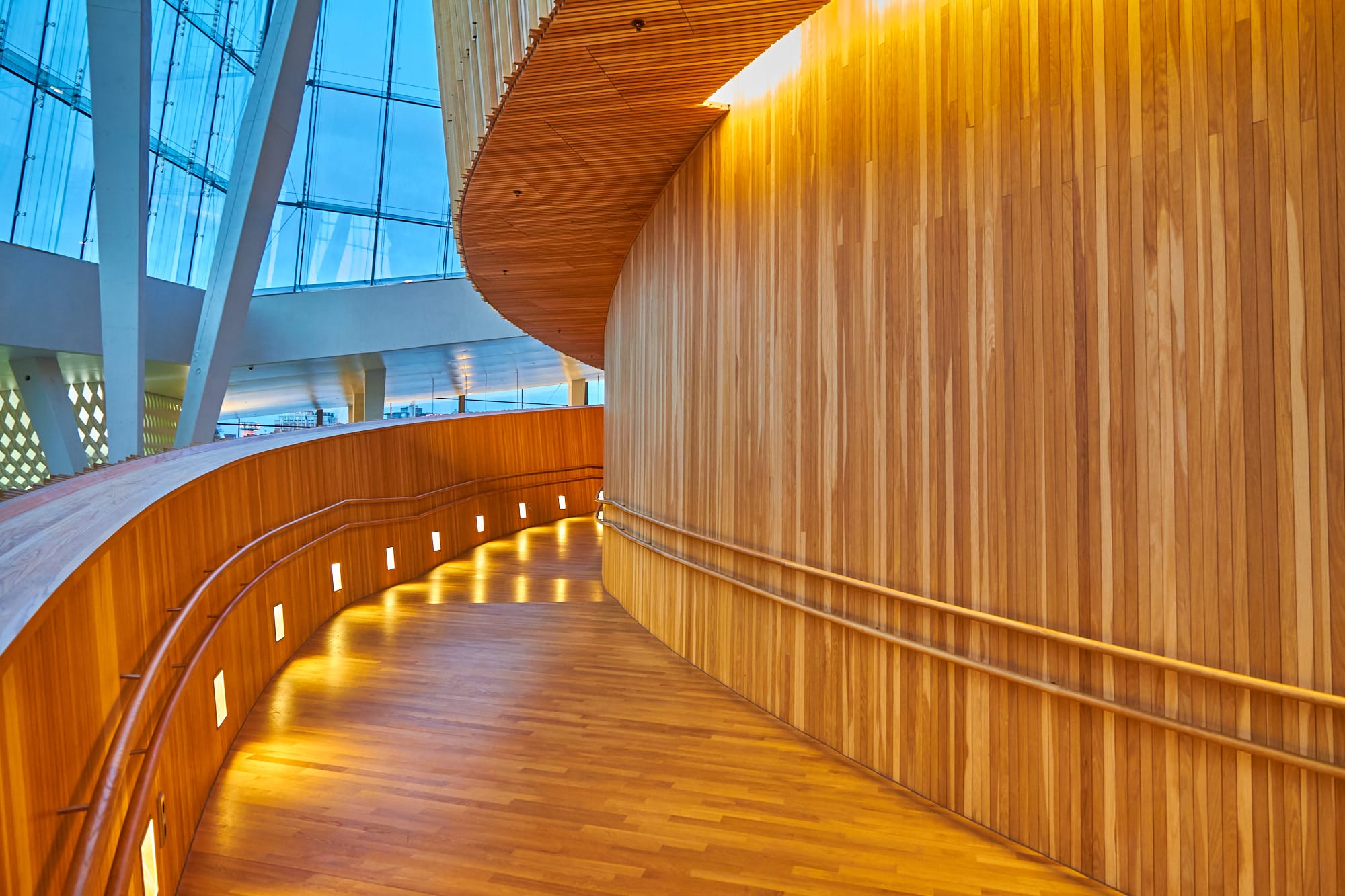
Stone is laid carefully where thousands of shoes will cross it. Wood is shaped with extraordinary precision along a corridor where people will lean against the rail. Glass is used not merely to separate inside from outside but to multiply the city through reflection. Light accompanies a ramp instead of merely illuminating it.
None of these things is necessary in the narrowest sense. A corridor only has to connect two places. A roof only has to keep weather out. A wall only has to stand. Once we move beyond necessity, however, design begins to tell us what we think human beings deserve.
The Small Politics of a Wall
One photograph in this series shows an adult standing with a very young child beside one of the Opera House’s vast exterior walls. Almost nothing happens. The building occupies nearly the entire frame. The two people are tiny by comparison. The child, dressed in purple, reaches toward the wall.
It is perhaps the smallest gesture in the photographs, and one of the most revealing. The child is not being told that the architecture is too important to touch.
This is where the idea of accessibility becomes larger than ramps, entrances, regulations, or admission prices, important as all of those are. There is also a cultural form of access: the feeling that a place belongs sufficiently to you that you are allowed to explore it.
Public space works differently when citizens are treated not as potential disturbances but as legitimate occupants.
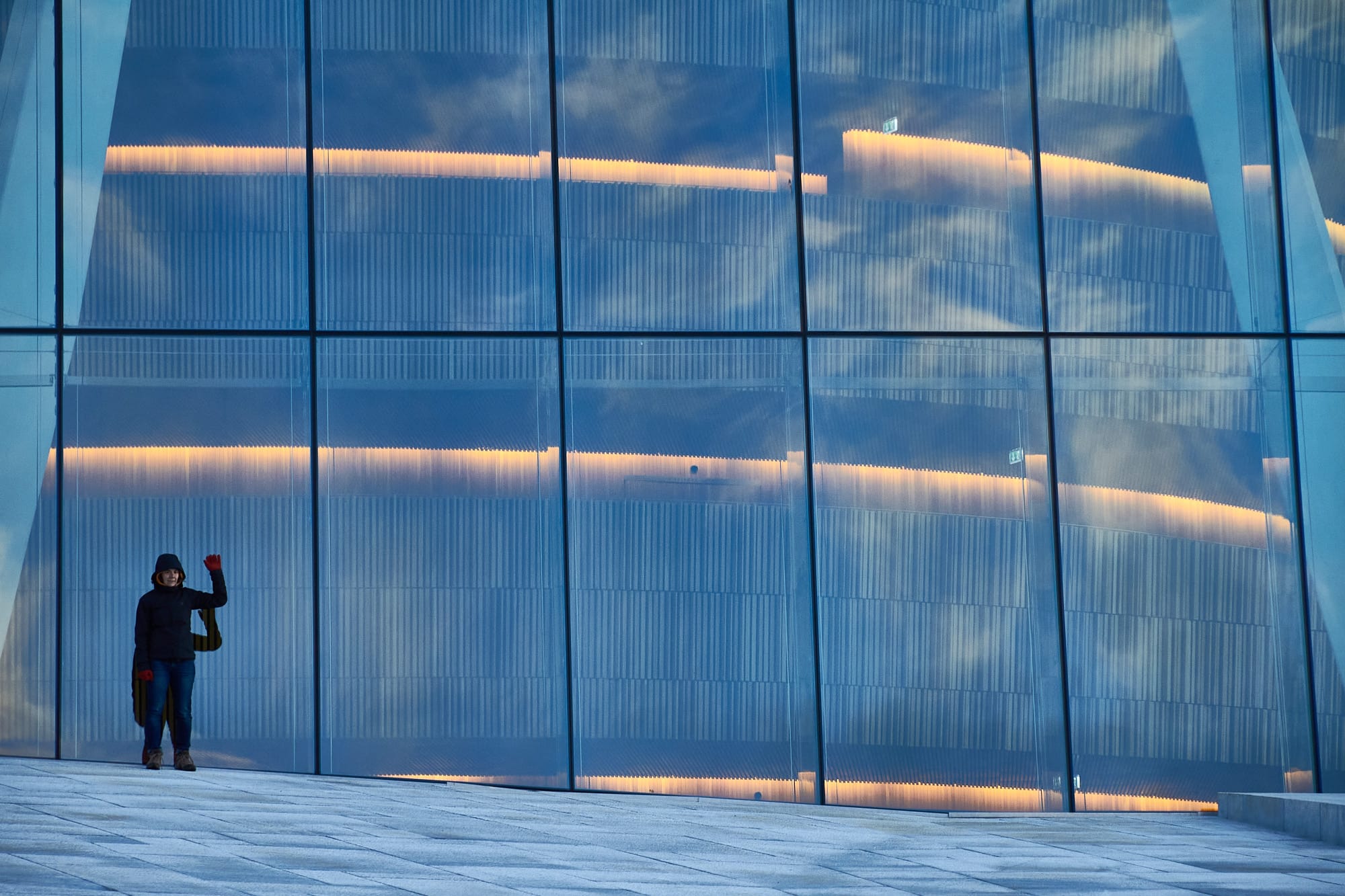
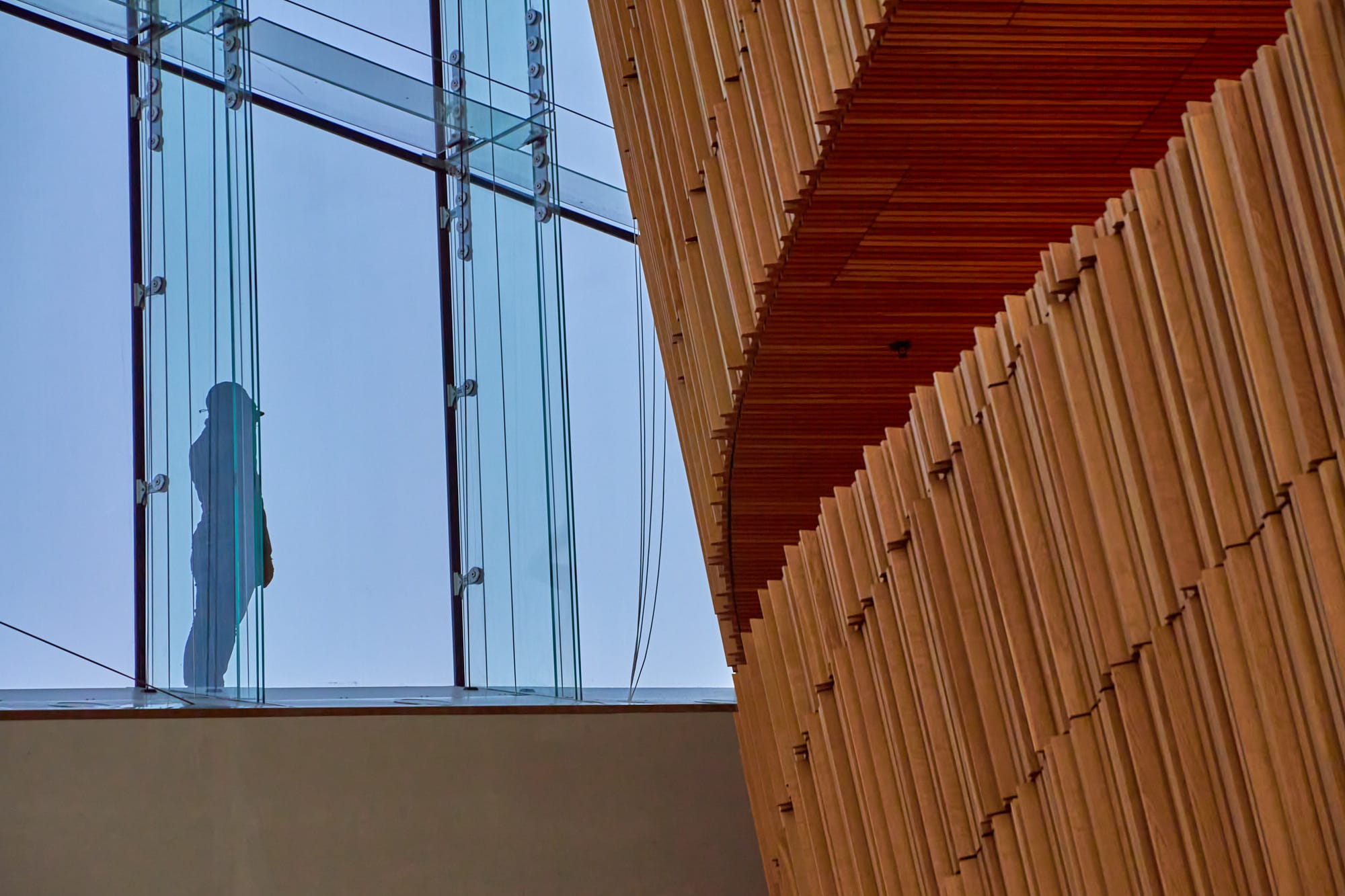
ou notice this in the photographs because the Opera House never seems empty, even when the human figures are minute. The people complete the architecture. Their presence gives scale to the walls and purpose to the slopes. A lone figure behind glass transforms a geometric composition into a scene of ordinary life.
Even the people photographing themselves matter. There can be a certain snobbery in the way tourism is discussed, particularly photography. Visitors are mocked for taking selfies, making souvenir pictures, standing where thousands have stood before them. But these small acts of appropriation are also part of how public places become personal.
A woman in an evening dress poses beside the glass. Friends photograph one another under a turbulent sky. A visitor frames the city from the roof. The architecture becomes part of somebody’s memory. That is also a form of ownership.
From Monument to Landscape
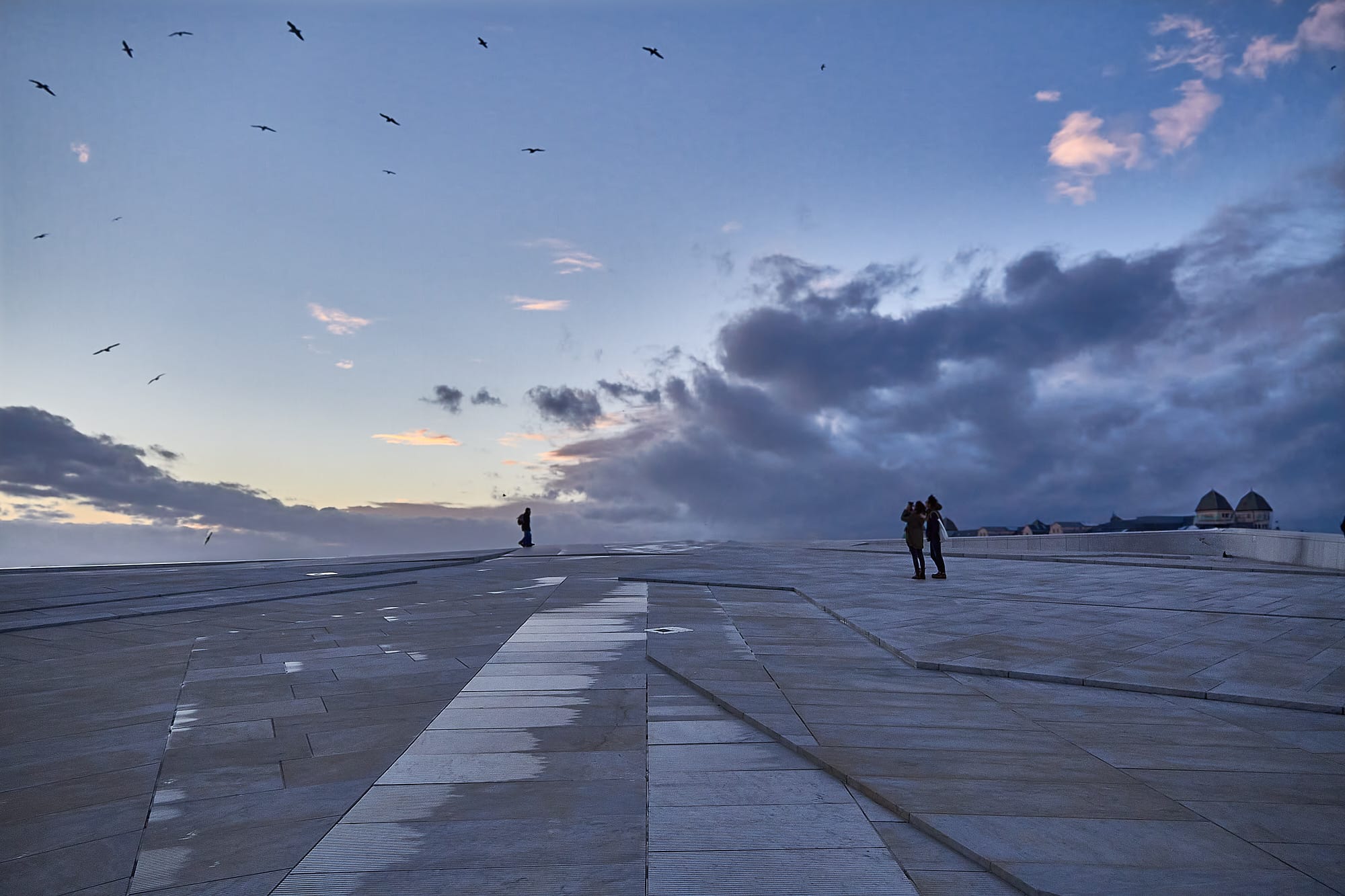
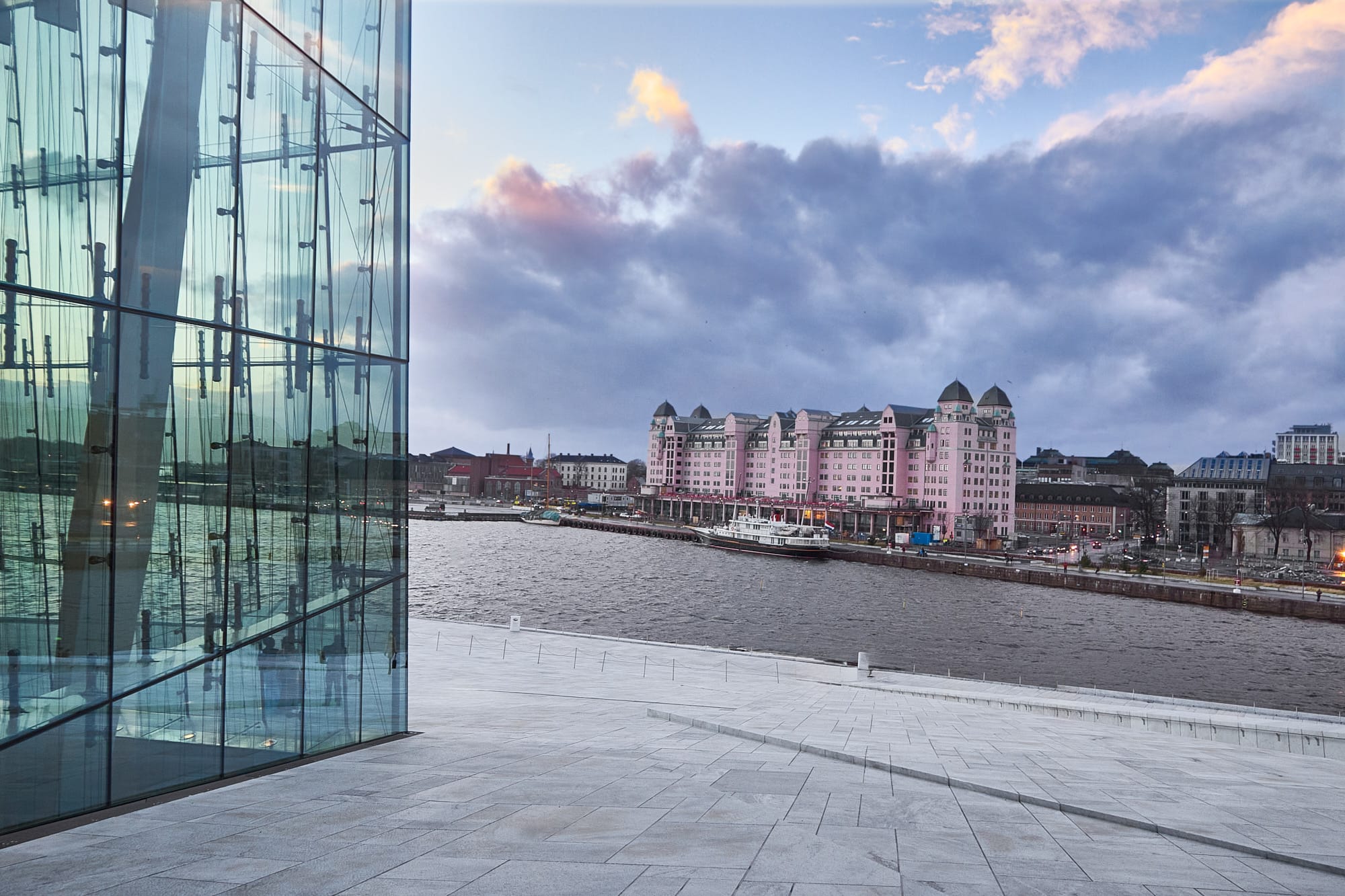
Toward evening, something else happens. The Opera House begins to dissolve. Its glass takes in the sky. The city appears inside the façade as reflection. Warm bands of interior light float across the blue exterior. People become silhouettes. On the roof, water left by the weather catches the last light while birds cross above the harbor.
The building has not become less monumental. But it has become less separate. This may be the most compelling aspect of the place: it behaves almost like a piece of urban geography.
People climb it as they would a small hill. They stop at its edges as they would at a waterfront. They cross it without necessarily entering it. The boundary between architecture and city becomes unusually porous.
That matters because public architecture is never only about buildings. It is about the kind of relationship a society imagines between individual and collective life.
A beautifully designed private house tells us something about its owner. A beautifully designed public building tells us something more difficult and perhaps more important: what level of care we are willing to extend to strangers.
The distinction is essential. Beauty can reinforce privilege. History provides countless examples of palaces, hotels, private gardens, exclusive resorts, and spectacular objects designed precisely to demonstrate who belongs and who does not.
But beauty can also move in the opposite direction. It can say: this has been made carefully because many people will use it. Not despite that fact. Because of it.
What a Traveler Can Learn
Travel often trains us to search for exceptional things. We make lists of monuments, landscapes, restaurants, museums, neighborhoods. We ask what must be seen before leaving a place.
There is another question worth asking: What does this society consider worth doing well? Sometimes the answer is not found in the destination that appears on the postcard.
It may be in a library where nobody asks you to buy anything. In the materials used at a neighborhood school. In a ferry terminal. A bench positioned toward a view. A path maintained through winter. A public swimming place. The lighting of an underpass. The way a building meets the street.
The Oslo Opera House is an enormous and highly visible example, but perhaps its real value for a traveler lies precisely in encouraging attention to smaller ones.
Once you begin noticing how a country designs the spaces between private lives, you begin seeing something that conventional tourism frequently overlooks.
You start seeing its assumptions about citizenship. About dignity. About who deserves comfort. About whether usefulness and beauty are considered enemies.
About whether the commons are understood as what remains after private interests have been satisfied, or as something worth designing in their own right.
Norway should not be romanticized. No country should. But it can be observed carefully.
And on the edge of Oslo’s harbor, there is a building where people walk across the roof of an opera house while others inside prepare for performances they may never attend.
Some stay for minutes. Others climb to the top and look across the city. Children touch the walls. People take pictures. Birds pass overhead. Nothing especially dramatic happens. Perhaps that is exactly the point. Beauty has entered ordinary life.
About the Oslo Opera House
The Oslo Opera House was designed by Norwegian architecture and design practice Snøhetta for Statsbygg, the Norwegian government’s building agency, and opened in Bjørvika in 2008.
Its walkable roof and open public spaces were conceived as an extension of the city itself — a place accessible well beyond the audience attending a performance.
The building is home to the Norwegian National Opera & Ballet, Norway’s largest music and performing arts institution, whose program brings together opera, ballet, concerts, orchestra, chorus, and artistic education.


Member discussion